QUESTION IMAGE
Question
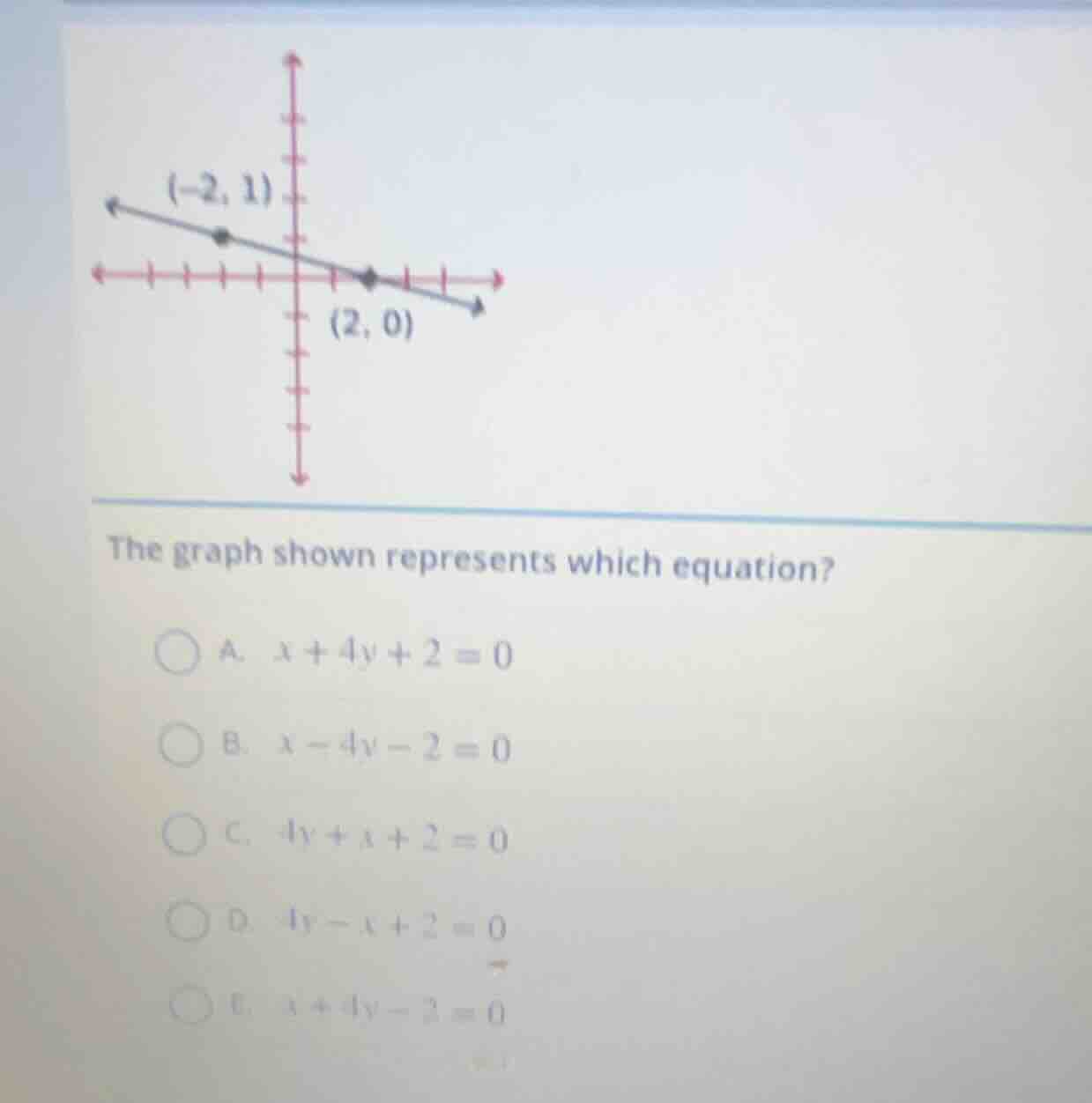
the graph shown represents which equation? a. $x + 4y + 2 = 0$ b. $x - 4y - 2 = 0$ c. $4y + x + 2 = 0$ d. $4y - x + 2 = 0$ e. $x + 4y - 2 = 0$
Step1: Find the slope
The two points on the line are \((-2, 1)\) and \((2, 0)\). The slope \(m\) is calculated as \(m=\frac{y_2 - y_1}{x_2 - x_1}=\frac{0 - 1}{2 - (-2)}=\frac{-1}{4}=-\frac{1}{4}\).
Step2: Use point - slope form
Using the point \((2, 0)\) and the slope \(m =-\frac{1}{4}\), the point - slope form is \(y - y_1=m(x - x_1)\). Substituting the values, we get \(y-0 =-\frac{1}{4}(x - 2)\).
Step3: Simplify the equation
\(y=-\frac{1}{4}x+\frac{1}{2}\). Multiply through by 4 to clear the fraction: \(4y=-x + 2\). Rearranging gives \(x + 4y-2 = 0\)? Wait, no, wait. Wait, let's check with the point \((-2,1)\). Let's test each option:
Option A: \(x + 4y+2 = 0\). Substitute \(x=-2,y = 1\): \(-2+4\times1 + 2=-2 + 4+2=4
eq0\).
Option B: \(x-4y - 2=0\). Substitute \(x=-2,y = 1\): \(-2-4\times1-2=-2 - 4 - 2=-8
eq0\).
Option C: \(4y+x + 2=0\). Substitute \(x=-2,y = 1\): \(4\times1+(-2)+2=4 - 2 + 2=4
eq0\). Wait, maybe I made a mistake in slope calculation. Wait, the two points are \((-2,1)\) and \((2,0)\). The slope \(m=\frac{0 - 1}{2-(-2)}=\frac{-1}{4}\). Let's use the slope - intercept form \(y=mx + b\). Using point \((2,0)\): \(0=-\frac{1}{4}\times2 + b\), \(0=-\frac{1}{2}+b\), so \(b=\frac{1}{2}\). So the equation is \(y=-\frac{1}{4}x+\frac{1}{2}\). Multiply both sides by 4: \(4y=-x + 2\), then \(x + 4y-2=0\)? Wait, no, \(4y+x - 2=0\)? Wait, the option E is \(x + 4y-2=0\)? Wait, the options are:
Wait the original options:
A. \(x + 4y+2 = 0\)
B. \(x-4y - 2=0\)
C. \(4y+x + 2=0\)
D. \(4y - x+2=0\)
E. \(x + 4y-2=0\)
Wait let's test point \((-2,1)\) in option E: \(x=-2,y = 1\): \(-2+4\times1-2=-2 + 4-2=0\). Test point \((2,0)\): \(2+4\times0-2=2 - 2=0\). Oh! I see, I made a mistake in the rearrangement earlier. Let's do it again. From \(y=-\frac{1}{4}x+\frac{1}{2}\), multiply by 4: \(4y=-x + 2\), then \(x + 4y-2=0\), which is option E. Wait, but let's check the options again. Wait the user's options:
Wait the options are:
A. \(x + 4y+2 = 0\)
B. \(x-4y - 2=0\)
C. \(4y+x + 2=0\)
D. \(4y - x+2=0\)
E. \(x + 4y-2=0\)
When \(x = 2,y = 0\): For option E: \(2+4\times0-2=0\), which works. For \(x=-2,y = 1\): \(-2 + 4\times1-2=-2 + 4-2=0\), which works. So the correct equation is \(x + 4y-2=0\), which is option E.
Wait, maybe my initial slope calculation was correct, but when I rearranged, I had a sign error. Let's re - derive the equation. The two points are \((x_1,y_1)=(-2,1)\) and \((x_2,y_2)=(2,0)\). The slope \(m=\frac{y_2 - y_1}{x_2 - x_1}=\frac{0 - 1}{2-(-2)}=\frac{-1}{4}\). Using the two - point form \(\frac{y - y_1}{y_2 - y_1}=\frac{x - x_1}{x_2 - x_1}\), we have \(\frac{y - 1}{0 - 1}=\frac{x+2}{2 + 2}\), \(\frac{y - 1}{-1}=\frac{x + 2}{4}\), cross - multiply: \(4(y - 1)=-(x + 2)\), \(4y-4=-x - 2\), \(x + 4y-4 + 2=0\), \(x + 4y-2=0\). Yes, that's correct.

Snap & solve any problem in the app
Get step-by-step solutions on Sovi AI
Photo-based solutions with guided steps
Explore more problems and detailed explanations
E. \(x + 4y-2 = 0\)