QUESTION IMAGE
Question
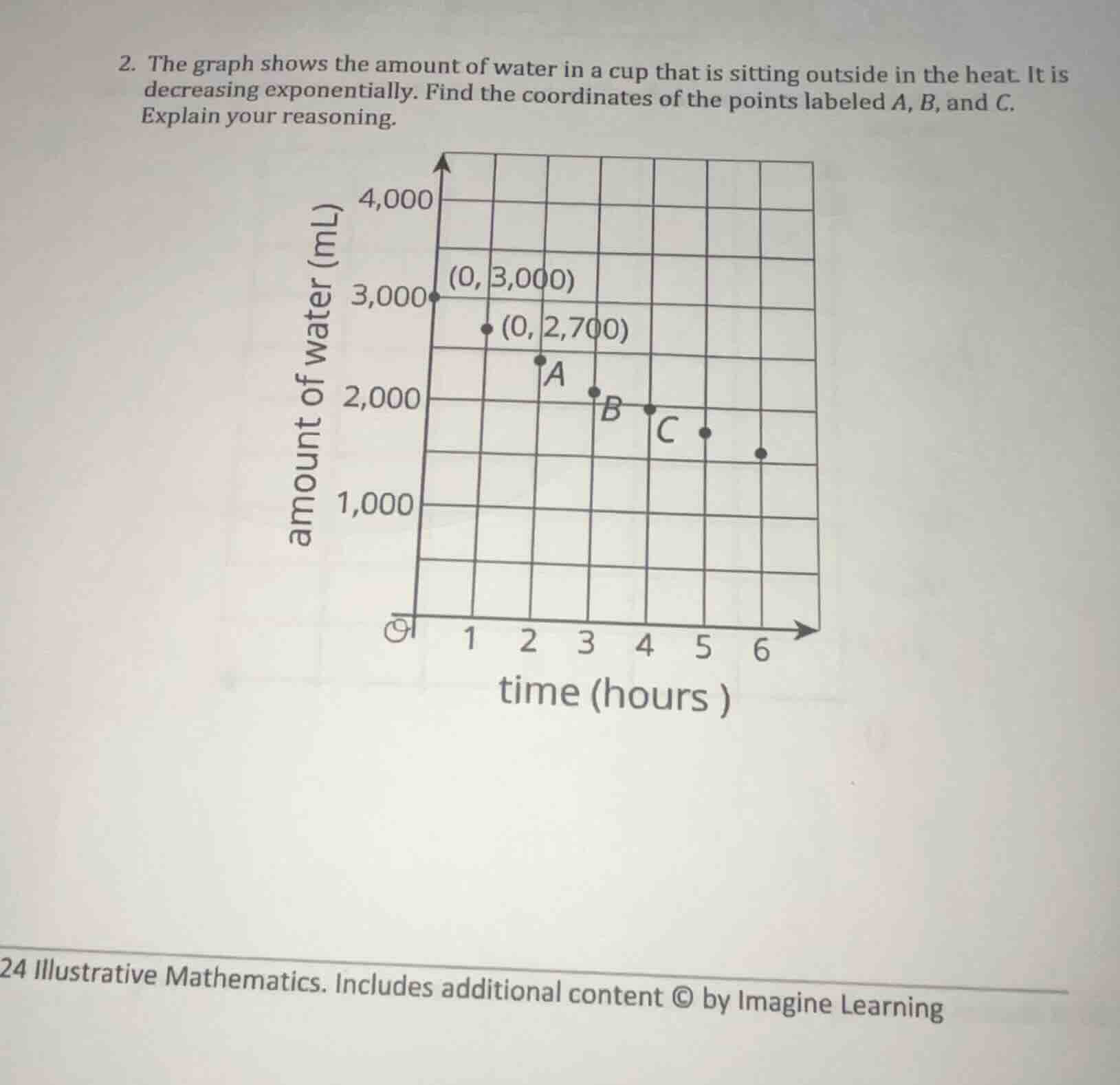
- the graph shows the amount of water in a cup that is sitting outside in the heat. it is decreasing exponentially. find the coordinates of the points labeled a, b, and c. explain your reasoning.
Step1: Find the decay factor
The initial amount at \( t = 0 \) is \( 3000 \) mL, and at \( t = 1 \), it is \( 2700 \) mL. The decay factor \( r \) is calculated as \( \frac{2700}{3000}=0.9 \). So the exponential decay formula is \( V(t)=3000(0.9)^t \), where \( V(t) \) is the volume at time \( t \).
Step2: Find coordinates of A (\( t = 2 \))
Substitute \( t = 2 \) into the formula: \( V(2)=3000(0.9)^2 = 3000\times0.81 = 2430 \). So point A has coordinates \( (2, 2430) \).
Step3: Find coordinates of B (\( t = 3 \))
Substitute \( t = 3 \) into the formula: \( V(3)=3000(0.9)^3 = 3000\times0.729 = 2187 \). So point B has coordinates \( (3, 2187) \).
Step4: Find coordinates of C (\( t = 4 \))
Substitute \( t = 4 \) into the formula: \( V(4)=3000(0.9)^4 = 3000\times0.6561 = 1968.3 \approx 1968 \) (or we can also observe the pattern from the graph grid, but using the decay factor is more accurate). Wait, but looking at the graph, at \( t = 4 \), the y - coordinate for point C: since the decay factor is 0.9, from \( t = 3 \) (2187), \( t = 4 \) would be \( 2187\times0.9 = 1968.3 \), but also, from the graph, the x - coordinate of C is 4. Alternatively, by observing the grid, the x - axis is time in hours, so for point A, x = 2; point B, x = 3; point C, x = 4. And for the y - values, using the decay factor:
For \( t = 2 \) (point A): \( 3000\times0.9^2=3000\times0.81 = 2430 \), so A is \( (2, 2430) \)
For \( t = 3 \) (point B): \( 3000\times0.9^3=3000\times0.729 = 2187 \), so B is \( (3, 2187) \)
For \( t = 4 \) (point C): \( 3000\times0.9^4=3000\times0.6561 = 1968.3\approx1968 \), but also, from the graph, the y - coordinate of C is at x = 4. Alternatively, if we look at the grid, the y - axis has markings. But the key is that the x - coordinate is the time (hours) and y - coordinate is the volume (mL). So:
- Point A: x = 2 (since it's at t = 2), and y = 3000×0.9² = 2430, so (2, 2430)
- Point B: x = 3, y = 3000×0.9³ = 2187, so (3, 2187)
- Point C: x = 4, y = 3000×0.9⁴ = 1968.3≈1968 (or if we consider the graph's grid, maybe rounded, but using the decay factor is precise)

Snap & solve any problem in the app
Get step-by-step solutions on Sovi AI
Photo-based solutions with guided steps
Explore more problems and detailed explanations
Point A: \( (2, 2430) \)
Point B: \( (3, 2187) \)
Point C: \( (4, 1968.3) \) (or approximately \( (4, 1968) \))
(If we use the graph's visual grid, we can also see that at x = 2 (A), the y is between 2000 and 3000, closer to 2430; x = 3 (B) between 2000 and 2430, x = 4 (C) close to 2000, but the decay factor method gives the exact values based on the exponential decay with factor 0.9)