QUESTION IMAGE
Question
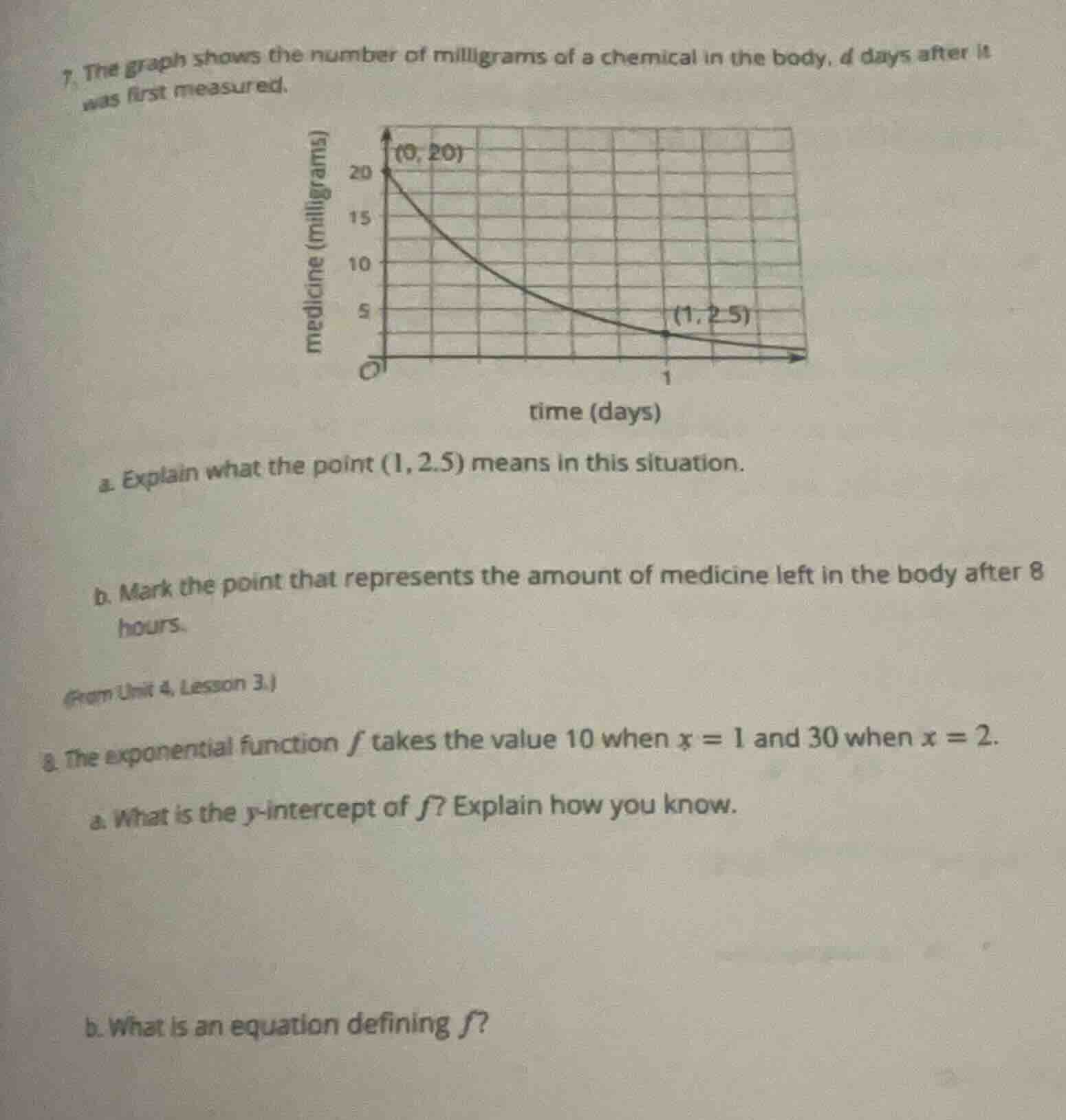
- the graph shows the number of milligrams of a chemical in the body, ( d ) days after it was first measured.
a. explain what the point ( (1, 2.5) ) means in this situation.
b. mark the point that represents the amount of medicine left in the body after 8 hours.
(from unit 4, lesson 3.)
- the exponential function ( f ) takes the value 10 when ( x = 1 ) and 30 when ( x = 2 ).
a. what is the ( y )-intercept of ( f )? explain how you know.
b. what is an equation defining ( f )?
Question 7a
In the context of the graph, the x - coordinate represents the number of days (\(d\)) after the chemical was first measured, and the y - coordinate represents the amount of the chemical (in milligrams) in the body. For the point \((1, 2.5)\), the x - value is 1 (which means 1 day) and the y - value is 2.5 (which means 2.5 milligrams). So, this point means that 1 day after the chemical was first measured, there are 2.5 milligrams of the chemical left in the body.
Step1: Recall the form of an exponential function
An exponential function has the form \(f(x)=ab^{x}\), where \(a\) is the y - intercept (the value of the function when \(x = 0\)) and \(b\) is the base (\(b>0,b
eq1\)).
Step2: Use the given values to set up equations
We know that \(f(1) = 10\) and \(f(2)=30\). Substituting into the exponential function:
When \(x = 1\), \(ab^{1}=10\), so \(ab = 10\) (Equation 1).
When \(x = 2\), \(ab^{2}=30\) (Equation 2).
Step3: Solve for \(b\)
Divide Equation 2 by Equation 1: \(\frac{ab^{2}}{ab}=\frac{30}{10}\). Simplifying the left - hand side gives \(b\), and the right - hand side gives 3. So \(b = 3\).
Step4: Solve for \(a\)
Substitute \(b = 3\) into Equation 1: \(a\times3=10\)? No, wait, let's correct that. Wait, if \(f(1)=ab = 10\) and \(f(2)=ab^{2}=30\), then \(\frac{ab^{2}}{ab}=\frac{30}{10}\Rightarrow b = 3\). Then from \(ab=10\), we have \(a\times3 = 10\)? No, that's a mistake. Wait, no, if \(f(1)=10\) and \(f(2)=30\), the ratio of \(f(2)\) to \(f(1)\) is \(\frac{30}{10}=3\), which is the growth factor \(b\). Then, to find \(a\) (the y - intercept, which is \(f(0)\)), we can use the fact that for an exponential function \(f(x)=ab^{x}\), \(f(x - 1)=\frac{f(x)}{b}\). So when \(x = 1\), \(f(0)=\frac{f(1)}{b}\). We know that \(f(1)=10\) and \(b = 3\), so \(f(0)=\frac{10}{3}\)? Wait, no, let's start over. Let the exponential function be \(f(x)=ab^{x}\). We have:
\(f(1)=ab = 10\)
\(f(2)=ab^{2}=30\)
Divide the second equation by the first: \(\frac{ab^{2}}{ab}=\frac{30}{10}\Rightarrow b = 3\)
Then substitute \(b = 3\) into \(ab = 10\): \(a\times3=10\Rightarrow a=\frac{10}{3}\)? No, that can't be. Wait, maybe I mixed up the values. Wait, the problem says "the exponential function \(f\) takes the value 10 when \(x = 1\) and 30 when \(x = 2\)". So the common ratio (base \(b\)) is \(\frac{30}{10}=3\). So the function is \(f(x)=a\times3^{x}\). When \(x = 1\), \(a\times3^{1}=10\Rightarrow a=\frac{10}{3}\)? But the y - intercept is when \(x = 0\), so \(f(0)=a\times3^{0}=a\). So if \(a=\frac{10}{3}\), the y - intercept is \(\frac{10}{3}\). Wait, maybe I made a mistake in the setup. Let's use the general formula for exponential growth. If \(f(x)\) is exponential, then \(f(x)=f(0)\times r^{x}\), where \(r\) is the growth rate. We know that \(f(1)=f(0)\times r=10\) and \(f(2)=f(0)\times r^{2}=30\). Divide the second equation by the first: \(\frac{f(0)\times r^{2}}{f(0)\times r}=\frac{30}{10}\Rightarrow r = 3\). Then substitute \(r = 3\) into \(f(0)\times r=10\), we get \(f(0)\times3 = 10\Rightarrow f(0)=\frac{10}{3}\). So the y - intercept is \(\frac{10}{3}\) (or approximately 3.33).
Step1: Recall the form of an exponential function
An exponential function is of the form \(f(x)=ab^{x}\), where \(a\) is the y - intercept and \(b\) is the base.
Step2: Determine \(a\) and \(b\)
From part (a), we found that \(a=\frac{10}{3}\) (the y - intercept) and \(b = 3\) (the base, since the ratio of \(f(2)\) to \(f(1)\) is 3).
Step3: Write the equation
Substitute \(a=\frac{10}{3}\) and \(b = 3\) into the exponential function formula. So \(f(x)=\frac{10}{3}\times3^{x}\). We can simplify this using the exponent rule \(a^{m}\times a^{n}=a^{m + n}\). \(\frac{10}{3}\times3^{x}=10\times3^{x-1}\) (because \(\frac{3^{x}}{3}=3^{x - 1}\)). Or we can also write it as \(f(x)=10\times3^{x - 1}\) (which is equivalent to \(\frac{10}{3}\times3^{x}\)).

Snap & solve any problem in the app
Get step-by-step solutions on Sovi AI
Photo-based solutions with guided steps
Explore more problems and detailed explanations
1 day after the chemical was first measured, there are 2.5 milligrams of the chemical in the body.
Question 7b
First, we need to convert 8 hours into days. Since there are 24 hours in a day, 8 hours is \(\frac{8}{24}=\frac{1}{3}\) days. The graph seems to represent an exponential decay function. From the point \((0, 20)\) (initial amount is 20 milligrams) and \((1, 2.5)\), we can find the decay factor. The general form of an exponential function is \(y = ab^{x}\), where \(a\) is the initial amount and \(b\) is the decay factor. When \(x = 0\), \(y=20\), so \(a = 20\). When \(x = 1\), \(y = 2.5\), so \(2.5=20\times b^{1}\), which gives \(b=\frac{2.5}{20}=\frac{1}{8}\). So the function is \(y = 20\times(\frac{1}{8})^{x}\). Now, when \(x=\frac{1}{3}\), we calculate \(y = 20\times(\frac{1}{8})^{\frac{1}{3}}\). We know that \(8^{\frac{1}{3}}=\sqrt[3]{8} = 2\), so \((\frac{1}{8})^{\frac{1}{3}}=\frac{1}{2}\). Then \(y=20\times\frac{1}{2}=10\). So the point representing the amount of medicine left after 8 hours is \((\frac{1}{3}, 10)\). To mark this point on the graph, we find the position on the x - axis corresponding to \(\frac{1}{3}\) days (which is about a third of the way from 0 to 1 on the x - axis) and the y - axis corresponding to 10 milligrams (halfway between 5 and 15 on the y - axis) and plot the point \((\frac{1}{3}, 10)\).