QUESTION IMAGE
Question
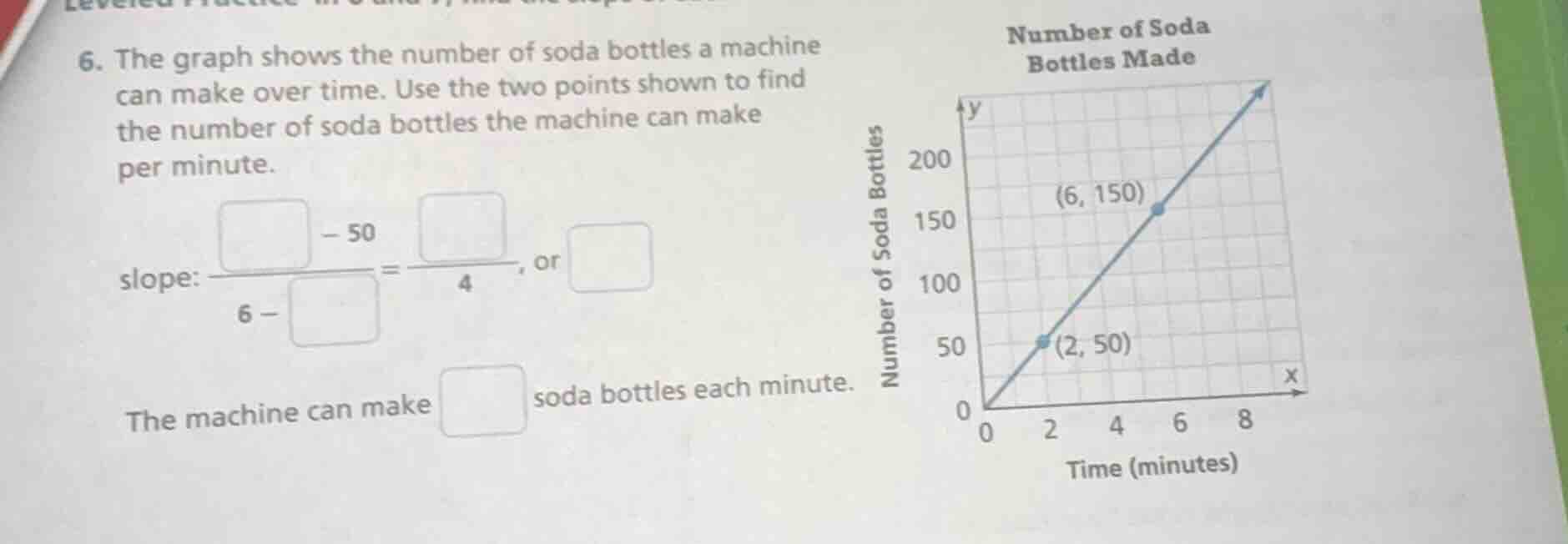
- the graph shows the number of soda bottles a machine can make over time. use the two points shown to find the number of soda bottles the machine can make per minute. slope: (□ - 50)/(6 - □) = □/4, or □ the machine can make □ soda bottles each minute. chart: number of soda bottles made, x-axis: time (minutes), y-axis: number of soda bottles, points (2, 50) and (6, 150)
Step1: Identify the two points
The two points from the graph are \((2, 50)\) and \((6, 150)\). In the slope formula \(\frac{y_2 - y_1}{x_2 - x_1}\), here \(y_2 = 150\), \(y_1 = 50\), \(x_2 = 6\), \(x_1 = 2\). So the numerator of the first fraction is \(150 - 50\), and the denominator is \(6 - 2\).
Step2: Calculate the numerator and denominator
For the first fraction: \(\frac{150 - 50}{6 - 2}=\frac{100}{4}\) (wait, no, wait, the first given numerator part is \(\square - 50\), so the first \(\square\) should be \(150\) because \(y_2 = 150\), then \(6 - \square\) is \(6 - 2\) (since \(x_1 = 2\)), so the first fraction is \(\frac{150 - 50}{6 - 2}\). Then the second fraction is \(\frac{100}{4}\) (because \(150 - 50 = 100\), \(6 - 2 = 4\)).
Step3: Simplify the fraction
Simplify \(\frac{100}{4}\), we divide \(100\) by \(4\), which is \(25\)? Wait, no, wait \(150 - 50 = 100\)? Wait no, \(150 - 50 = 100\)? Wait \(150 - 50 = 100\), and \(6 - 2 = 4\), then \(\frac{100}{4}=25\)? Wait no, wait \(50\) to \(150\) is \(100\) over \(4\) minutes? Wait no, the two points are \((2,50)\) and \((6,150)\). The change in \(y\) is \(150 - 50 = 100\), change in \(x\) is \(6 - 2 = 4\). So slope is \(\frac{100}{4}=25\)? Wait but let's check: from \(x = 2\) to \(x = 6\), that's \(4\) minutes, and \(y\) goes from \(50\) to \(150\), which is \(100\) bottles. So per minute, \(100\div4 = 25\)? Wait but wait, when \(x = 2\), \(y = 50\), so per minute, \(50\div2 = 25\), and \(150\div6 = 25\), so yes, the slope (rate) is \(25\) bottles per minute. Wait, but wait, the first fraction in the problem is \(\frac{\square - 50}{6 - \square}\), so the first \(\square\) is \(150\) (since \(y_2 = 150\)), the second \(\square\) in the denominator is \(2\) (since \(x_1 = 2\)), then the second fraction is \(\frac{100}{4}\) (since \(150 - 50 = 100\), \(6 - 2 = 4\)), and then simplifying \(\frac{100}{4}=25\). So the machine can make \(25\) soda bottles each minute? Wait no, wait \(50\) bottles in \(2\) minutes is \(25\) per minute, \(150\) in \(6\) minutes is \(25\) per minute. So the slope (rate) is \(25\). Wait but let's re - check the calculations:
First, fill in the blanks:
slope: \(\frac{150 - 50}{6 - 2}=\frac{100}{4}\), or \(25\). Wait no, wait \(150 - 50 = 100\)? Wait \(150 - 50 = 100\), \(6 - 2 = 4\), then \(\frac{100}{4}=25\). So the first \(\square\) is \(150\), the denominator \(\square\) is \(2\), the second numerator \(\square\) is \(100\), and the last \(\square\) is \(25\). Then the machine can make \(25\) soda bottles each minute? Wait but wait, let's check with the point \((2,50)\): \(2\) minutes, \(50\) bottles, so \(50\div2 = 25\) per minute. Correct.
Wait, but maybe I made a mistake earlier. Let's do it again:
The slope formula is \(\frac{y_2 - y_1}{x_2 - x_1}\). Here, \((x_1,y_1)=(2,50)\) and \((x_2,y_2)=(6,150)\). So \(y_2 - y_1 = 150 - 50 = 100\), \(x_2 - x_1 = 6 - 2 = 4\). So the first fraction is \(\frac{150 - 50}{6 - 2}\), so the first \(\square\) is \(150\), the denominator \(\square\) is \(2\). Then \(150 - 50 = 100\), \(6 - 2 = 4\), so the second fraction is \(\frac{100}{4}\), and \(\frac{100}{4}=25\). So the slope is \(25\), meaning the machine makes \(25\) soda bottles per minute.
Wait, but wait, the problem's first fraction is \(\frac{\square - 50}{6 - \square}\), so:
- First \(\square\) (numerator top): \(150\) (because \(y_2 = 150\))
- Denominator \(\square\): \(2\) (because \(x_1 = 2\))
- Second numerator \(\square\): \(100\) (because \(150 - 50 = 100\))
- Then \(\frac{100}{4}=25\) (the last \(\square\))
Then the machine can make \(2…

Snap & solve any problem in the app
Get step-by-step solutions on Sovi AI
Photo-based solutions with guided steps
Explore more problems and detailed explanations
First blank: \(150\), second blank (denominator): \(2\), third blank (numerator of second fraction): \(100\), fourth blank (slope): \(25\), and the machine can make \(25\) soda bottles each minute.
So filling in the blanks:
slope: \(\frac{\boldsymbol{150}- 50}{6-\boldsymbol{2}}=\frac{\boldsymbol{100}}{4}\), or \(\boldsymbol{25}\)
The machine can make \(\boldsymbol{25}\) soda bottles each minute.