QUESTION IMAGE
Question
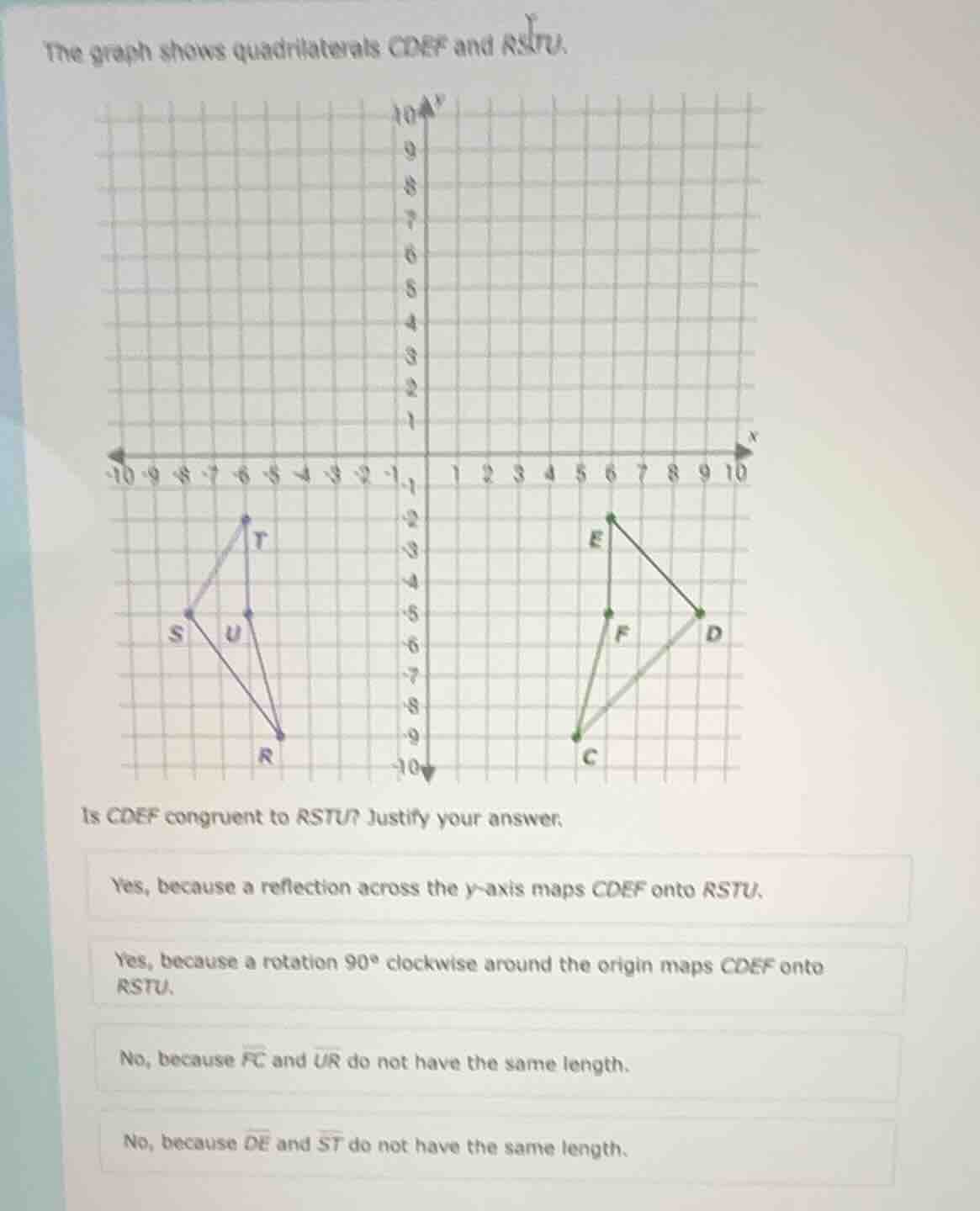
the graph shows quadrilaterals cdef and rstu.
is cdef congruent to rstu? justify your answer.
yes, because a reflection across the y - axis maps cdef onto rstu.
yes, because a rotation 90° clockwise around the origin maps cdef onto rstu.
no, because \\(\overline{fc}\\) and \\(\overline{ur}\\) do not have the same length.
no, because \\(\overline{de}\\) and \\(\overline{st}\\) do not have the same length.
To determine if CDEF and RSTU are congruent, we can check the lengths of corresponding sides. Let's find the coordinates of the vertices:
- For CDEF: Let's assume coordinates (from the graph, approximate): C(4, -9), D(8, -5), E(6, -2), F(6, -5)
- For RSTU: S(-8, -5), T(-6, -2), U(-6, -5), R(-4, -9)
Now, calculate the length of \( \overline{DE} \) (in CDEF) and \( \overline{ST} \) (in RSTU) using the distance formula \( d = \sqrt{(x_2 - x_1)^2 + (y_2 - y_1)^2} \) or by counting grid units (since horizontal/vertical lines).
For \( \overline{DE} \): From D(8, -5) to E(6, -2). The horizontal distance is \( 8 - 6 = 2 \), vertical distance is \( -2 - (-5) = 3 \). So length is \( \sqrt{2^2 + 3^2} = \sqrt{4 + 9} = \sqrt{13} \).
For \( \overline{ST} \): From S(-8, -5) to T(-6, -2). Horizontal distance \( -6 - (-8) = 2 \), vertical distance \( -2 - (-5) = 3 \). Length is \( \sqrt{2^2 + 3^2} = \sqrt{13} \)? Wait, no, wait. Wait, maybe I made a mistake. Wait, let's check another side. Wait, actually, let's check \( \overline{DE} \) and \( \overline{ST} \) again. Wait, no, the fourth option says "No, because \( \overline{DE} \) and \( \overline{ST} \) do not have the same length." Wait, maybe my coordinate assumption is wrong. Let's re - examine the graph.
Looking at the vertical lines: For \( \overline{EF} \) in CDEF: E(6, -2) to F(6, -5). That's a vertical line, length is \( |-2 - (-5)| = 3 \). For \( \overline{TU} \) in RSTU: T(-6, -2) to U(-6, -5). Vertical line, length is \( |-2 - (-5)| = 3 \). Now, \( \overline{DE} \): D(8, -5) to E(6, -2). The change in x: \( 8 - 6 = 2 \), change in y: \( -5 - (-2) = -3 \), so length \( \sqrt{(2)^2 + (-3)^2} = \sqrt{4 + 9} = \sqrt{13} \approx 3.605 \).
\( \overline{ST} \): S(-8, -5) to T(-6, -2). Change in x: \( -6 - (-8) = 2 \), change in y: \( -2 - (-5) = 3 \), length \( \sqrt{(2)^2 + (3)^2} = \sqrt{13} \approx 3.605 \). Wait, that's the same. Wait, maybe another side. Wait, \( \overline{FC} \) and \( \overline{UR} \). \( \overline{FC} \): F(6, -5) to C(4, -9). Change in x: \( 4 - 6 = -2 \), change in y: \( -9 - (-5) = -4 \), length \( \sqrt{(-2)^2 + (-4)^2} = \sqrt{4 + 16} = \sqrt{20} = 2\sqrt{5} \approx 4.472 \). \( \overline{UR} \): U(-6, -5) to R(-4, -9). Change in x: \( -4 - (-6) = 2 \), change in y: \( -9 - (-5) = -4 \), length \( \sqrt{(2)^2 + (-4)^2} = \sqrt{4 + 16} = \sqrt{20} = 2\sqrt{5} \approx 4.472 \). Wait, maybe the mistake is in the first two options. Let's check the reflection. A reflection across the y - axis would map (x, y) to (-x, y). Let's take point C(4, -9): reflection over y - axis is (-4, -9), which is R. F(6, -5): reflection is (-6, -5), which is U. E(6, -2): reflection is (-6, -2), which is T. D(8, -5): reflection is (-8, -5), which is S. Wait, that's exactly the mapping! So a reflection across the y - axis maps C(4, -9) to R(-4, -9), F(6, -5) to U(-6, -5), E(6, -2) to T(-6, -2), D(8, -5) to S(-8, -5). So the first option says "Yes, because a reflection across the y - axis maps CDEF onto RSTU." But wait, let's check the sides again. Wait, maybe I messed up the coordinates. Let's list the coordinates properly:
- CDEF:
- C: Let's say from the graph, C is at (4, -9) (since it's 4 units right on x - axis from origin, 9 units down on y - axis)
- D: (8, -5) (8 right, 5 down)
- E: (6, -2) (6 right, 2 down)
- F: (6, -5) (6 right, 5 down)
- RSTU:
- R: (-4, -9) (4 left, 9 down)
- S: (-8, -5) (8 left, 5 down)
- T: (-6, -2) (6 left, 2 down)
- U: (-6, -5) (6 left, 5 down)
Now, reflecting CDEF over the y - axis (rule: (x, y) → (-x, y)):
- C(4, -9) → (-4, -9) = R
- D…

Snap & solve any problem in the app
Get step-by-step solutions on Sovi AI
Photo-based solutions with guided steps
Explore more problems and detailed explanations
Yes, because a reflection across the y - axis maps CDEF onto RSTU.