QUESTION IMAGE
Question
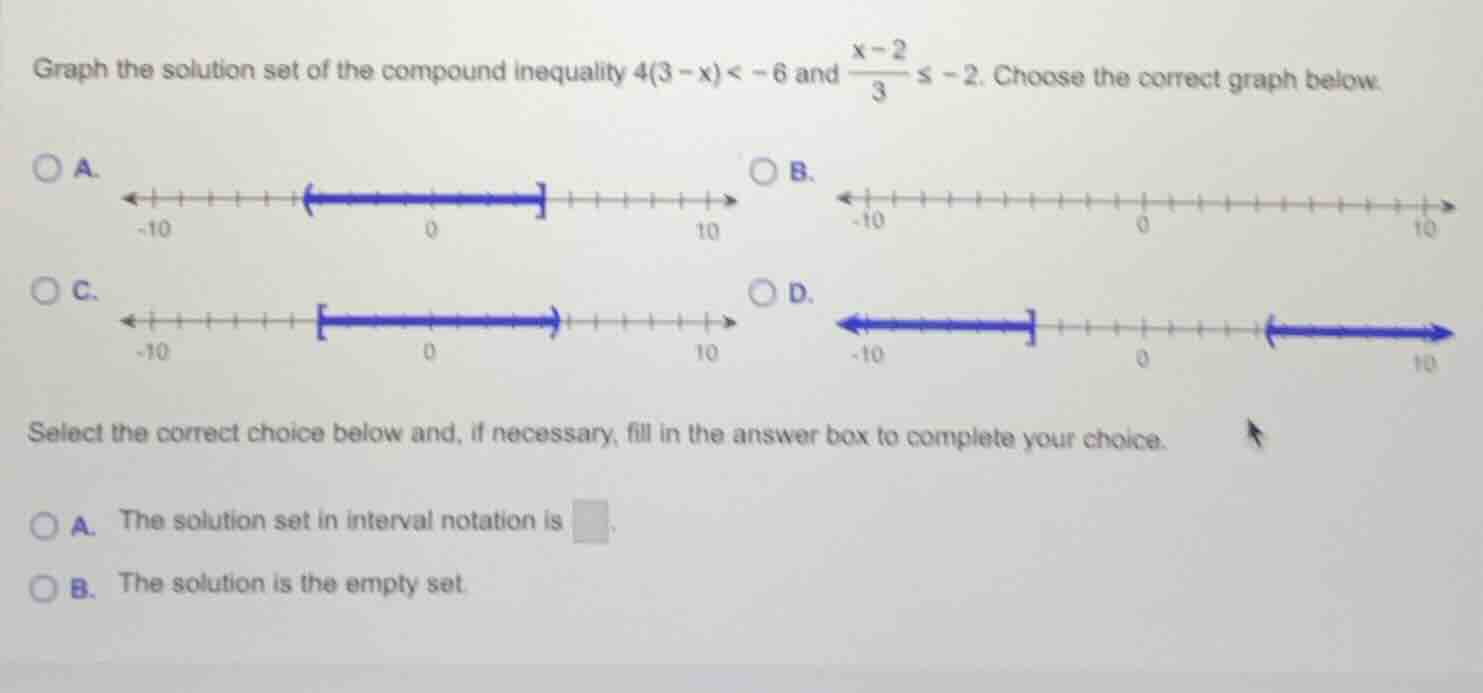
graph the solution set of the compound inequality $4(3 - x) < -6$ and $\frac{x - 2}{3} leq -2$. choose the correct graph below.
a.
<graph with a number line from -10 to 10, an open circle at some point left of 0 and a closed circle at some point right of 0, blue line between them>
b.
<graph with a number line from -10 to 10, no blue line>
c.
<graph with a number line from -10 to 10, a closed circle at some point left of 0 and an open circle at some point right of 0, blue line between them>
d.
<graph with a number line from -10 to 10, two blue lines: one from left to a closed circle left of 0, one from an open circle right of 0 to right>
select the correct choice below and, if necessary, fill in the answer box to complete your choice.
a. the solution set in interval notation is
b. the solution is the empty set.
Step1: Solve first inequality
Start with $4(3-x) < -6$.
Divide both sides by 4:
$\frac{4(3-x)}{4} < \frac{-6}{4}$
Simplify: $3-x < -\frac{3}{2}$
Subtract 3 from both sides:
$-x < -\frac{3}{2} - 3$
$-x < -\frac{9}{2}$
Multiply by -1 (reverse inequality):
$x > \frac{9}{2}$ or $x > 4.5$
Step2: Solve second inequality
Start with $\frac{x-2}{3} \leq -2$.
Multiply both sides by 3:
$x-2 \leq -6$
Add 2 to both sides:
$x \leq -6 + 2$
$x \leq -4$
Step3: Analyze compound "and" condition
The compound inequality requires $x > 4.5$ and $x \leq -4$. There are no numbers that satisfy both conditions simultaneously.

Snap & solve any problem in the app
Get step-by-step solutions on Sovi AI
Photo-based solutions with guided steps
Explore more problems and detailed explanations