QUESTION IMAGE
Question
graphing solution sets
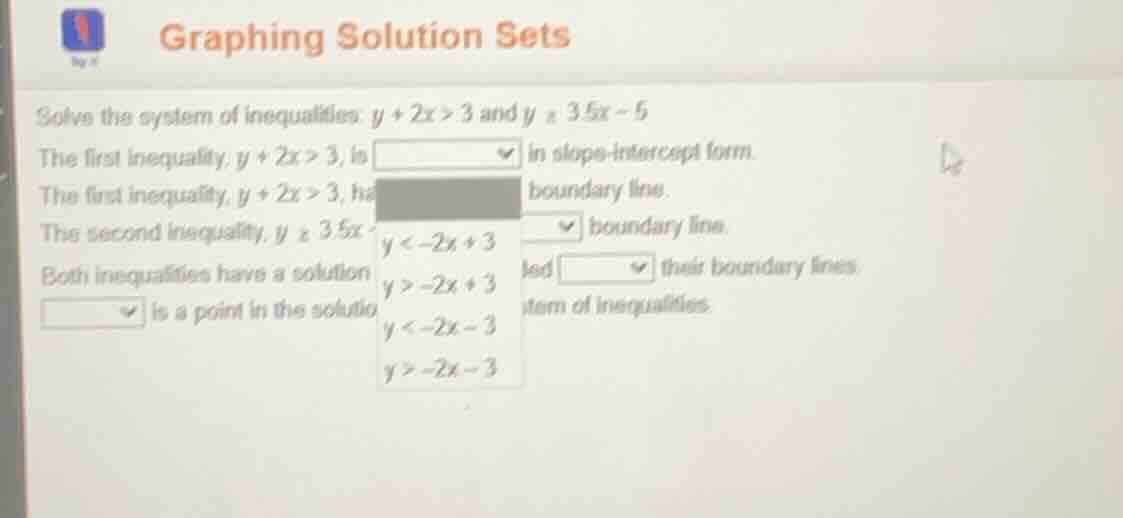
solve the system of inequalities: ( y + 2x > 3 ) and ( y geq 3.5x - 5 )
the first inequality, ( y + 2x > 3 ), is (square) in slope - intercept form.
the first inequality, ( y + 2x > 3 ), ha(square) boundary line.
the second inequality, ( y geq 3.5x)(square) boundary line.
both inequalities have a solutio(square)led (square) their boundary lines.
(square) is a point in the solutio(square)tem of inequalities.
(y < - 2x + 3)(y > - 2x + 3)(y < - 2x - 3)(y > - 2x - 3)
Step1: Rearrange to slope-intercept form
$y + 2x > 3 \implies y > -2x + 3$
Step2: Identify boundary line type
For $y > -2x + 3$, inequality is $>$, so boundary is dashed.
Step3: Identify second inequality boundary
For $y \geq 3.5x - 5$, inequality is $\geq$, so boundary is solid.
Step4: Describe solution region
Solutions lie above dashed $y=-2x+3$, above solid $y=3.5x-5$.
Step5: Test a valid solution point
Test $(2, 2)$:
$2 + 2(2) = 6 > 3$, and $2 \geq 3.5(2)-5 = 2$, which holds.

Snap & solve any problem in the app
Get step-by-step solutions on Sovi AI
Photo-based solutions with guided steps
Explore more problems and detailed explanations
The first inequality $y + 2x > 3$, is $\boldsymbol{y > -2x + 3}$ in slope-intercept form.
The first inequality $y + 2x > 3$, has a $\boldsymbol{dashed}$ boundary line.
The second inequality $y \geq 3.5x - 5$ has a $\boldsymbol{solid}$ boundary line.
Both inequalities have a solution set that lies $\boldsymbol{above}$ their boundary lines.
$\boldsymbol{(2, 2)}$ is a point in the solution set of the system of inequalities.