QUESTION IMAGE
Question
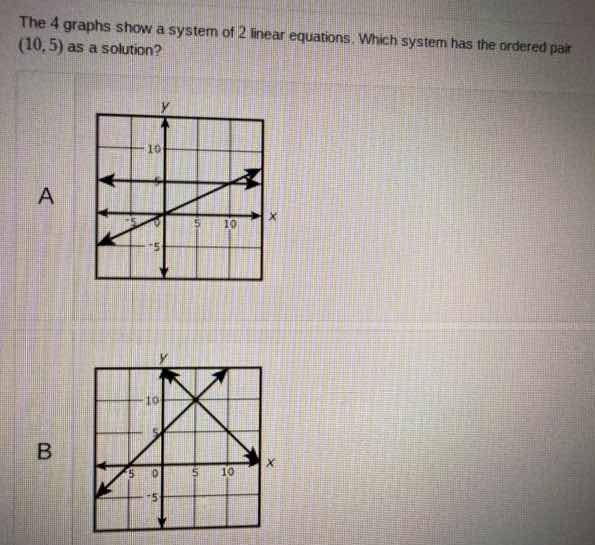
the 4 graphs show a system of 2 linear equations. which system has the ordered pair (10, 5) as a solution? a graph b graph
To determine which system has the ordered pair \((10, 5)\) as a solution, we analyze the graphs:
Graph A:
- One line is horizontal (constant \(y\)-value). From the grid, it appears to be \(y = 4\) (since it's at \(y = 4\) across the \(x\)-axis).
- The other line passes through the origin and has a slope. For \(x = 10\), the \(y\)-value on this line would be calculated by its slope. If we assume the line passes through \((0, 0)\) and, say, \((10, 5)\), but the horizontal line is \(y = 4\), so at \(x = 10\), the horizontal line has \(y = 4\), not \(5\). Thus, \((10, 5)\) is not a solution for Graph A.
Graph B:
- One line has a positive slope, passing through the origin and, likely, \((10, 10)\) (if we follow the grid). Wait, no—wait, the other line has a negative slope. Wait, let's re-examine. Wait, the two lines in Graph B: one with positive slope (going from bottom-left to top-right) and one with negative slope (going from top-left to bottom-right). Let's check the intersection or the values at \(x = 10\).
- For the line with positive slope: If we assume it passes through \((0, 0)\) and, say, \((10, 10)\), but no—wait, the other line (negative slope) might intersect at \((10, 5)\)? Wait, no, let's think again. Wait, the ordered pair \((10, 5)\) means at \(x = 10\), \(y = 5\). Let's check the lines in Graph B:
- The line with positive slope: Let's say it goes through \((0, 0)\) and \((10, 10)\) (slope \(1\)), but the other line (negative slope) might go through \((0, 10)\) and \((10, 0)\) (slope \(-1\)). Wait, no—wait, the intersection of these two lines would be at \((5, 5)\)? No, wait, if one line is \(y = x\) (positive slope, through origin) and the other is \(y = -x + 10\) (negative slope, through \((0, 10)\) and \((10, 0)\)), then their intersection is at \(x = 5\), \(y = 5\). Wait, that's not \((10, 5)\). Wait, maybe I misread the graphs.
Wait, perhaps the correct approach is: For a system of linear equations, the solution is the point where the two lines intersect. So we need to find which graph has the two lines intersecting at \((10, 5)\) or where at \(x = 10\), both lines have \(y = 5\).
Wait, maybe the initial analysis was wrong. Let's re-express:
- In Graph A: One line is horizontal (\(y = 4\)) and the other is a line with slope \(0.5\) (from \((0, 0)\) to \((10, 5)\)). Wait, if the horizontal line is \(y = 4\), then at \(x = 10\), the slanted line has \(y = 5\), but the horizontal line has \(y = 4\), so they don't intersect at \((10, 5)\).
- In Graph B: The two lines—one with positive slope (say \(y = x\)) and one with negative slope (say \(y = -x + 15\))? No, this is getting confusing. Wait, the key is: The ordered pair \((10, 5)\) must satisfy both equations (i.e., lie on both lines). So we check for each graph if at \(x = 10\), both lines have \(y = 5\).
Wait, maybe the correct answer is Graph B? Wait, no—wait, maybe I made a mistake. Wait, let's look at the grid again. For Graph A: The horizontal line is at \(y = 4\) (since the grid has \(y = 4\) marked). The slanted line goes through the origin and, at \(x = 10\), would have \(y = 5\) (if slope is \(0.5\)). But the horizontal line is \(y = 4\), so at \(x = 10\), the slanted line has \(y = 5\), but the horizontal line has \(y = 4\), so \((10, 5)\) is on the slanted line but not on the horizontal line. Thus, not a solution.
For Graph B: The two lines—one with positive slope (through origin) and one with negative slope. Let's assume the positive slope line is \(y = 0.5x\) (so at \(x = 10\), \(y = 5\)) and the negative slope line is, say, \(y = -0.5x +…

Snap & solve any problem in the app
Get step-by-step solutions on Sovi AI
Photo-based solutions with guided steps
Explore more problems and detailed explanations
B