QUESTION IMAGE
Question
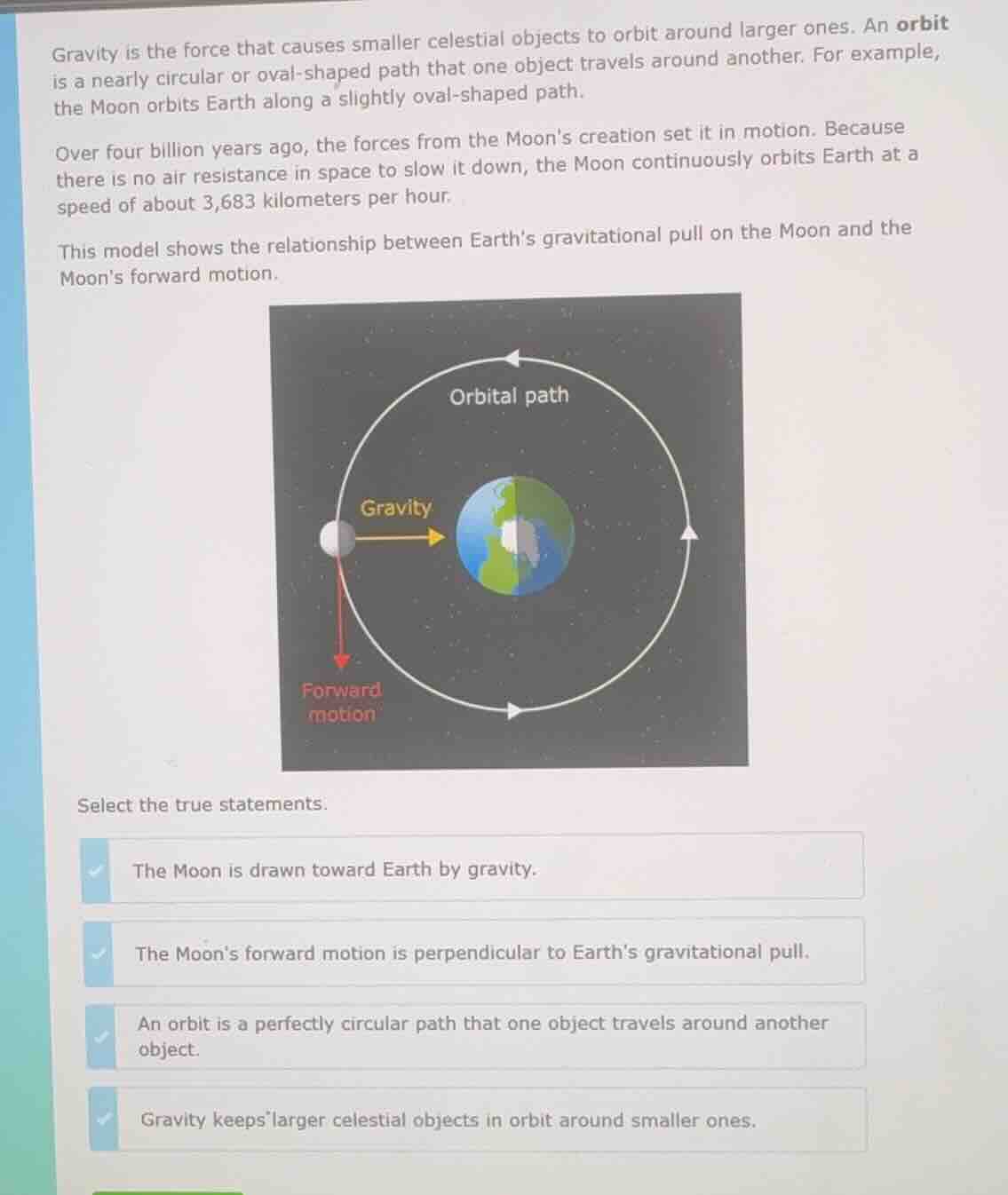
gravity is the force that causes smaller celestial objects to orbit around larger ones. an orbit is a nearly circular or oval - shaped path that one object travels around another. for example, the moon orbits earth along a slightly oval - shaped path. over four billion years ago, the forces from the moons creation set it in motion. because there is no air resistance in space to slow it down, the moon continuously orbits earth at a speed of about 3,683 kilometers per hour. this model shows the relationship between earths gravitational pull on the moon and the moons forward motion. select the true statements. the moon is drawn toward earth by gravity. the moons forward motion is perpendicular to earths gravitational pull. an orbit is a perfectly circular path that one object travels around another object. gravity keeps larger celestial objects in orbit around smaller ones.
- The text states gravity pulls smaller celestial objects toward larger ones, so the Moon is drawn to Earth by gravity.
- The diagram shows the Moon's forward motion arrow is perpendicular (90 degrees) to the gravity arrow toward Earth.
- The text defines an orbit as nearly circular or oval-shaped, not perfectly circular, so this statement is false.
- The text says gravity causes smaller objects to orbit larger ones, not the reverse, so this statement is false.

Snap & solve any problem in the app
Get step-by-step solutions on Sovi AI
Photo-based solutions with guided steps
Explore more problems and detailed explanations
- The Moon is drawn toward Earth by gravity.
- The Moon's forward motion is perpendicular to Earth's gravitational pull.