QUESTION IMAGE
Question
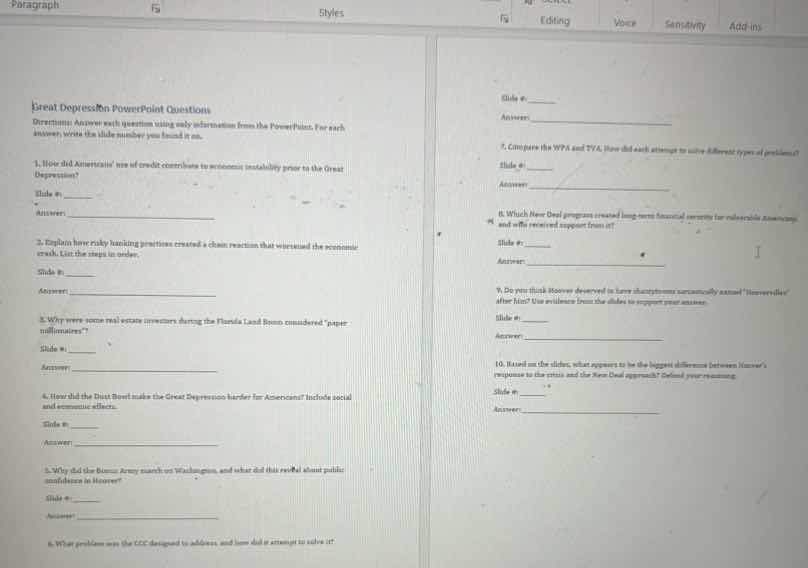
great depression powerpoint questions
directions: answer each question using only information from the powerpoint. for each answer, write the slide number you found it on.
- how did americans’ use of credit contribute to economic instability prior to the great depression?
slide #: ______
answer: _________________________
- explain how risky banking practices created a chain reaction that worsened the economic crash (be sure to map it out).
slide #: ______
answer: _________________________
- why were some real estate investors during the florida land boom considered “paper millionaires”?
slide #: ______
answer: _________________________
- how did the dust bowl make the great depression harder for americans? include social and economic effects.
slide #: ______
answer: _________________________
- why did the bonus army march on washington, and what did this reveal about public attitudes toward the hoover administration?
slide #: ______
answer: _________________________
- what problem was the ccc designed to address, and how did it attempt to solve it?
slide #: ______
answer: _________________________
- compare the wpa and tva. how did each attempt to solve different types of problems?
slide #: ______
answer: _________________________
- which new deal program created long - term financial security for vulnerable americans, and who was excluded/supported from it?
slide #: ______
answer: _________________________
- do you think hoover deserved to have shantytowns nationally named “hoovervilles” after him? use evidence from the slides to support your answer.
slide #: ______
answer: _________________________
- based on the slides, what appears to be the biggest difference between hoover’s response to the crisis and the new deal approach? defend your reasoning.
slide #: ______
answer: _________________________
Since the provided content is a set of questions related to the Great Depression, its causes, impacts, and related historical events, the relevant discipline is Social Science, specifically the subfield of History. As these questions require explanations based on historical knowledge (no calculations needed), we'll use the Answer - Explanation Format.
1. How did Americans’ use of credit contribute to economic instability prior to the Great Depression?
Before the Great Depression, many Americans used credit to buy consumer goods (like cars, appliances) and invest in the stock market. This led to high personal debt. When economic conditions worsened (e.g., stock market crash, job losses), people couldn't repay debts. Banks faced defaults, reduced lending, and businesses lost revenue as consumers cut spending, creating a downward economic spiral.
Banks engaged in risky practices: over - lending (e.g., to risky borrowers, for stock speculation), not having enough reserves, and investing depositors’ money in risky ventures. When depositors panicked (after stock market crash) and demanded withdrawals (bank runs), banks lacked funds to pay. Banks failed, which meant businesses lost access to loans, couldn't operate, laid off workers. Unemployed workers spent less, so more businesses struggled, and the economic crash worsened. Order: Risky banking (over - lending, low reserves) → bank runs → bank failures → business loan shortages → business closures/layoffs → reduced consumer spending → more economic decline.
During the Florida Land Boom, real estate prices soared due to speculation. Investors bought land at inflated prices, using credit or selling quickly at higher prices. Their “wealth” was on paper (based on the speculative land value), not from actual productive assets or cash. When the boom collapsed, land values plummeted, and their paper - based wealth disappeared.

Snap & solve any problem in the app
Get step-by-step solutions on Sovi AI
Photo-based solutions with guided steps
Explore more problems and detailed explanations
Americans’ heavy use of credit (for consumer goods, stock market speculation) led to high personal/business debt. When economic troubles hit, defaults on loans (e.g., mortgages, consumer debt) caused bank failures, reduced consumer spending, and worsened economic instability.