QUESTION IMAGE
Question
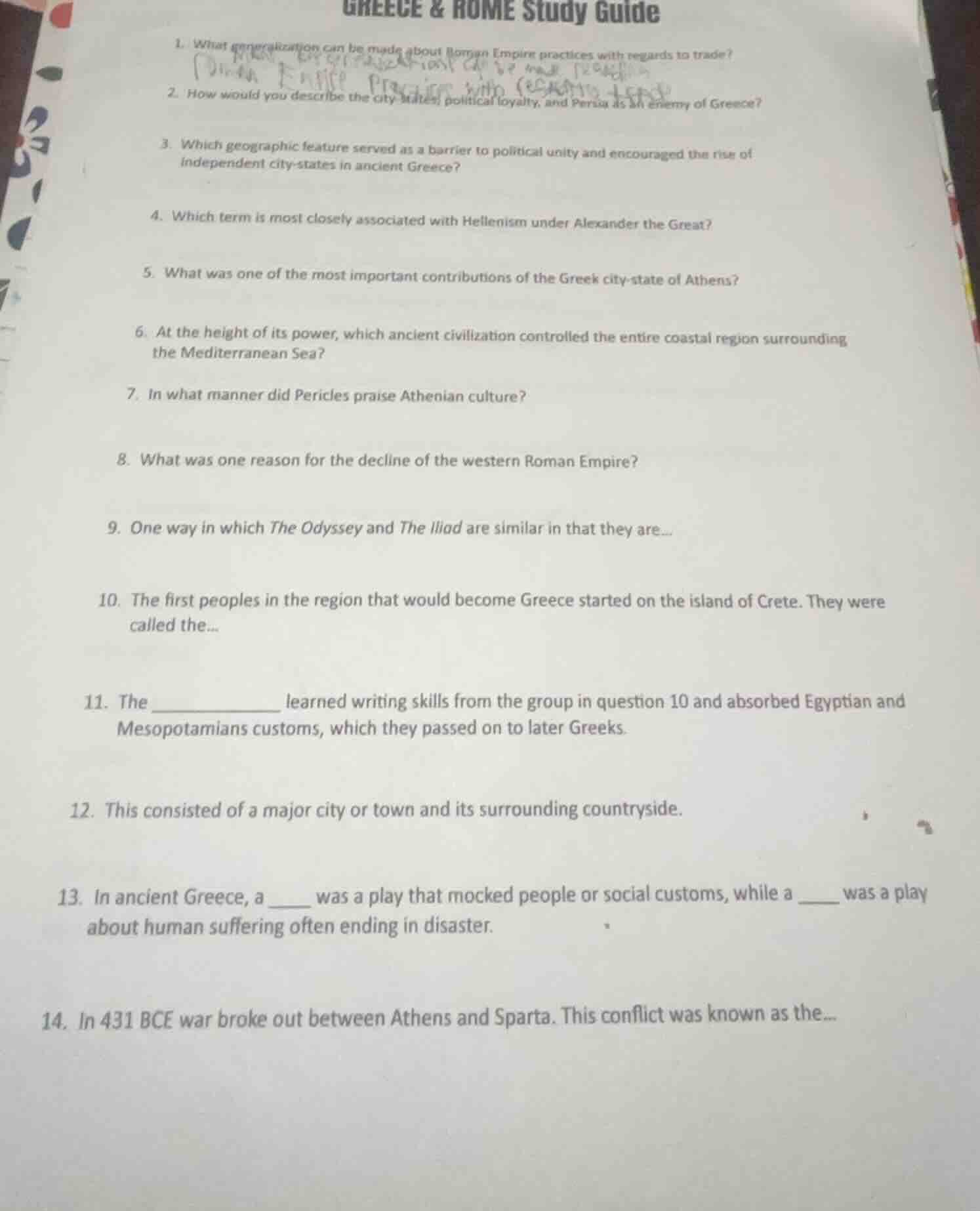
greece & rome study guide1. what generalization can be made about roman empire practices with regards to trade?2. how would you describe the city-states political loyalty, and persia as an enemy of greece?3. which geographic feature served as a barrier to political unity and encouraged the rise of independent city-states in ancient greece?4. which term is most closely associated with hellenism under alexander the great?5. what was one of the most important contributions of the greek city-state of athens?6. at the height of its power, which ancient civilization controlled the entire coastal region surrounding the mediterranean sea?7. in what manner did pericles praise athenian culture?8. what was one reason for the decline of the western roman empire?9. one way in which the odyssey and the iliad are similar in that they are...10. the first peoples in the region that would become greece started on the island of crete. they were called the...11. the __________ learned writing skills from the group in question 10 and absorbed egyptian and mesopotamians customs, which they passed on to later greeks.12. this consisted of a major city or town and its surrounding countryside.13. in ancient greece, a was a play that mocked people or social customs, while a __ was a play about human suffering often ending in disaster.14. in 431 bce war broke out between athens and sparta. this conflict was known as the...
- Summarizes Roman trade's core traits: integrated routes, tolerance for local goods, and economic control.
- Explains Greek city-state loyalty and Persia's role as a unifying external threat.
- Identifies the geographic barrier that split Greek communities.
- Names the key cultural spread linked to Alexander's conquests.
- Highlights Athens' foundational political innovation.
- Notes the civilization that dominated Mediterranean coasts at its peak.
- Describes Pericles' famous public tribute to Athenian values.
- Lists a major, widely cited cause of Western Rome's fall.
- States the shared cultural and literary origin of the two epics.
- Names the earliest major civilization of the Greek region.
- Identifies the group that adopted and passed on Cretan and Near Eastern culture to later Greeks.
- Defines the core political and geographic unit of ancient Greece.
- Matches the two main ancient Greek theater genres to their descriptions.
- Names the famous 5th-century BCE Greek war.

Snap & solve any problem in the app
Get step-by-step solutions on Sovi AI
Photo-based solutions with guided steps
Explore more problems and detailed explanations
- The Roman Empire established extensive, secure trade routes across its territories, promoted the exchange of goods from Europe, Africa, and Asia, and used trade to strengthen economic control and integration of its provinces.
- Greek city-states (poleis) had intense local political loyalty, prioritizing their own city's autonomy over pan-Greek unity; Persia served as a rare unifying external enemy, as Greek city-states temporarily allied to fight Persian invasions (e.g., the Greco-Persian Wars).
- Mountainous terrain
- Cultural diffusion (the spread of Greek language, art, and culture across the conquered regions of the Mediterranean and Near East)
- The development and practice of democracy (direct democracy for eligible citizens)
- The Roman Empire
- Pericles praised Athenian culture in his Funeral Oration, celebrating its commitment to democracy, freedom, intellectual achievement, and civic responsibility, while framing Athenians as models for other societies.
- One major reason is the repeated invasions by Germanic tribes (such as the Visigoths and Vandals) that overwhelmed the empire's military defenses.
- Epic poems rooted in ancient Greek oral tradition, attributed to Homer, that reflect Greek cultural values and myths.
- Minoans
- Mycenaeans
- City-state (polis)
- comedy; tragedy
- Peloponnesian War