QUESTION IMAGE
Question
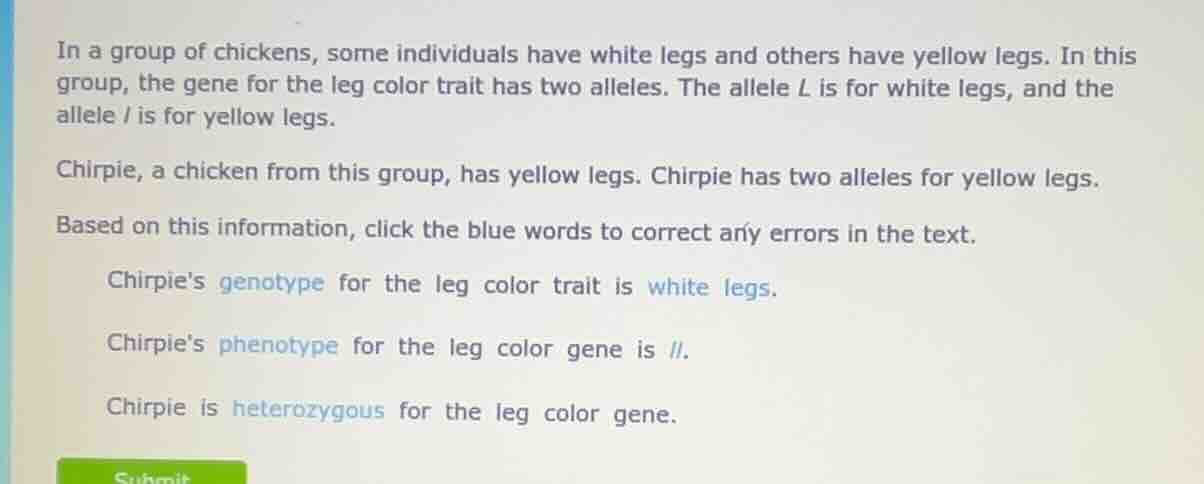
in a group of chickens, some individuals have white legs and others have yellow legs. in this group, the gene for the leg color trait has two alleles. the allele l is for white legs, and the allele l is for yellow legs. chirpie, a chicken from this group, has yellow legs. chirpie has two alleles for yellow legs. based on this information, click the blue words to correct any errors in the text. chirpies genotype for the leg color trait is white legs. chirpies phenotype for the leg color gene is ll. chirpie is heterozygous for the leg color gene.
- For the first sentence: Genotype refers to the genetic makeup (alleles), and phenotype is the observable trait. Chirpie has yellow legs (phenotype) and two alleles for yellow legs (so genotype should be \( ll \), and phenotype is yellow legs). So "white legs" (phenotype part here is wrong, and genotype description was mixed) should be corrected. Wait, the first blue word is "genotype" and then "white legs"? Wait, no, the sentence is "Chirpie's genotype for the leg color trait is white legs." Genotype is the alleles, so "white legs" is a phenotype, so we need to correct "white legs" to \( ll \) (since Chirpie has two yellow leg alleles, which is \( ll \)). Also, the second sentence: "Chirpie's phenotype for the leg color gene is \( ll \)." Phenotype is the observable trait, so \( ll \) is genotype, so we correct "phenotype" to "genotype" or correct \( ll \) to "yellow legs". Third sentence: "Chirpie is heterozygous for the leg color gene." Heterozygous means two different alleles, but Chirpie has two same alleles ( \( ll \) ), so it's homozygous recessive. So:
- First correction: In "Chirpie's genotype for the leg color trait is white legs", "white legs" (phenotype) should be replaced with \( ll \) (genotype, since two yellow leg alleles, \( l \) is for yellow, so two \( l \)s: \( ll \)).
- Second correction: In "Chirpie's phenotype for the leg color gene is \( ll \)", \( ll \) is genotype, so we correct "phenotype" to "genotype" or correct \( ll \) to "yellow legs". Since phenotype is observable, "yellow legs" is the phenotype, so replace \( ll \) with "yellow legs".
- Third correction: In "Chirpie is heterozygous for the leg color gene", heterozygous is wrong; it's homozygous (specifically homozygous recessive), so replace "heterozygous" with "homozygous" (or "homozygous recessive").
Wait, let's re-express:
- Sentence 1: "Chirpie's genotype for the leg color trait is white legs." Genotype is the allele combination. White legs is a phenotype. Chirpie has two \( l \) alleles (since yellow legs, and two yellow alleles), so genotype is \( ll \). So correct "white legs" to \( ll \).
- Sentence 2: "Chirpie's phenotype for the leg color gene is \( ll \)." Phenotype is the physical trait (yellow legs), \( ll \) is genotype. So correct "phenotype" to "genotype" (if we keep \( ll \)) or correct \( ll \) to "yellow legs". Let's do the latter: replace \( ll \) with "yellow legs".
- Sentence 3: "Chirpie is heterozygous for the leg color gene." Heterozygous means one \( L \) and one \( l \), but Chirpie has two \( l \)s, so it's homozygous (homozygous recessive). So replace "heterozygous" with "homozygous".
So the corrections are:
- In the first sentence, "white legs" → \( ll \)
- In the second sentence, \( ll \) → "yellow legs"
- In the third sentence, "heterozygous" → "homozygous"

Snap & solve any problem in the app
Get step-by-step solutions on Sovi AI
Photo-based solutions with guided steps
Explore more problems and detailed explanations
- For "Chirpie's genotype for the leg color trait is white legs": Correct "white legs" to \( ll \) (since genotype is the allele combination, and Chirpie has two \( l \) alleles).
- For "Chirpie's phenotype for the leg color gene is \( ll \)": Correct \( ll \) to "yellow legs" (since phenotype is the observable trait, and \( ll \) is genotype).
- For "Chirpie is heterozygous for the leg color gene": Correct "heterozygous" to "homozygous" (since Chirpie has two identical alleles, \( ll \), so it is homozygous recessive).
(If we follow the blue words: first blue word group: "genotype" and "white legs"? Wait, no, the blue words are "genotype", "white legs", "phenotype", "\( ll \)", "heterozygous". Wait, the original text's blue words are:
- First sentence: blue words are "genotype" and "white legs"? No, the sentence is "Chirpie's genotype for the leg color trait is white legs." So blue words are "genotype" (maybe not blue? Wait, the problem says "click the blue words to correct any errors". So the blue words are the ones to click, so:
- First blue - "genotype" (no, wait, maybe the blue words are "genotype", "white legs", "phenotype", "\( ll \)", "heterozygous". Let's parse each:
- "Chirpie's genotype for the leg color trait is white legs."
- Genotype is the allele combination (e.g., \( ll \)), while "white legs" is a phenotype. Since Chirpie has two \( l \) alleles (yellow legs), the genotype is \( ll \). So correct "white legs" to \( ll \).
- "Chirpie's phenotype for the leg color gene is \( \boldsymbol{ll} \)."
- Phenotype is the observable trait (yellow legs), while \( ll \) is a genotype. So correct \( ll \) to "yellow legs" (or correct "phenotype" to "genotype", but since \( ll \) is genotype, replacing \( ll \) with "yellow legs" makes phenotype correct).
- "Chirpie is heterozygous for the leg color gene."
- Heterozygous means two different alleles (e.g., \( Ll \)), but Chirpie has two identical alleles (\( ll \)), so it is homozygous. Correct "heterozygous" to "homozygous" (specifically homozygous recessive, but "homozygous" is sufficient here).
So the corrections are:
- In "Chirpie's genotype for the leg color trait is white legs", change "white legs" to \( ll \).
- In "Chirpie's phenotype for the leg color gene is \( ll \)", change \( ll \) to "yellow legs".
- In "Chirpie is heterozygous for the leg color gene", change "heterozygous" to "homozygous".
(Note: The blue words are the ones to click, so for each blue - marked part, we correct as above.)