QUESTION IMAGE
Question
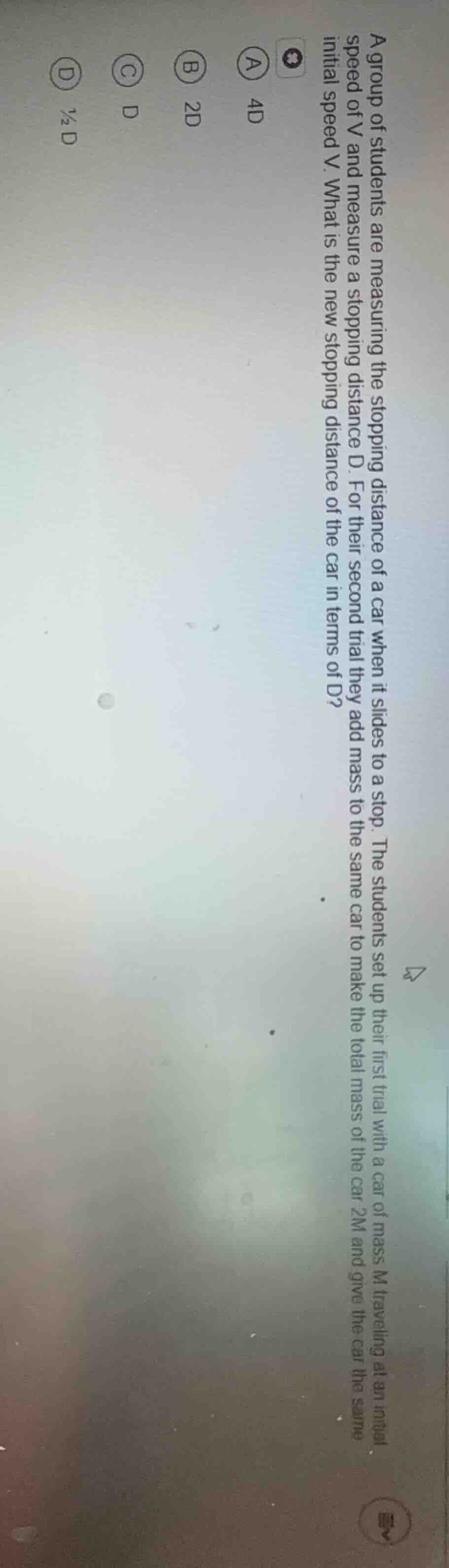
a group of students are measuring the stopping distance of a car when it slides to a stop. the students set up their first trial with a car of mass m traveling at an initial speed of v and measure a stopping distance d. for their second trial they add mass to the same car to make the total mass of the car 2m and give the car the same initial speed v. what is the new stopping distance of the car in terms of d?a 4db 2dc dd $\frac{1}{2}$d
Step1: Relate work and kinetic energy
The work done by friction equals the change in kinetic energy. For the first trial:
$$\mu MgD = \frac{1}{2}MV^2$$
Step2: Simplify to solve for D
Cancel mass $M$ from both sides:
$$\mu gD = \frac{1}{2}V^2 \implies D = \frac{V^2}{2\mu g}$$
Step3: Analyze the second trial
For mass $2M$, initial speed $V$:
$$\mu (2M)gD' = \frac{1}{2}(2M)V^2$$
Step4: Simplify to find $D'$
Cancel $2M$ from both sides:
$$\mu gD' = \frac{1}{2}V^2$$
Substitute $\frac{1}{2}V^2 = \mu gD$:
$$D' = D$$

Snap & solve any problem in the app
Get step-by-step solutions on Sovi AI
Photo-based solutions with guided steps
Explore more problems and detailed explanations
C. D