QUESTION IMAGE
Question
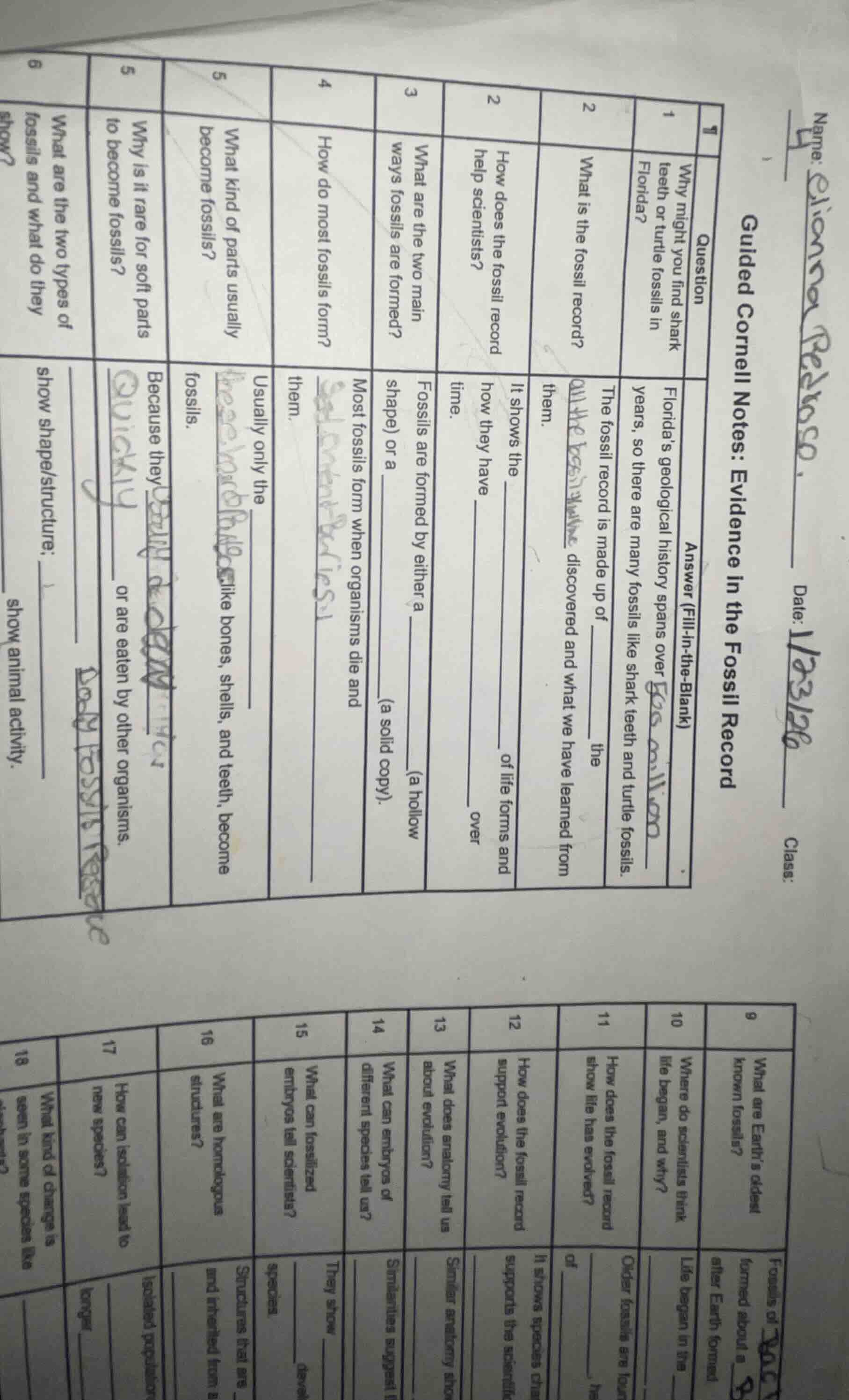
guided cornell notes: evidence in the fossil record
question
answer (fill - in - the - blank)
- why might you find shark teeth or turtle fossils in florida?
florida’s geological history spans over ______ years, so there are many fossils like shark teeth and turtle fossils.
- what is the fossil record?
the fossil record is made up of ____ the ____ discovered and what we have learned from them.
- how does the fossil record help scientists?
it shows the ____ of life forms and how they have ____ over time.
- what are the two main ways fossils are formed?
fossils are formed by either a ____ (a hollow shape) or a ____ (a solid copy).
- how do most fossils form?
most fossils form when organisms die and ______.
- what kind of parts usually become fossils?
usually only the ______ like bones, shells, and teeth, become fossils.
- why is it rare for soft parts to become fossils?
because they ______ or are eaten by other organisms.
- what are the two types of fossils and what do they show?
____ show shape/structure; ____ show animal activity.
- what are earth’s oldest known fossils?
fossils of ____ formed about ____ after earth formed.
- where do scientists think life began, and why?
life began in the ______
- how does the fossil record show life has evolved?
older fossils are found ____ of __ has ____
- how does the fossil record support evolution?
it shows species change ____ supports the scientific ____
- what does anatomy tell us about evolution?
similar anatomy shows ______
- what can embryos of different species tell us?
similarities suggest ______
- what can fossilized embryos tell scientists?
they show ______
- what are homologous structures?
structures that are ____ and inherited from a ____
- how can isolation lead to new species?
isolated populations ____ longer ____
- what kind of change is seen in some species like ______
To solve these fill - in - the - blank questions about the fossil record, we analyze each one based on the knowledge of fossils and related geological and biological concepts:
Question 1
- Explanation: Florida has a long geological history (spanning over millions of years). This long - term geological activity and the appropriate environmental conditions (like sedimentation) have led to the preservation of many fossils, including shark teeth and turtle fossils.
- Answer: millions
Question 2
- Explanation: The fossil record is a collection of all the fossils that have been discovered and the information we have gleaned from studying them. It is a comprehensive record of past life forms.
- Answer: all the fossils; information
Question 2 (second one)
- Explanation: The fossil record shows the history of life forms (their evolution, appearance, and disappearance) and how these life forms have changed over time. This helps scientists understand the process of evolution and the development of different species.
- Answer: history; changed
Question 3
- Explanation: There are two main ways to form fossils. A mold is a hollow shape that forms when an organism decays and leaves an impression in the sediment. A cast is a solid copy of the organism that forms when the mold is filled with sediment or mineral deposits.
- Answer: mold; cast
Question 4
- Explanation: Most fossils form when organisms die and are quickly buried by sediment (like sand, mud, or volcanic ash). This burial protects the organism from being destroyed by scavengers, weathering, or other processes, allowing the fossilization process to start.
- Answer: are quickly buried by sediment
Question 5
- Explanation: Usually, only the hard parts of an organism, such as bones, shells, and teeth, have a better chance of becoming fossils. Soft parts are more likely to decay or be eaten, so they rarely fossilize.
- Answer: hard parts
Question 5 (second one)
- Explanation: Soft parts of organisms decay quickly or are eaten by other organisms. Since they do not last long enough to go through the fossilization process (which requires time and specific conditions for preservation), it is rare for them to become fossils.
- Answer: decay quickly
Question 6
- Explanation: The two types of fossils are body fossils and trace fossils. Body fossils (like bones, shells) show the shape and structure of the organism. Trace fossils (like footprints, burrows) show the activity of the animal (how it moved, what it did).
- Answer: body fossils; trace fossils
Question 9
- Explanation: Earth's oldest known fossils are of cyanobacteria (or stromatolites formed by cyanobacteria). These fossils were formed about 3.5 billion years ago, long after the Earth was formed (the Earth is about 4.6 billion years old).
- Answer: cyanobacteria (or stromatolites); 3.5 billion years
Question 10
- Explanation: Scientists think life began in the ocean. The ocean provided a stable environment with the necessary chemicals, protection from UV radiation, and a medium for chemical reactions to occur, which are all conducive to the origin of life.
- Answer: ocean
Question 11
- Explanation: The fossil record shows how life has evolved by showing the order of fossils in the rock layers. Older fossils are found in lower rock layers, and younger fossils are found in upper layers. This sequence shows the changes in life forms over time, from simpler to more complex organisms.
- Answer: order of fo…

Snap & solve any problem in the app
Get step-by-step solutions on Sovi AI
Photo-based solutions with guided steps
Explore more problems and detailed explanations
To solve these fill - in - the - blank questions about the fossil record, we analyze each one based on the knowledge of fossils and related geological and biological concepts:
Question 1
- Explanation: Florida has a long geological history (spanning over millions of years). This long - term geological activity and the appropriate environmental conditions (like sedimentation) have led to the preservation of many fossils, including shark teeth and turtle fossils.
- Answer: millions
Question 2
- Explanation: The fossil record is a collection of all the fossils that have been discovered and the information we have gleaned from studying them. It is a comprehensive record of past life forms.
- Answer: all the fossils; information
Question 2 (second one)
- Explanation: The fossil record shows the history of life forms (their evolution, appearance, and disappearance) and how these life forms have changed over time. This helps scientists understand the process of evolution and the development of different species.
- Answer: history; changed
Question 3
- Explanation: There are two main ways to form fossils. A mold is a hollow shape that forms when an organism decays and leaves an impression in the sediment. A cast is a solid copy of the organism that forms when the mold is filled with sediment or mineral deposits.
- Answer: mold; cast
Question 4
- Explanation: Most fossils form when organisms die and are quickly buried by sediment (like sand, mud, or volcanic ash). This burial protects the organism from being destroyed by scavengers, weathering, or other processes, allowing the fossilization process to start.
- Answer: are quickly buried by sediment
Question 5
- Explanation: Usually, only the hard parts of an organism, such as bones, shells, and teeth, have a better chance of becoming fossils. Soft parts are more likely to decay or be eaten, so they rarely fossilize.
- Answer: hard parts
Question 5 (second one)
- Explanation: Soft parts of organisms decay quickly or are eaten by other organisms. Since they do not last long enough to go through the fossilization process (which requires time and specific conditions for preservation), it is rare for them to become fossils.
- Answer: decay quickly
Question 6
- Explanation: The two types of fossils are body fossils and trace fossils. Body fossils (like bones, shells) show the shape and structure of the organism. Trace fossils (like footprints, burrows) show the activity of the animal (how it moved, what it did).
- Answer: body fossils; trace fossils
Question 9
- Explanation: Earth's oldest known fossils are of cyanobacteria (or stromatolites formed by cyanobacteria). These fossils were formed about 3.5 billion years ago, long after the Earth was formed (the Earth is about 4.6 billion years old).
- Answer: cyanobacteria (or stromatolites); 3.5 billion years
Question 10
- Explanation: Scientists think life began in the ocean. The ocean provided a stable environment with the necessary chemicals, protection from UV radiation, and a medium for chemical reactions to occur, which are all conducive to the origin of life.
- Answer: ocean
Question 11
- Explanation: The fossil record shows how life has evolved by showing the order of fossils in the rock layers. Older fossils are found in lower rock layers, and younger fossils are found in upper layers. This sequence shows the changes in life forms over time, from simpler to more complex organisms.
- Answer: order of fossils in rock layers
Question 12
- Explanation: The fossil record supports evolution by showing the sequence of species change over time. We can see how older species gave rise to new species, how some species went extinct, and how the characteristics of species changed, all of which are in line with the theory of evolution.
- Answer: sequence of species change over time
Question 13
- Explanation: Similar anatomy (structures with the same basic form but different functions, like the forelimbs of mammals) shows that different species may have a common ancestor. These similar structures are called homologous structures, and they suggest that species evolved from a shared ancestor.
- Answer: different species may have a common ancestor
Question 14
- Explanation: Embryos of different species can tell us about their evolutionary relationships. Similarities in the early stages of embryonic development (like the presence of gill slits in the embryos of fish, reptiles, birds, and mammals) suggest that these species share a common ancestor.
- Answer: evolutionary relationships; common ancestor
Question 15
- Explanation: Fossilized embryos show the stages of development of ancient organisms. By comparing these fossilized embryos with the embryos of modern organisms, scientists can understand how the development process has evolved over time and the relationships between different species.
- Answer: the stages of development of ancient organisms
Question 16
- Explanation: Homologous structures are structures that are similar in form (structure and anatomy) but have different functions. These structures are inherited from a common ancestor, and the different functions are the result of adaptation to different environments.
- Answer: similar in form but have different functions; common ancestor
Question 17
- Explanation: Isolation (geographic, reproductive, etc.) can lead to new species through a process called speciation. When a population is isolated, different genetic mutations and adaptations occur in the isolated population compared to the original population. Over time, these differences can become so great that the isolated population becomes a new species.
- Answer: speciation (by causing different adaptations and genetic changes in isolated populations)
Question 18
- Explanation: The kind of change seen in some species over time is evolution (or gradual change). This can be in the form of changes in physical characteristics, behavior, or genetic makeup, which help the species adapt to their environment and may lead to the formation of new species.
- Answer: evolution (or gradual change)