QUESTION IMAGE
Question
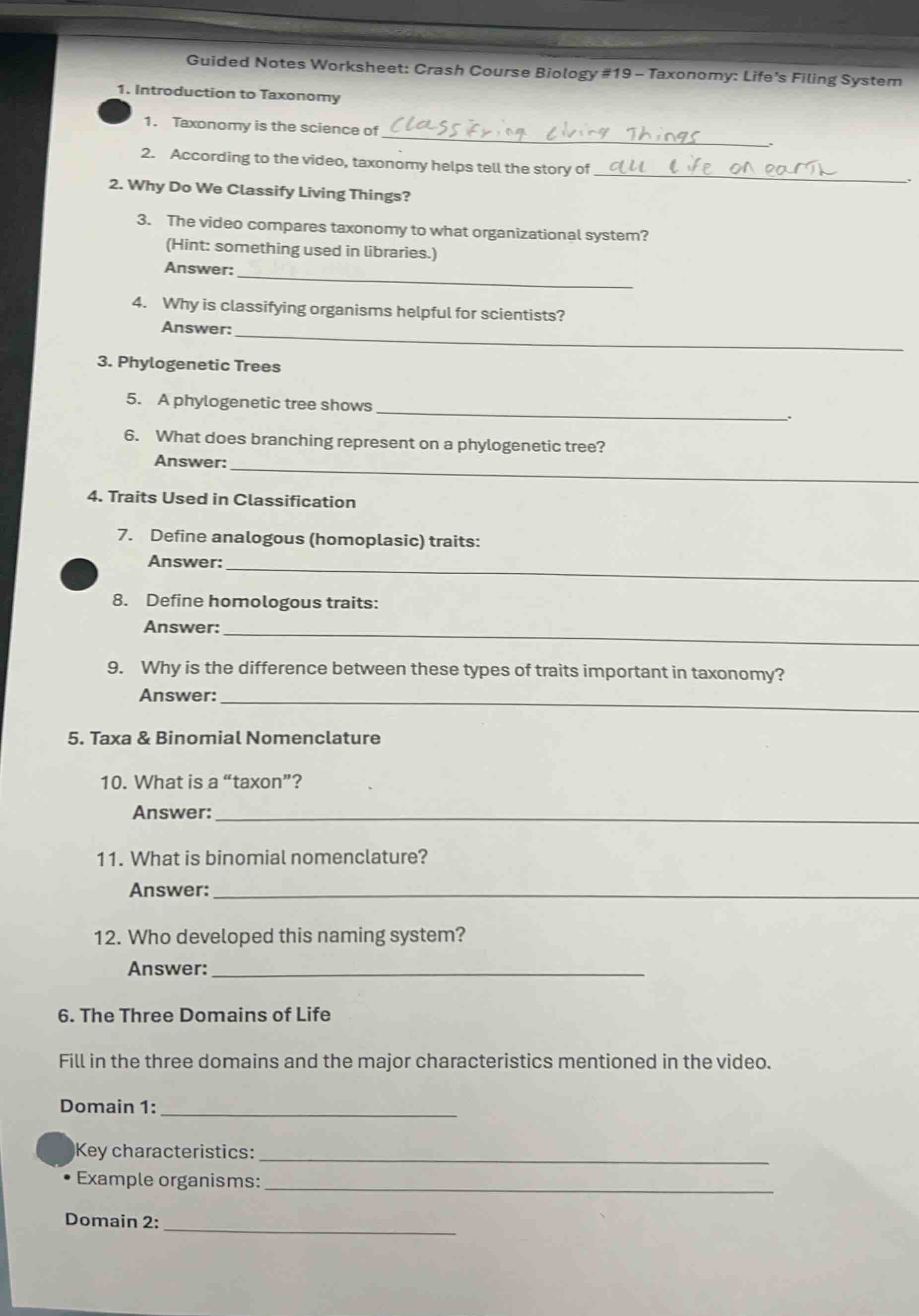
guided notes worksheet: crash course biology #19 – taxonomy: lifes filing system
- introduction to taxonomy
- taxonomy is the science of _______________.
- according to the video, taxonomy helps tell the story of _______________.
- why do we classify living things?
- the video compares taxonomy to what organizational system?
(hint: something used in libraries.)
answer: _______________
- why is classifying organisms helpful for scientists?
answer: _______________
- phylogenetic trees
- a phylogenetic tree shows _______________.
- what does branching represent on a phylogenetic tree?
answer: _______________
- traits used in classification
- define analogous (homoplasic) traits:
answer: _______________
- define homologous traits:
answer: _______________
- why is the difference between these types of traits important in taxonomy?
answer: _______________
- taxa & binomial nomenclature
- what is a “taxon”?
answer: _______________
- what is binomial nomenclature?
answer: _______________
- who developed this naming system?
answer: _______________
- the three domains of life
fill in the three domains and the major characteristics mentioned in the video.
domain 1: _______________
key characteristics: _______________
- example organisms: _______________
domain 2: _______________
All answers are based on content from Crash Course Biology #19: Taxonomy: Life's Filing System.
- Answers address core taxonomy definitions, purposes, and key concepts from the video.
- Phylogenetic tree and trait definitions align with standard biological taxonomy terminology from the lesson.
- Binomial nomenclature and domain details match the video's coverage of modern taxonomic systems.

Snap & solve any problem in the app
Get step-by-step solutions on Sovi AI
Photo-based solutions with guided steps
Explore more problems and detailed explanations
- Classifying living things
- all life on Earth
- The Dewey Decimal System
- It helps scientists organize, identify, and study organisms, and see evolutionary relationships.
- evolutionary relationships between organisms
- Branching represents the point where a single species split into two distinct, new species.
- Traits that are similar in structure/function but evolved independently in unrelated organisms (not from a common ancestor).
- Traits that are similar in structure and come from a shared common ancestor.
- Using homologous traits helps correctly map evolutionary relationships, while confusing them with analogous traits can lead to wrong taxonomic groupings.
- A taxon is any level of group in the taxonomic classification system (e.g., species, genus, family).
- Binomial nomenclature is the two-part scientific naming system for organisms, using a genus and species name.
- Carolus Linnaeus
- Domain 1: Bacteria
Key characteristics: Prokaryotic, single-celled, have cell walls with peptidoglycan
- Example organisms: E. coli, Streptococcus
- Domain 2: Archaea
Key characteristics: Prokaryotic, single-celled, live in extreme environments, cell walls without peptidoglycan
- Example organisms: Thermophiles, halophiles
- Domain 3: Eukarya
Key characteristics: Eukaryotic (cells have a nucleus and organelles), includes single-celled and multicellular organisms
- Example organisms: Humans, trees, mushrooms, amoebas