QUESTION IMAGE
Question
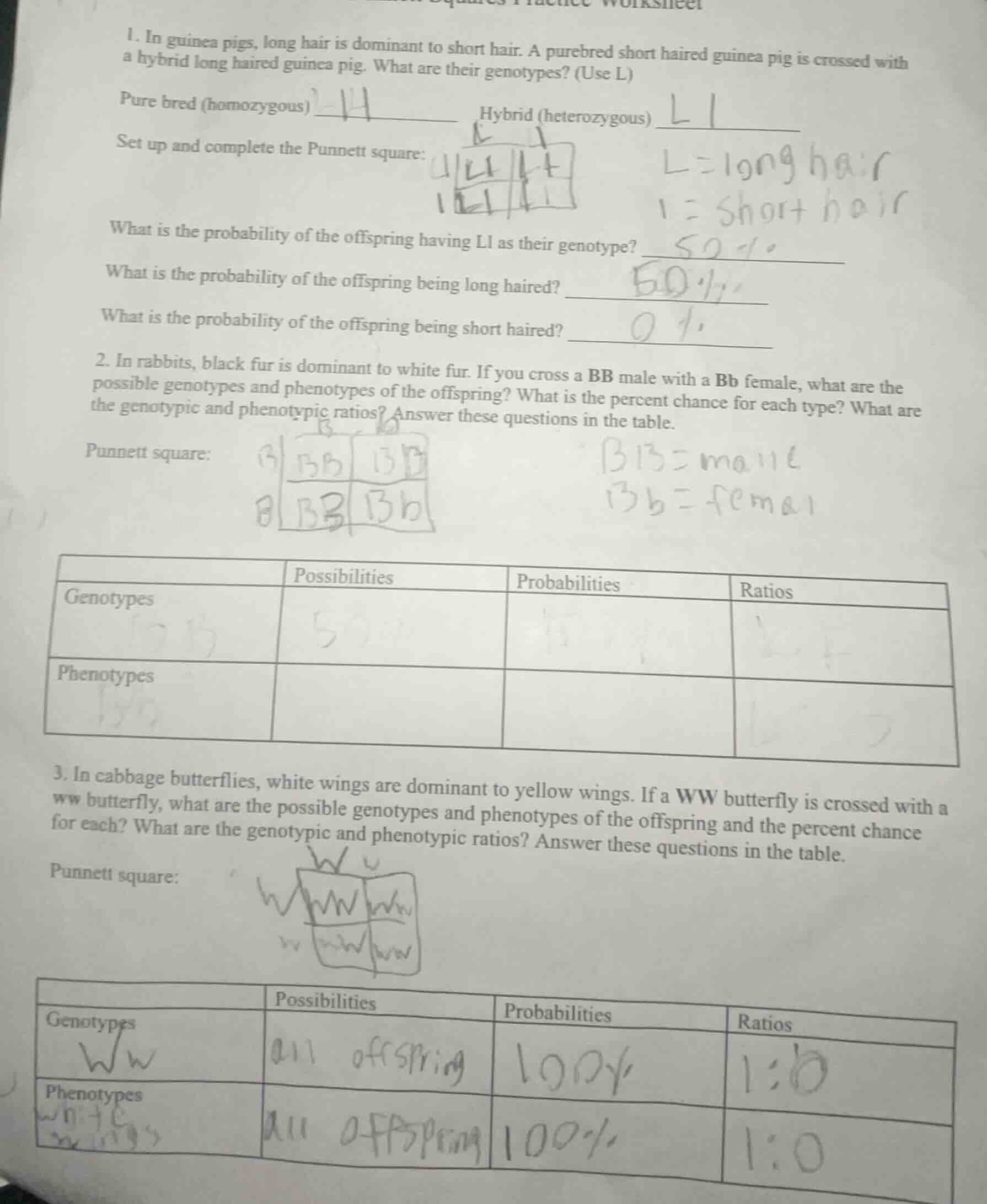
- in guinea pigs, long hair is dominant to short hair. a purebred short haired guinea pig is crossed with a hybrid long haired guinea pig. what are their genotypes? (use l)
pure bred (homozygous) ____ hybrid (heterozygous) ____
set up and complete the punnett square:
what is the probability of the offspring having ll as their genotype? ______
what is the probability of the offspring being long haired? ______
what is the probability of the offspring being short haired? ______
- in rabbits, black fur is dominant to white fur. if you cross a bb male with a bb female, what are the possible genotypes and phenotypes of the offspring? what is the percent chance for each type? what are the genotypic and phenotypic ratios? answer these questions in the table.
punnett square:
| possibilities | probabilities | ratios | |
| genotypes | |||
| phenotypes |
- in cabbage butterflies, white wings are dominant to yellow wings. if a ww butterfly is crossed with a ww butterfly, what are the possible genotypes and phenotypes of the offspring and the percent chance for each? what are the genotypic and phenotypic ratios? answer these questions in the table.
punnett square:
| possibilities | probabilities | ratios | |
| genotypes | |||
| phenotypes |
Problem 1: Guinea Pigs Hair Length Genetics
Step 1: Determine Genotypes
- Purebred (homozygous) short - haired: Since short hair is recessive (long is dominant), the genotype is \( ll \) (because purebred means both alleles are the same, and for the recessive trait, it's two recessive alleles).
- Hybrid (heterozygous) long - haired: Hybrid means one dominant and one recessive allele. Since long hair is dominant (\( L \)), the genotype is \( Ll \).
Step 2: Set Up Punnett Square
The purebred short - haired (\( ll \)) will contribute \( l \) alleles, and the hybrid long - haired (\( Ll \)) will contribute \( L \) and \( l \) alleles. The Punnett square is:
| \( L \) | \( l \) | |
|---|---|---|
| \( l \) | \( Ll \) | \( ll \) |
Step 3: Calculate Probability of \( Ll \) Genotype
There are 4 possible offspring genotypes in the Punnett square (\( Ll, ll, Ll, ll \)). The number of \( Ll \) genotypes is 2. So the probability is \( \frac{2}{4}=\frac{1}{2} = 50\% \).
Step 4: Probability of Long - Haired Offspring
Long - haired offspring have genotypes \( LL \) or \( Ll \). From the Punnett square, the long - haired genotypes (\( Ll \)) are 2 out of 4. So the probability is \( \frac{2}{4}=\frac{1}{2}=50\% \).
Step 5: Probability of Short - Haired Offspring
Short - haired offspring have genotype \( ll \). There are 2 out of 4, but wait, no: short hair is recessive, so \( ll \) is short - haired. Wait, in the Punnett square, \( ll \) occurs 2 times. But wait, the purebred is short - haired (\( ll \)) and hybrid is \( Ll \). Wait, no, the initial mistake: long hair is dominant (\( L \)), short is recessive (\( l \)). So purebred short - haired is \( ll \), hybrid long - haired is \( Ll \). The Punnett square gives \( Ll, ll, Ll, ll \). So long - haired (\( Ll \)): 2/4 = 50%, short - haired (\( ll \)): 2/4 = 50%? Wait, the original answer had 0% for short - haired, which was wrong. Let's correct:
Wait, no, the problem says "purebred short - haired" (so \( ll \)) and "hybrid long - haired" (so \( Ll \)). So when we cross \( ll \times Ll \), the Punnett square is:
Parent 1 (ll): gametes are \( l \) and \( l \)
Parent 2 (Ll): gametes are \( L \) and \( l \)
So the offspring are:
\( l\times L = Ll \)
\( l\times l = ll \)
\( l\times L = Ll \)
\( l\times l = ll \)
So long - haired (\( Ll \)): 2/4 = 50%, short - haired (\( ll \)): 2/4 = 50%. The original answer's 0% for short - haired was incorrect.
Step 1: Determine Gametes
- Male with genotype \( BB \): can only produce \( B \) gametes.
- Female with genotype \( Bb \): can produce \( B \) and \( b \) gametes.
Step 2: Set Up Punnett Square
| \( B \) | \( B \) | |
|---|---|---|
| \( b \) | \( Bb \) | \( Bb \) |
Step 3: Analyze Genotypes
- Genotype \( BB \): number of times in Punnett square = 2
- Genotype \( Bb \): number of times in Punnett square = 2
- Total number of offspring genotypes = 4
Step 4: Analyze Phenotypes
- Black fur is dominant (\( B \) is dominant over \( b \)). So both \( BB \) and \( Bb \) genotypes result in black fur. White fur would be \( bb \), but there are no \( bb \) genotypes here.
Step 5: Calculate Probabilities and Ratios
- Genotypes:
- \( BB \): Probability = \( \frac{2}{4}=50\% \), Ratio ( \( BB: Bb \)) = \( 2:2 = 1:1 \)
- \( Bb \): Probability = \( \frac{2}{4}=50\% \)
- Phenotypes:
- Black fur: All 4 offspring have black fur (since \( BB \) and \( Bb \) are black). So Probability = \( 100\% \), Ratio (black: white) = \( 4:0 = 1:0 \)
Step 1: Determine Gametes
- Butterfly with genotype \( WW \): produces \( W \) gametes.
- Butterfly with genotype \( ww \): produces \( w \) gametes.
Step 2: Set Up Punnett Square
| \( W \) | \( W \) | |
|---|---|---|
| \( w \) | \( Ww \) | \( Ww \) |
Step 3: Analyze Genotypes and Phenotypes
- Genotypes: All offspring have genotype \( Ww \) (4 out of 4). So probability = \( 100\% \), ratio ( \( Ww: \) other genotypes) = \( 4:0 = 1:0 \)
- Phenotypes: White wings are dominant (\( W \) is dominant over \( w \)). So all offspring with \( Ww \) genotype have white wings. Probability = \( 100\% \), ratio (white: yellow) = \( 4:0 = 1:0 \)

Snap & solve any problem in the app
Get step-by-step solutions on Sovi AI
Photo-based solutions with guided steps
Explore more problems and detailed explanations
(Corrected for Problem 1):
- Purebred (homozygous) short - haired genotype: \( ll \)
- Hybrid (heterozygous) long - haired genotype: \( Ll \)
- Probability of \( Ll \) genotype: \( 50\% \) (or \( \frac{1}{2} \))
- Probability of long - haired offspring: \( 50\% \) (or \( \frac{1}{2} \))
- Probability of short - haired offspring: \( 50\% \) (or \( \frac{1}{2} \))