QUESTION IMAGE
Question
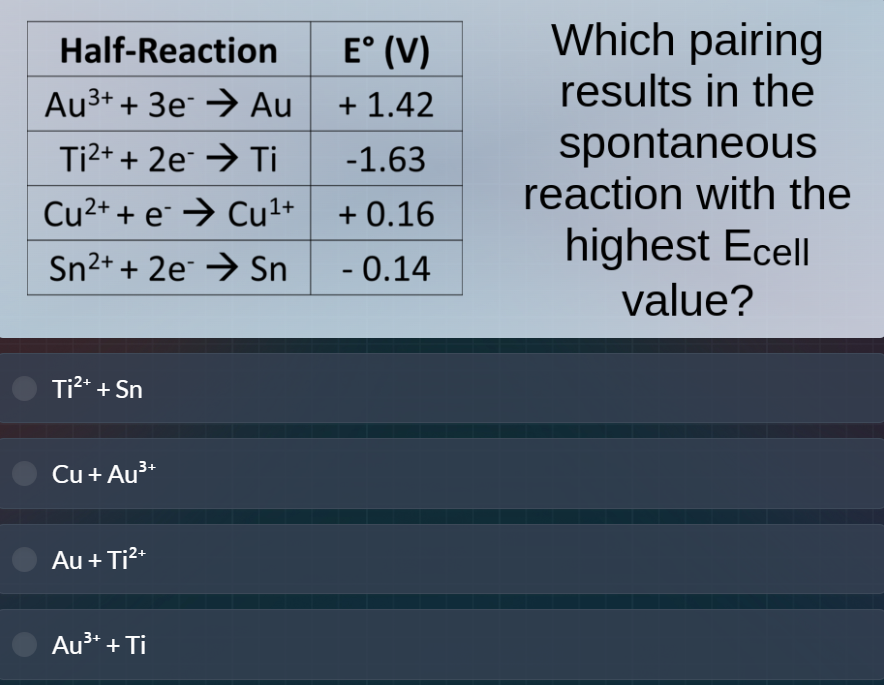
half - reaction | e° (v)
au³⁺ + 3e⁻ → au | + 1.42
ti²⁺ + 2e⁻ → ti | - 1.63
cu²⁺ + e⁻ → cu¹⁺ | + 0.16
sn²⁺ + 2e⁻ → sn | - 0.14
which pairing results in the spontaneous reaction with the highest e_cell value?
options: ti²⁺ + sn; cu + au³⁺; au + ti²⁺; au³⁺ + ti
To determine the spontaneous reaction with the highest \( E_{\text{cell}} \), we use the formula \( E_{\text{cell}} = E_{\text{cathode}} - E_{\text{anode}} \) (for reduction potentials, the cathode is the half - reaction with the higher \( E^{\circ} \), and the anode is the one with the lower \( E^{\circ} \); we reverse the anode half - reaction, so \( E_{\text{cell}}=E^{\circ}_{\text{cathode (reduction)}}+E^{\circ}_{\text{anode (oxidation)}} \), since \( E^{\circ}_{\text{oxidation}}=-E^{\circ}_{\text{reduction}} \) of the reverse reaction).
Option 1: \( \text{Ti}^{2 + }+\text{Sn} \)
- For the reaction \( \text{Ti}^{2+}+\text{Sn}\to\text{Ti}+\text{Sn}^{2+} \)
- Cathode (reduction): \( \text{Ti}^{2+}+2e^-\to\text{Ti} \), \( E^{\circ}_{\text{cathode}}=- 1.63\space V \)
- Anode (oxidation): \( \text{Sn}\to\text{Sn}^{2+}+2e^- \), the reverse of \( \text{Sn}^{2+}+2e^-\to\text{Sn} \), so \( E^{\circ}_{\text{anode}} = 0.14\space V \)
- \( E_{\text{cell}}=E^{\circ}_{\text{cathode}}+E^{\circ}_{\text{anode}}=-1.63 + 0.14=-1.49\space V \) (non - spontaneous as \( E_{\text{cell}}<0 \))
Option 2: \( \text{Cu}+\text{Au}^{3+} \)
- For the reaction \( \text{Cu}+\text{Au}^{3+}\to\text{Cu}^{+}+\text{Au} \)
- Cathode (reduction): \( \text{Au}^{3+}+3e^-\to\text{Au} \), \( E^{\circ}_{\text{cathode}} = 1.42\space V \)
- Anode (oxidation): \( \text{Cu}\to\text{Cu}^{+}+e^- \), reverse of \( \text{Cu}^{2+}+e^-\to\text{Cu}^+ \)? No, wait, for the reaction between \( \text{Cu} \) and \( \text{Au}^{3+} \), the possible reaction is \( 3\text{Cu}+ \text{Au}^{3+}\to3\text{Cu}^++\text{Au} \) (we need to balance electrons, but for \( E_{\text{cell}} \) calculation, we can use the half - reactions). The oxidation of \( \text{Cu} \) to \( \text{Cu}^+ \): \( \text{Cu}\to\text{Cu}^++e^- \), \( E^{\circ}_{\text{anode}} = 0.16\space V \) (since the reduction of \( \text{Cu}^+ \) from \( \text{Cu}^{2+} \) is \( 0.16\space V \), the oxidation of \( \text{Cu} \) to \( \text{Cu}^+ \) has \( E^{\circ}=0.16\space V \))
- \( E_{\text{cell}}=E^{\circ}_{\text{cathode}}+E^{\circ}_{\text{anode}}=1.42 + 0.16 = 1.58\space V \)
Option 3: \( \text{Au}+\text{Ti}^{2+} \)
- For the reaction \( \text{Au}+\text{Ti}^{2+}\to\text{Au}^{3+}+\text{Ti} \)
- Cathode (reduction): \( \text{Ti}^{2+}+2e^-\to\text{Ti} \), \( E^{\circ}_{\text{cathode}}=-1.63\space V \)
- Anode (oxidation): \( \text{Au}\to\text{Au}^{3+}+3e^- \), reverse of \( \text{Au}^{3+}+3e^-\to\text{Au} \), \( E^{\circ}_{\text{anode}}=- 1.42\space V \)
- \( E_{\text{cell}}=E^{\circ}_{\text{cathode}}+E^{\circ}_{\text{anode}}=-1.63-1.42=-3.05\space V \) (non - spontaneous)
Option 4: \( \text{Au}^{3+}+\text{Ti} \)
- For the reaction \( \text{Au}^{3+}+\text{Ti}\to\text{Au}+\text{Ti}^{2+} \)
- Cathode (reduction): \( \text{Au}^{3+}+3e^-\to\text{Au} \), \( E^{\circ}_{\text{cathode}} = 1.42\space V \)
- Anode (oxidation): \( \text{Ti}\to\text{Ti}^{2+}+2e^- \), reverse of \( \text{Ti}^{2+}+2e^-\to\text{Ti} \), \( E^{\circ}_{\text{anode}} = 1.63\space V \)
- \( E_{\text{cell}}=E^{\circ}_{\text{cathode}}+E^{\circ}_{\text{anode}}=1.42 + 1.63=3.05\space V \)
Comparing the \( E_{\text{cell}} \) values:
- For \( \text{Ti}^{2+}+\text{Sn} \): \( E_{\text{cell}}=-1.49\space V \)
- For \( \text{Cu}+\text{Au}^{3+} \): \( E_{\text{cell}} = 1.58\space V \)
- For \( \text{Au}+\text{Ti}^{2+} \): \( E_{\text{cell}}=-3.05\space V \)
- For \( \text{Au}^{3+}+\text{Ti} \): \( E_{\text{cell}} = 3.05\space V \)
The reaction \( \text{Au}^{3+}+\text{Ti} \) has the highest \( E_{\text{cell}} \) val…

Snap & solve any problem in the app
Get step-by-step solutions on Sovi AI
Photo-based solutions with guided steps
Explore more problems and detailed explanations
\( \text{Au}^{3+}+\text{Ti} \) (the option corresponding to \( \text{Au}^{3+}+\text{Ti} \))