QUESTION IMAGE
Question
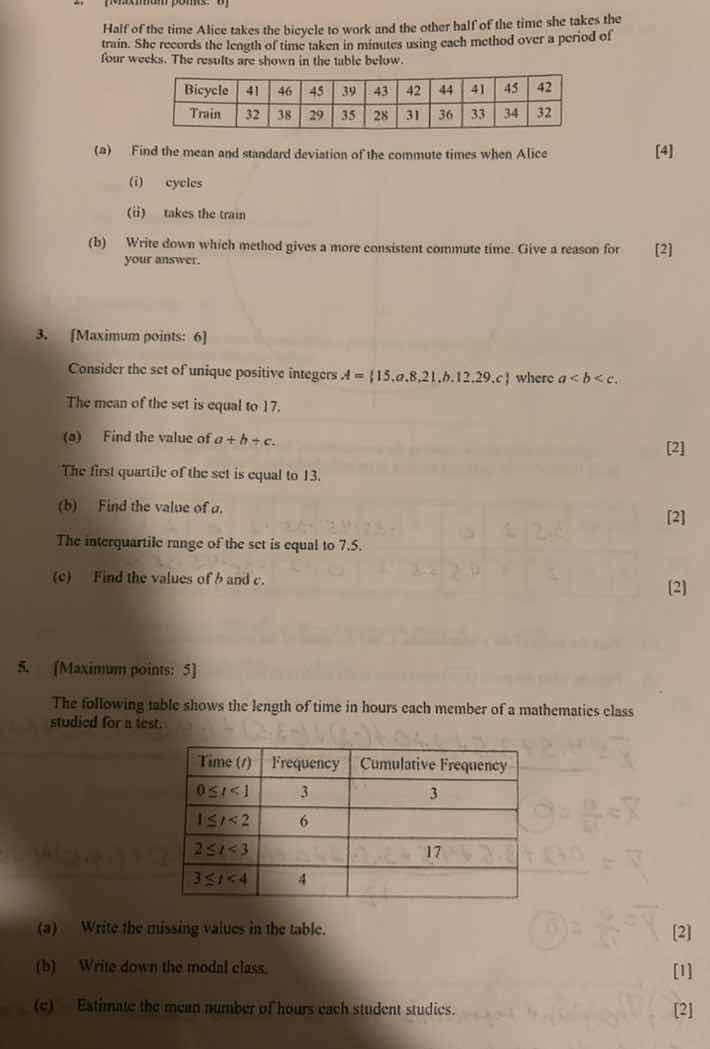
- half of the time alice takes the bicycle to work and the other half of the time she takes the train. she records the length of time taken in minutes using each method over a period of four weeks. the results are shown in the table below.
bicycle 41 46 45 39 43 42 44 41 45 42
train 32 38 29 35 28 31 36 33 34 32
(a) find the mean and standard deviation of the commute times when alice
(i) cycles
(ii) takes the train
(b) write down which method gives a more consistent commute time. give a reason for your answer.
- maximum points: 6
consider the set of unique positive integers $a=\\{15,a,8,21,b,12,29,c\\}$ where $a < b < c$.
the mean of the set is equal to 17.
(a) find the value of $a + b + c$.
the first quartile of the set is equal to 13.
(b) find the value of $a$.
the interquartile range of the set is equal to 7.5.
(c) find the values of $b$ and $c$.
- maximum points: 5
the following table shows the length of time in hours each member of a mathematics class studied for a test.
time ($t$) frequency cumulative frequency
$0\leq t<1$ 3 3
$1\leq t<2$ 6
$2\leq t<3$ 17
$3\leq t<4$ 4
(a) write the missing values in the table.
(b) write down the modal class.
(c) estimate the mean number of hours each student studies.
Problem 2
(i) Bicycle:
Step1: Calculate mean commute time
Sum all bicycle times: $41+46+45+39+43+42+44+41+45+42 = 428$
Mean $\bar{x}_b = \frac{428}{10} = 42.8$
Step2: Calculate standard deviation
First find squared differences from mean:
$(41-42.8)^2+(46-42.8)^2+(45-42.8)^2+(39-42.8)^2+(43-42.8)^2+(42-42.8)^2+(44-42.8)^2+(41-42.8)^2+(45-42.8)^2+(42-42.8)^2$
$=3.24+10.24+4.84+14.44+0.04+0.64+1.44+3.24+4.84+0.64 = 43.6$
Variance $s_b^2 = \frac{43.6}{10} = 4.36$
Standard deviation $s_b = \sqrt{4.36} \approx 2.09$
(ii) Train:
Step1: Calculate mean commute time
Sum all train times: $32+38+29+35+28+31+36+33+34+32 = 328$
Mean $\bar{x}_t = \frac{328}{10} = 32.8$
Step2: Calculate standard deviation
First find squared differences from mean:
$(32-32.8)^2+(38-32.8)^2+(29-32.8)^2+(35-32.8)^2+(28-32.8)^2+(31-32.8)^2+(36-32.8)^2+(33-32.8)^2+(34-32.8)^2+(32-32.8)^2$
$=0.64+27.04+14.44+4.84+23.04+3.24+10.24+0.04+1.44+0.64 = 85.6$
Variance $s_t^2 = \frac{85.6}{10} = 8.56$
Standard deviation $s_t = \sqrt{8.56} \approx 2.93$
(b)
Step1: Compare standard deviations
Bicycle standard deviation ($\approx2.09$) < Train standard deviation ($\approx2.93$)
(a)
Step1: Use mean to find $a+b+c$
Set has 9 elements, mean = 17. Total sum: $9 \times 17 = 153$
Sum of known values: $15+8+21+12+29 = 85$
$a+b+c = 153 - 85 = 68$
(b)
Step1: Order set and use first quartile
Ordered known values: $8,12,15,21,29$. With $a,b,c$ (unique, $a
Solve for $a$: $a+12=26 \implies a=14$ (correction: $a$ must be >12, since 12 is in set, unique. Ordered set: $8,12,a,b,c,15,21,29$? No, $n=9$, positions 1-9. $Q_1$ is value at position $\lceil\frac{9}{4}
ceil=3$ (alternate method for discrete data: $Q_1$ is the $\frac{n+1}{4}$th term = 2.5th, average of 2nd and 3rd. Let ordered set: $8,12,a,b,c,15,21,29$ is wrong, $a<b<c$ unique, so ordered set: $8,12,15,a,b,c,21,29$ no, $n=9$. Correct ordered set: $8,12,a,15,b,21,c,29$ no, $a<b<c$, unique. $Q_1=13$, so 2nd term=12, 3rd term=$a$, $\frac{12+a}{2}=13 \implies a=14$
(c)
Step1: Use interquartile range to find $b,c$
$IQR=7.5$, $Q_1=13$, so $Q_3=13+7.5=20.5$
$Q_3$ is $\frac{3(9+1)}{4}=7.5$th term, average of 7th and 8th values.
We know $a=14$, $a+b+c=68 \implies b+c=68-14=54$
Ordered set: $8,12,14,15,b,c,21,29$ (wait $n=9$, so ordered set: $8,12,14,15,b,c,21,29$ is 8 elements, add missing: $8,12,14,15,b,c,21,29$ no, original set $A=\{15,a,8,21,b,12,29,c\}$, 9 elements. Ordered: $8,12,14,15,b,c,21,29$ no, $b$ and $c$ are between 15 and 21? No, $Q_3=20.5$, so 7th term=$b$, 8th term=$c$, $\frac{b+c}{2}=20.5 \implies b+c=41$. But $a+b+c=68$, $a=14$, so $b+c=54$? No, correction: $Q_3$ for $n=9$ is the 7th term (position $\frac{3n}{4}=6.75$, round up to 7). $Q_3=20.5$? No, $IQR=Q_3-Q_1=7.5$, $Q_1=13$, so $Q_3=20.5$. So 7th term is 20, 8th term is 21? No, $b$ and $c$ are unique, $a=14$, $a+b+c=68 \implies b+c=54$. $b>15$, $c>b$, $29$ is in set. So ordered set: $8,12,14,15,b,c,21,29$ no, $n=9$, so $8,12,14,15,b,c,21,29,x$ no, original set has 9 elements: $8,12,14,15,21,29,b,c$ (missing one? No, $A=\{15,a,8,21,b,12,29,c\}$: 8 elements? No, $15,a,8,21,b,12,29,c$ is 8 elements, typo? No, it's 9: $15,a,8,21,b,12,29,c$ no, 8. Oh, $A=\{15,a,8,21,b,12,29,c\}$ is 8, so maybe $A=\{15,a,8,21,b,12,29,c,d\}$ no, problem says "set of unique positive integers $A=\{15,a,8,21,b,12,29,c\}$ where $a
(a)
Step1: Find missing cumulative frequencies
For $2≤t<3$: cumulative frequency = previous cumulative + frequency = $3+6+8=17$ (so frequency for $2≤t<3$ is $17-9=8$)
For $3≤t<4$: cumulative frequency = $17+4=21$
(b)
Step1: Identify modal class
Modal class is the class with highest frequency: $1≤t<2$ (frequency=6)
(c)
Step1: Estimate mean
Use midpoints of each class:
Midpoint for $0≤t<1$: $0.5$, $1≤t<2$: $1.5$, $2≤t<3$: $2.5$, $3≤t<4$: $3.5$
Total sum of (midpoint×frequency): $(0.5×3)+(1.5×6)+(2.5×8)+(3.5×4) = 1.5+9+20+14=44.5$
Total students: $21$
Mean = $\frac{44.5}{21}≈2.12$

Snap & solve any problem in the app
Get step-by-step solutions on Sovi AI
Photo-based solutions with guided steps
Explore more problems and detailed explanations
(i) Bicycle: Mean = $42.8$ minutes, Standard deviation $\approx2.09$ minutes
(ii) Train: Mean = $32.8$ minutes, Standard deviation $\approx2.93$ minutes
(b) The bicycle gives a more consistent commute time, because it has a smaller standard deviation, meaning commute times vary less.
---