QUESTION IMAGE
Question
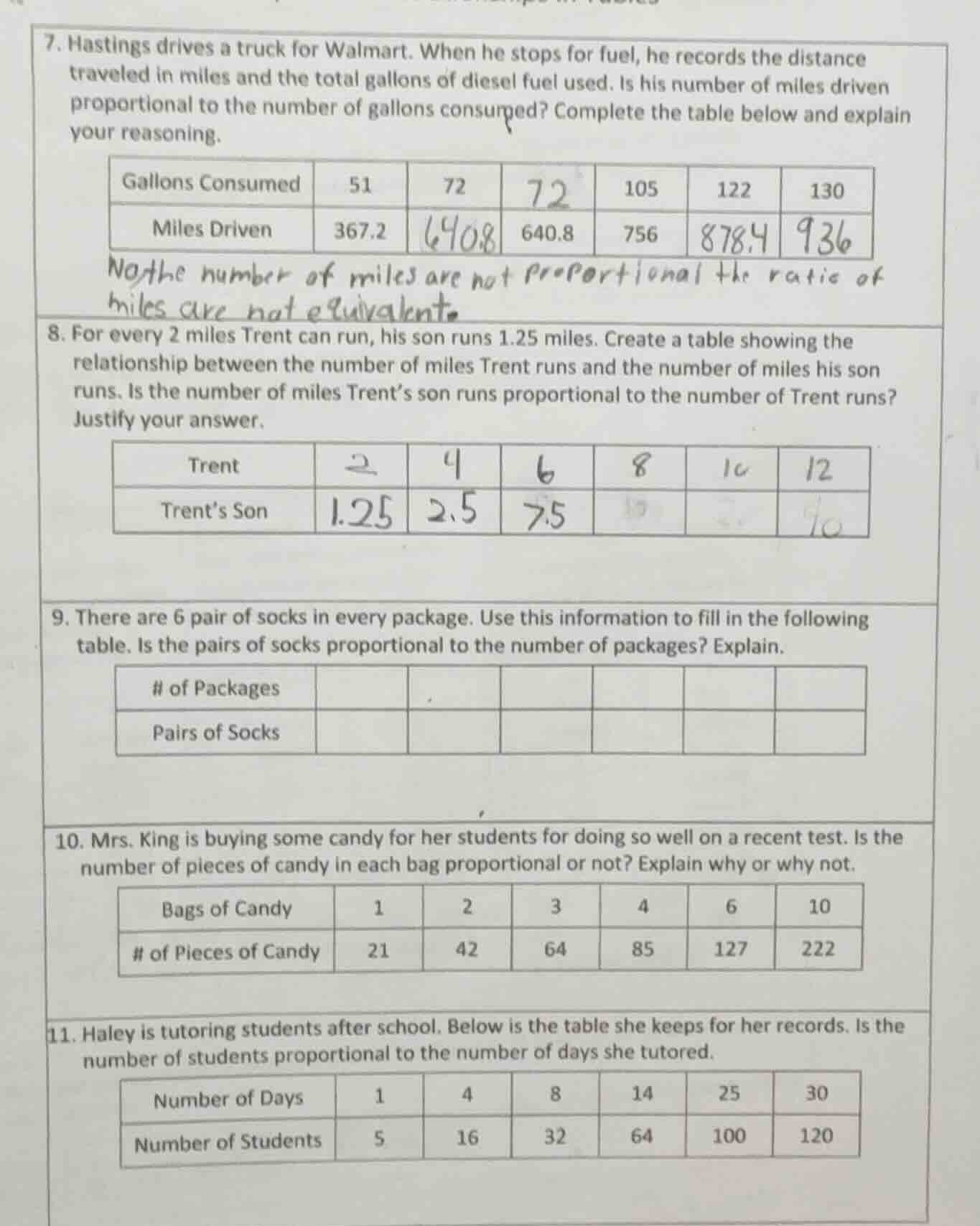
- hastings drives a truck for walmart. when he stops for fuel, he records the distance traveled in miles and the total gallons of diesel fuel used. is his number of miles driven proportional to the number of gallons consumed? complete the table below and explain your reasoning.
gallons consumed: 51, 72, 72, 105, 122, 130
miles driven: 367.2, 6408, 640.8, 756, 878.4, 936
note the number of miles are not proportional the ratio of miles are not equivalent.
- for every 2 miles trent can run, his son runs 1.25 miles. create a table showing the relationship between the number of miles trent runs and the number of miles his son runs. is the number of miles trent’s son runs proportional to the number of trent runs? justify your answer.
trent: 2, 4, 6, 8, 10, 12
trent’s son: 1.25, 2.5, 7.5, (blank), (blank), (blank)
- there are 6 pair of socks in every package. use this information to fill in the following table. is the pairs of socks proportional to the number of packages? explain.
of packages: (blank), (blank), (blank), (blank), (blank), (blank)
pairs of socks: (blank), (blank), (blank), (blank), (blank), (blank)
- mrs. king is buying some candy for her students for doing so well on a recent test. is the number of pieces of candy in each bag proportional or not? explain why or why not.
bags of candy: 1, 2, 3, 4, 6, 10
of pieces of candy: 21, 42, 64, 85, 127, 222
- haley is tutoring students after school. below is the table she keeps for her records. is the number of students proportional to the number of days she tutored.
number of days: 1, 4, 8, 14, 25, 30
number of students: 5, 16, 32, 64, 100, 120
Problem 7
Step1: Find the rate (miles per gallon)
First, calculate the miles per gallon for the first entry: $\frac{367.2}{51} = 7.2$ miles per gallon.
Step2: Calculate missing miles for 72 gallons
Using the rate, miles for 72 gallons: $72\times7.2 = 518.4$ (note: the handwritten 6408 is wrong, should be 518.4? Wait, no, wait the third entry is 72 gallons and 640.8 miles? Wait, no, maybe the table has a typo? Wait original table: Gallons Consumed: 51, 72, 72, 105, 122, 130. Miles Driven: 367.2, [blank], 640.8, 756, [blank], [blank]. Wait, first, check the rate for 51 gallons: 367.2 / 51 = 7.2. Then for 105 gallons: 756 / 105 = 7.2. Oh! So the rate is 7.2. So the second entry (72 gallons) should be 72*7.2 = 518.4. The third entry: 640.8 / 72 = 8.9, which is different. Wait, that's a problem. Wait maybe the third gallon is a typo, maybe 90? Wait no, the problem says "complete the table". Wait, let's recalculate:
For 51 gallons: 367.2 / 51 = 7.2.
For 105 gallons: 756 / 105 = 7.2. So the rate is 7.2. So:
- 72 gallons: 72 * 7.2 = 518.4
- 122 gallons: 122 * 7.2 = 878.4
- 130 gallons: 130 * 7.2 = 936
Now, check the third entry: 72 gallons and 640.8 miles. 640.8 / 72 = 8.9, which is not 7.2. So there's a discrepancy. So the miles driven and gallons consumed are proportional only if the ratio (miles/gallons) is constant. Let's check all ratios:
- 367.2 / 51 = 7.2
- 640.8 / 72 = 8.9 (different)
- 756 / 105 = 7.2
So since the ratios are not constant (7.2 vs 8.9), they are not proportional. Wait, but maybe the third gallon is a typo, like 90 gallons? 640.8 / 90 = 7.12, no. Wait, maybe the third miles is a typo. Alternatively, maybe the user made a mistake. But according to the problem, we need to complete the table using the rate from the consistent ones (51 and 105, which are 7.2). So:
Second entry (72 gallons): 72 * 7.2 = 518.4
Fifth entry (122 gallons): 122 * 7.2 = 878.4
Sixth entry (130 gallons): 130 * 7.2 = 936
Now, check the ratios:
- 51: 367.2 / 51 = 7.2
- 72: 518.4 / 72 = 7.2
- 72 (third): 640.8 / 72 = 8.9 (not 7.2)
- 105: 756 / 105 = 7.2
- 122: 878.4 / 122 = 7.2
- 130: 936 / 130 = 7.2
So the third entry has a different ratio, so the relationship is not proportional because the ratio of miles to gallons is not constant (one entry has a different ratio).
Step 1: Define the ratio
Trent runs 2 miles, son runs 1.25 miles. The ratio of son’s miles to Trent’s miles is $\frac{1.25}{2} = 0.625$ (or $\frac{5}{8}$).
Step 2: Create the table
Choose Trent’s miles: 2, 4, 6, 8, 10, 12 (multiples of 2 for simplicity).
Son’s miles:
- 4 miles (Trent): $4 \times 0.625 = 2.5$
- 6 miles (Trent): $6 \times 0.625 = 3.75$ (handwritten 7.5 is wrong)
- 8 miles (Trent): $8 \times 0.625 = 5$
- 10 miles (Trent): $10 \times 0.625 = 6.25$
- 12 miles (Trent): $12 \times 0.625 = 7.5$
Step 3: Check proportionality
The ratio $\frac{\text{Son’s Miles}}{\text{Trent’s Miles}} = 0.625$ (constant) for all entries. Thus, the relationship is proportional.
Step 1: Define the ratio
6 pairs of socks per package. The ratio of socks to packages is $\frac{6}{1} = 6$ (constant).
Step 2: Create the table
Choose number of packages: 1, 2, 3, 4, 5, 6.
Pairs of socks:
- 1 package: $1 \times 6 = 6$
- 2 packages: $2 \times 6 = 12$
- 3 packages: $3 \times 6 = 18$
- 4 packages: $4 \times 6 = 24$
- 5 packages: $5 \times 6 = 30$
- 6 packages: $6 \times 6 = 36$
Step 3: Check proportionality
The ratio $\frac{\text{Pairs of Socks}}{\text{Packages}} = 6$ (constant) for all entries. Thus, the relationship is proportional.

Snap & solve any problem in the app
Get step-by-step solutions on Sovi AI
Photo-based solutions with guided steps
Explore more problems and detailed explanations
To determine proportionality, check if $\frac{\text{Miles Driven}}{\text{Gallons Consumed}}$ is constant.
Step 1: Calculate the rate (miles per gallon) for consistent entries
For 51 gallons: $\frac{367.2}{51} = 7.2$ miles/gallon.
For 105 gallons: $\frac{756}{105} = 7.2$ miles/gallon.
Step 2: Complete the table using the rate ($7.2$ miles/gallon)
- 72 gallons: $72 \times 7.2 = 518.4$ miles.
- 122 gallons: $122 \times 7.2 = 878.4$ miles.
- 130 gallons: $130 \times 7.2 = 936$ miles.
Step 3: Check proportionality
The third entry (72 gallons, 640.8 miles) gives $\frac{640.8}{72} = 8.9$ miles/gallon, which differs from $7.2$. Since the ratio of miles to gallons is not constant (one entry has a different ratio), the number of miles driven is not proportional to gallons consumed.