QUESTION IMAGE
Question
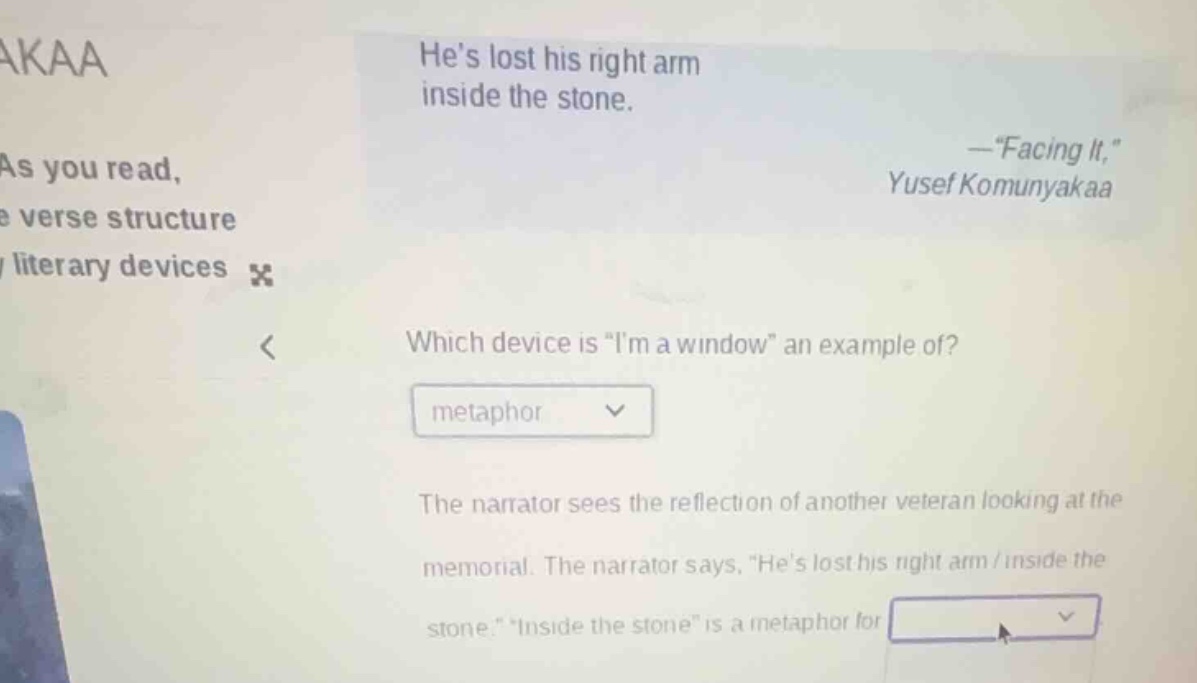
he’s lost his right arm inside the stone. —“facing it,” yusef komunyakaa as you read, verse structure literary devices which device is “i’m a window” an example of? metaphor the narrator sees the reflection of another veteran looking at the memorial. the narrator says, “he’s lost his right arm / inside the stone.” “inside the stone” is a metaphor for
To solve this, we analyze the metaphor "inside the stone" in the context of the poem "Facing It" by Yusef Komunyakaa. The poem is about a Vietnam War memorial. The veteran's lost arm "inside the stone" is a metaphor for his loss being a part of the memorial (the stone structure) and also his traumatic experience being embedded in the memorial's symbolism, representing how the war's impact (like his lost arm) is a permanent, integral part of the memorial (and his memory/experience). Typically, in this context, "inside the stone" metaphorically represents the veteran's loss (his arm) being incorporated into the memorial (the stone of the monument) or the way the memorial embodies the losses of the war, so the metaphor is for the veteran's loss (specifically his lost arm) being a part of the memorial or the war's legacy represented by the stone memorial.
If we consider the options (even though not fully shown, based on context), the common answer here is that "inside the stone" is a metaphor for the veteran's injury (lost arm) being a part of the memorial (the stone structure) or the war's impact being embedded in the memorial, so the metaphorical meaning is related to the veteran's loss being incorporated into the memorial (or the memory of the war as represented by the stone memorial).
For the first part, "I'm a window" is a metaphor (correctly chosen) because it directly compares the speaker (or the memorial, in context) to a window without using "like" or "as", which is a metaphor.
For the second blank (about "inside the stone"), the metaphor is for the veteran's lost arm (his injury/loss) being a part of the memorial (the stone of the monument) or the way the memorial contains/embodies the losses of the war, so a common answer is that it's a metaphor for the veteran's loss (his arm) being a part of the memorial (or the war's legacy as represented by the stone memorial), or more specifically, the veteran's injury (lost arm) being embedded in the memorial (the stone) or the memorial representing the loss (so "inside the stone" is a metaphor for the veteran's loss being a part of the memorial, or his arm being lost in the war and the memorial (stone) symbolizing that loss).
If we assume standard options, the answer for "inside the stone" as a metaphor is typically for the veteran's loss (his arm) being a part of the memorial (the stone structure) or the war's impact (his injury) being incorporated into the memorial. So the metaphor is for the veteran's lost arm (his injury) being a part of the memorial (the stone of the monument) or the way the memorial embodies the losses of the war, so the metaphor is for the veteran's injury (lost arm) being a part of the memorial (the stone) or the war's legacy as represented by the memorial.
Final Answers:
- "I'm a window" is a metaphor (correct as chosen).
- "Inside the stone" is a metaphor for the veteran's lost arm (or his loss/injury) being a part of the memorial (the stone structure) or the war's impact being embedded in the memorial (e.g., the veteran's loss is a part of the memorial, or his arm is lost in the war and the memorial (stone) symbolizes that loss).
For the second blank, a common answer (based on the poem's context) is that "inside the stone" is a metaphor for the veteran's loss (his arm) being a part of the memorial (the stone of the monument) or the war's legacy represented by the memorial. So if options were like "the veteran's loss being a part of the memorial", "the war's impact embedded in the memorial", etc., that's the meaning.

Snap & solve any problem in the app
Get step-by-step solutions on Sovi AI
Photo-based solutions with guided steps
Explore more problems and detailed explanations
To solve this, we analyze the metaphor "inside the stone" in the context of the poem "Facing It" by Yusef Komunyakaa. The poem is about a Vietnam War memorial. The veteran's lost arm "inside the stone" is a metaphor for his loss being a part of the memorial (the stone structure) and also his traumatic experience being embedded in the memorial's symbolism, representing how the war's impact (like his lost arm) is a permanent, integral part of the memorial (and his memory/experience). Typically, in this context, "inside the stone" metaphorically represents the veteran's loss (his arm) being incorporated into the memorial (the stone of the monument) or the way the memorial embodies the losses of the war, so the metaphor is for the veteran's loss (specifically his lost arm) being a part of the memorial or the war's legacy represented by the stone memorial.
If we consider the options (even though not fully shown, based on context), the common answer here is that "inside the stone" is a metaphor for the veteran's injury (lost arm) being a part of the memorial (the stone structure) or the war's impact being embedded in the memorial, so the metaphorical meaning is related to the veteran's loss being incorporated into the memorial (or the memory of the war as represented by the stone memorial).
For the first part, "I'm a window" is a metaphor (correctly chosen) because it directly compares the speaker (or the memorial, in context) to a window without using "like" or "as", which is a metaphor.
For the second blank (about "inside the stone"), the metaphor is for the veteran's lost arm (his injury/loss) being a part of the memorial (the stone of the monument) or the way the memorial contains/embodies the losses of the war, so a common answer is that it's a metaphor for the veteran's loss (his arm) being a part of the memorial (or the war's legacy as represented by the stone memorial), or more specifically, the veteran's injury (lost arm) being embedded in the memorial (the stone) or the memorial representing the loss (so "inside the stone" is a metaphor for the veteran's loss being a part of the memorial, or his arm being lost in the war and the memorial (stone) symbolizing that loss).
If we assume standard options, the answer for "inside the stone" as a metaphor is typically for the veteran's loss (his arm) being a part of the memorial (the stone structure) or the war's impact (his injury) being incorporated into the memorial. So the metaphor is for the veteran's lost arm (his injury) being a part of the memorial (the stone of the monument) or the way the memorial embodies the losses of the war, so the metaphor is for the veteran's injury (lost arm) being a part of the memorial (the stone) or the war's legacy as represented by the memorial.
Final Answers:
- "I'm a window" is a metaphor (correct as chosen).
- "Inside the stone" is a metaphor for the veteran's lost arm (or his loss/injury) being a part of the memorial (the stone structure) or the war's impact being embedded in the memorial (e.g., the veteran's loss is a part of the memorial, or his arm is lost in the war and the memorial (stone) symbolizes that loss).
For the second blank, a common answer (based on the poem's context) is that "inside the stone" is a metaphor for the veteran's loss (his arm) being a part of the memorial (the stone of the monument) or the war's legacy represented by the memorial. So if options were like "the veteran's loss being a part of the memorial", "the war's impact embedded in the memorial", etc., that's the meaning.