QUESTION IMAGE
Question
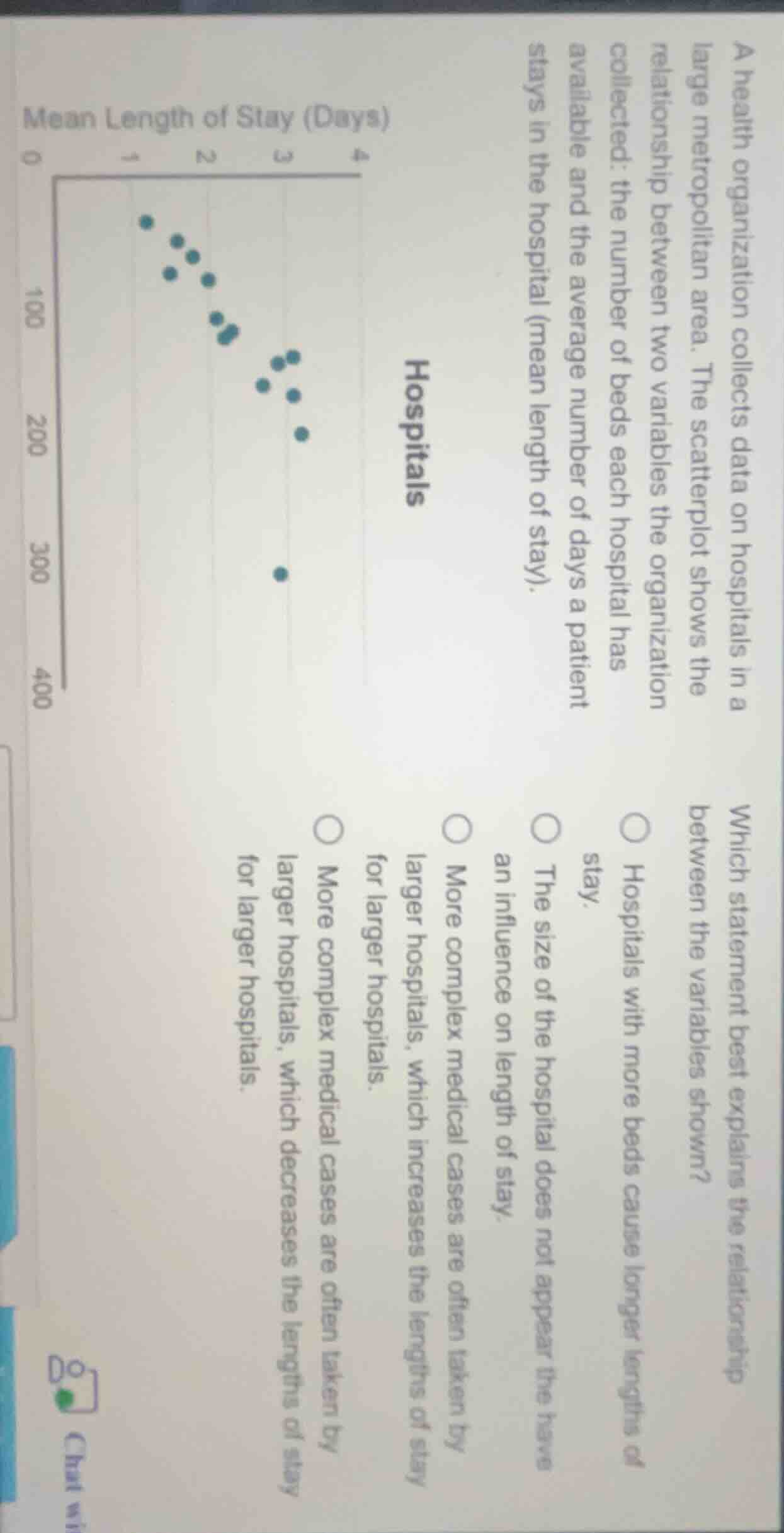
a health organization collects data on hospitals in a large metropolitan area. the scatterplot shows the relationship between two variables the organization collected: the number of beds each hospital has available and the average number of days a patient stays in the hospital (mean length of stay).
which statement best explains the relationship between the variables shown?
hospitals with more beds cause longer lengths of stay.
the size of the hospital does not appear the have an influence on length of stay.
more complex medical cases are often taken by larger hospitals, which increases the lengths of stay for larger hospitals.
more complex medical cases are often taken by larger hospitals, which decreases the lengths of stay for larger hospitals.
- Analyze the first option: Correlation does not imply causation, so "hospitals with more beds cause longer lengths of stay" is incorrect as we can't conclude causation from a scatterplot.
- Analyze the second option: The scatterplot shows a relationship (negative trend), so the size (number of beds) does have an influence, making this option wrong.
- Analyze the third option: If more complex cases (which may need more care) are in larger hospitals, we might expect longer stays, but the scatterplot shows a negative trend (more beds, shorter stay on average), so this is wrong.
- Analyze the fourth option: If larger hospitals take more complex cases but the stay length is shorter, it could be that larger hospitals are more efficient in handling complex cases, reducing stay length. This matches the negative trend in the scatterplot.

Snap & solve any problem in the app
Get step-by-step solutions on Sovi AI
Photo-based solutions with guided steps
Explore more problems and detailed explanations
More complex medical cases are often taken by larger hospitals, which decreases the lengths of stay for larger hospitals.