QUESTION IMAGE
Question
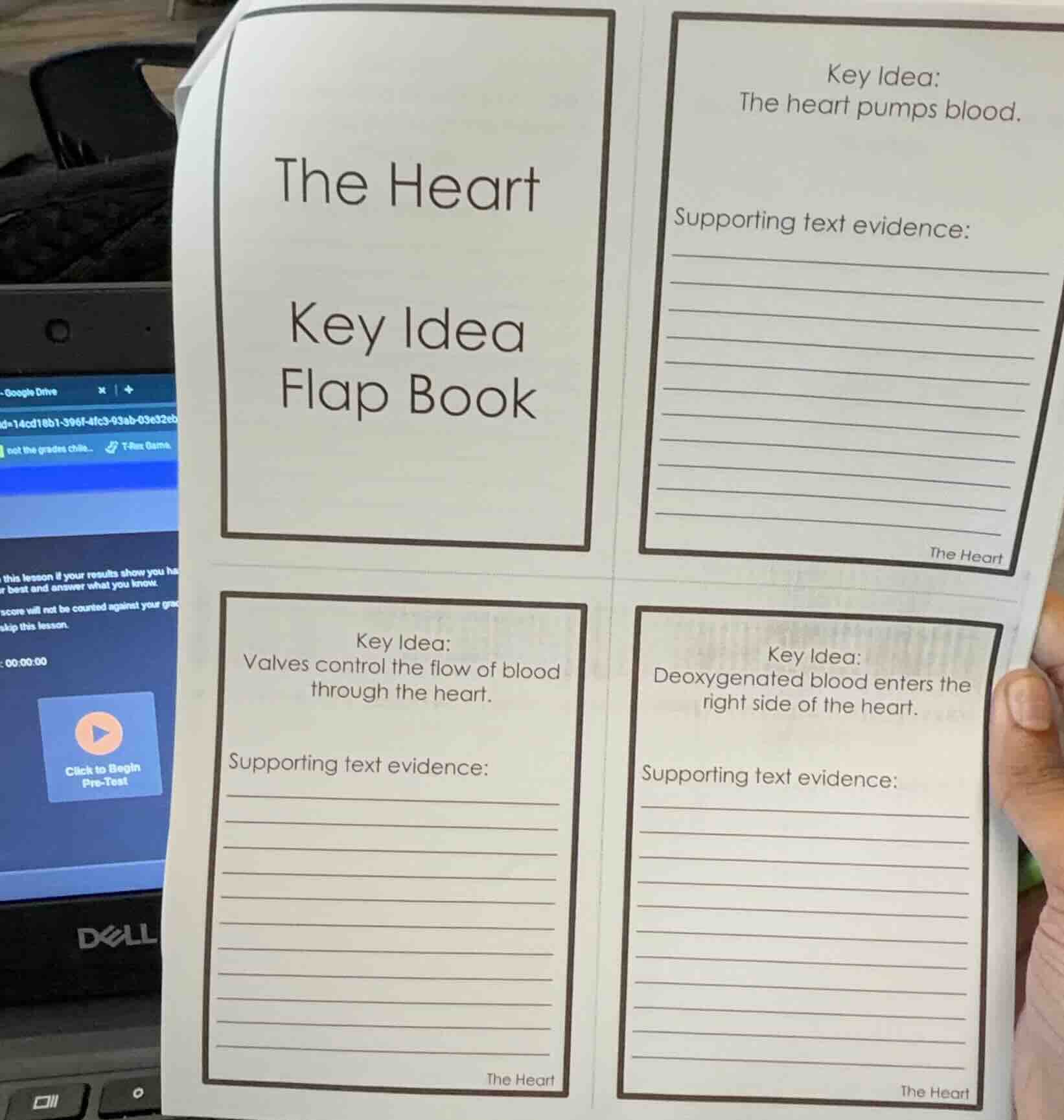
the heart
key idea
flap book
key idea:
the heart pumps blood.
supporting text evidence:
the heart
key idea:
valves control the flow of blood through the heart.
supporting text evidence:
the heart
key idea:
deoxygenated blood enters the right side of the heart.
supporting text evidence:
the heart
To fill in the supporting text evidence for each key idea about the heart, we can use basic biological knowledge about the heart's function:
1. Key Idea: The heart pumps blood.
Supporting text evidence:
The heart is a muscular organ with four chambers (left/right atria and ventricles). It contracts rhythmically: the atria contract to fill the ventricles, then the ventricles contract to push blood out—either to the lungs (from the right ventricle) or to the rest of the body (from the left ventricle). This contraction creates pressure that circulates blood through blood vessels (arteries, veins, capillaries) to deliver oxygen and nutrients and remove waste.
2. Key Idea: Valves control the flow of blood through the heart.
Supporting text evidence:
The heart has four valves: tricuspid (between right atrium and ventricle), pulmonary (between right ventricle and pulmonary artery), mitral (between left atrium and ventricle), and aortic (between left ventricle and aorta). These valves act as one - way “doors”: they open to let blood flow forward (e.g., from atrium to ventricle) and close to prevent backflow (e.g., so blood does not return to the atrium after the ventricle contracts). This ensures blood moves in a single direction through the heart’s chambers and out to the body/lungs.
3. Key Idea: Deoxygenated blood enters the right side of the heart.
Supporting text evidence:
Deoxygenated blood (low in oxygen, high in carbon dioxide) from the body’s tissues returns to the heart via two large veins called the superior and inferior vena cava. This blood empties into the right atrium. From the right atrium, it flows through the tricuspid valve into the right ventricle. The right ventricle then pumps this deoxygenated blood through the pulmonary valve and into the pulmonary artery, which carries it to the lungs to pick up oxygen (and release carbon dioxide).
If you need to condense these for the flap book (e.g., into shorter sentences), you can simplify them while keeping the key details, for example:
- For “The heart pumps blood”: “The heart’s muscles contract to push blood through vessels to the body and lungs.”
- For “Valves control blood flow”: “Heart valves open/close to stop blood from flowing backward, directing it through chambers.”
- For “Deoxygenated blood enters the right side”: “Deoxygenated blood from the body enters the right atrium via vena cava, then moves to the right ventricle.”

Snap & solve any problem in the app
Get step-by-step solutions on Sovi AI
Photo-based solutions with guided steps
Explore more problems and detailed explanations
To fill in the supporting text evidence for each key idea about the heart, we can use basic biological knowledge about the heart's function:
1. Key Idea: The heart pumps blood.
Supporting text evidence:
The heart is a muscular organ with four chambers (left/right atria and ventricles). It contracts rhythmically: the atria contract to fill the ventricles, then the ventricles contract to push blood out—either to the lungs (from the right ventricle) or to the rest of the body (from the left ventricle). This contraction creates pressure that circulates blood through blood vessels (arteries, veins, capillaries) to deliver oxygen and nutrients and remove waste.
2. Key Idea: Valves control the flow of blood through the heart.
Supporting text evidence:
The heart has four valves: tricuspid (between right atrium and ventricle), pulmonary (between right ventricle and pulmonary artery), mitral (between left atrium and ventricle), and aortic (between left ventricle and aorta). These valves act as one - way “doors”: they open to let blood flow forward (e.g., from atrium to ventricle) and close to prevent backflow (e.g., so blood does not return to the atrium after the ventricle contracts). This ensures blood moves in a single direction through the heart’s chambers and out to the body/lungs.
3. Key Idea: Deoxygenated blood enters the right side of the heart.
Supporting text evidence:
Deoxygenated blood (low in oxygen, high in carbon dioxide) from the body’s tissues returns to the heart via two large veins called the superior and inferior vena cava. This blood empties into the right atrium. From the right atrium, it flows through the tricuspid valve into the right ventricle. The right ventricle then pumps this deoxygenated blood through the pulmonary valve and into the pulmonary artery, which carries it to the lungs to pick up oxygen (and release carbon dioxide).
If you need to condense these for the flap book (e.g., into shorter sentences), you can simplify them while keeping the key details, for example:
- For “The heart pumps blood”: “The heart’s muscles contract to push blood through vessels to the body and lungs.”
- For “Valves control blood flow”: “Heart valves open/close to stop blood from flowing backward, directing it through chambers.”
- For “Deoxygenated blood enters the right side”: “Deoxygenated blood from the body enters the right atrium via vena cava, then moves to the right ventricle.”