QUESTION IMAGE
Question
heat transfer
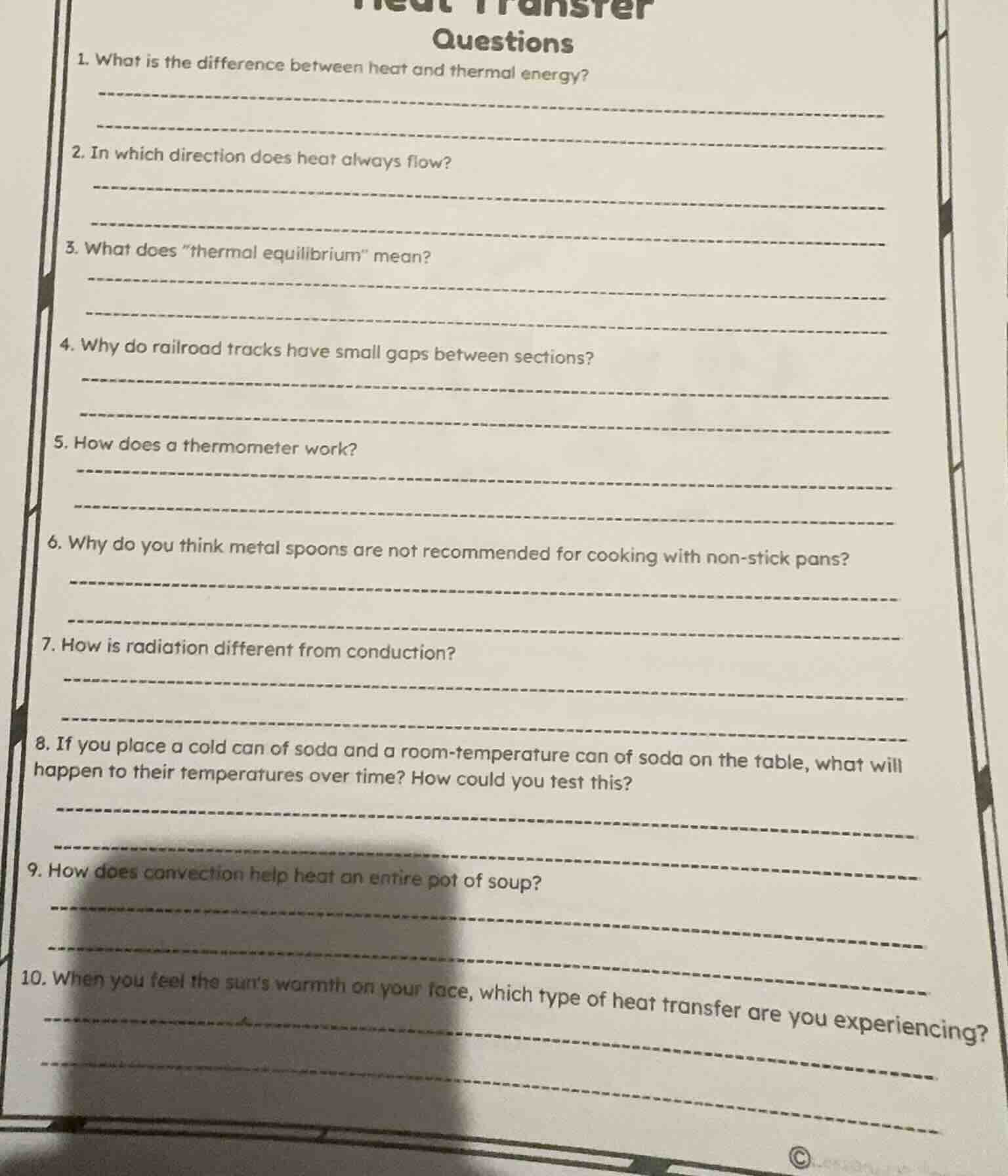
questions
- what is the difference between heat and thermal energy?
- in which direction does heat always flow?
- what does \thermal equilibrium\ mean?
- why do railroad tracks have small gaps between sections?
- how does a thermometer work?
- why do you think metal spoons are not recommended for cooking with non - stick pans?
- how is radiation different from conduction?
- if you place a cold can of soda and a room - temperature can of soda on the table, what will happen to their temperatures over time? how could you test this?
- how does convection help heat an entire pot of soup?
- when you feel the suns warmth on your face, which type of heat transfer are you experiencing?

Snap & solve any problem in the app
Get step-by-step solutions on Sovi AI
Photo-based solutions with guided steps
Explore more problems and detailed explanations
- Thermal energy is the total internal energy of a system, while heat is the transfer of that energy between systems due to a temperature difference.
- Heat always flows from a region of higher temperature to a region of lower temperature.
- Thermal equilibrium is the state in which two or more objects in physical contact reach the same temperature and no net heat transfer occurs between them.
- Gaps allow for thermal expansion of the metal in hot weather, preventing the tracks from buckling or warping.
- A thermometer works through thermal expansion; as the temperature increases, the liquid inside expands and rises up a calibrated scale.
- Metal spoons can scratch and damage the delicate non-stick coating (like Teflon) on the pan's surface.
- Radiation transfers energy through electromagnetic waves without requiring a medium, whereas conduction requires direct physical contact between particles.
- The cold can't temperature will rise and the room-temperature can't will stay the same or slightly decrease until both reach room temperature; you can test this using two thermometers.
- Convection creates currents where heated, less dense soup rises and cooler, denser soup sinks, circulating heat throughout the pot.
- Radiation.