QUESTION IMAGE
Question
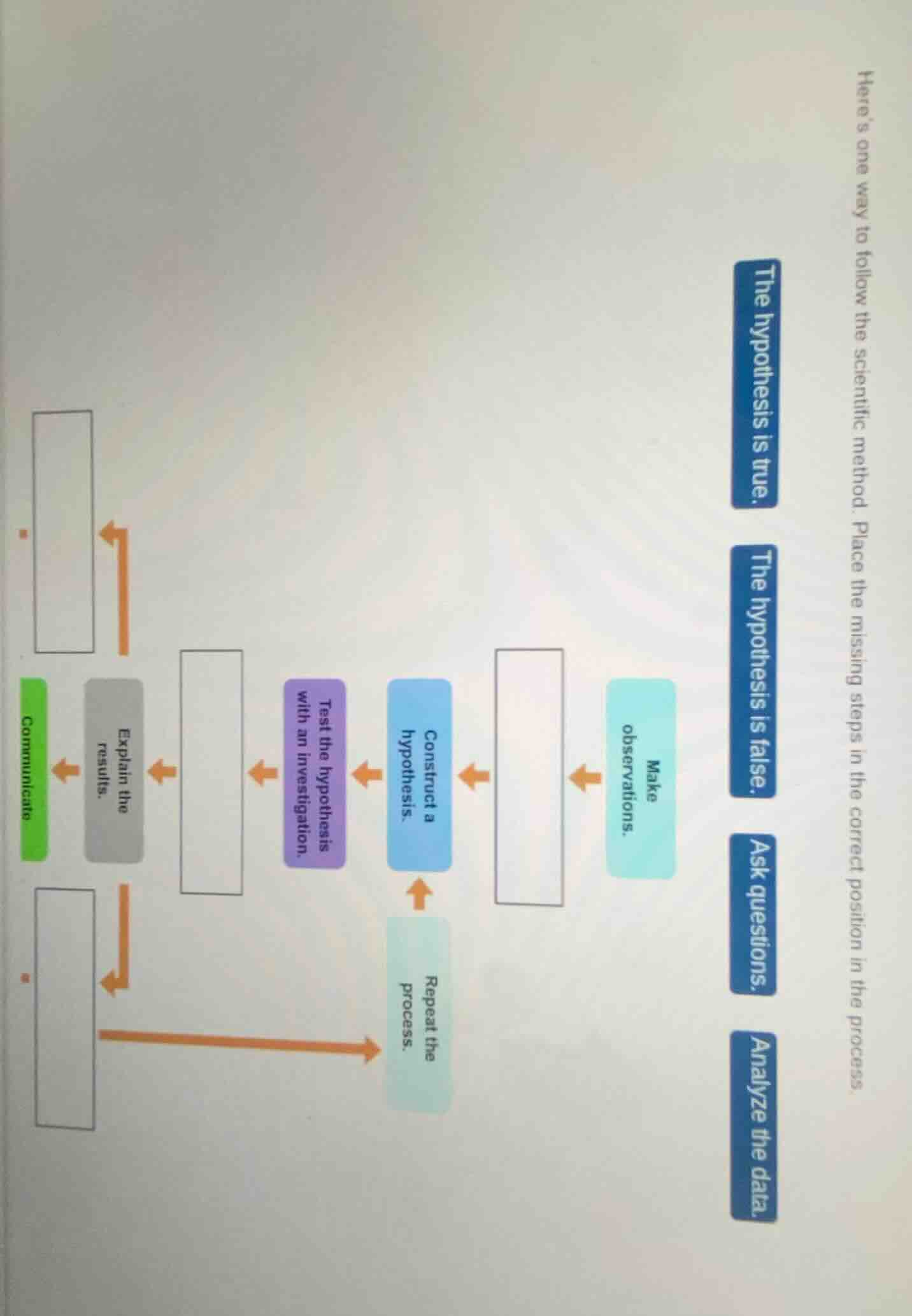
here’s one way to follow the scientific method. place the missing steps in the correct position in the process.
make observations.
construct a hypothesis.
test the hypothesis with an investigation.
explain the results.
communicate
the hypothesis is true.
the hypothesis is false.
ask questions.
analyze the data.
repeat the process.
To solve this, we recall the scientific method steps:
- First missing step (before "Construct a hypothesis"): After making observations, the next step is to Ask questions (to define the problem/query).
- Step after "Test the hypothesis": After testing, we Analyze the data (to interpret results).
- Step after "Analyze the data": Then, we determine if The hypothesis is true or false.
- Final missing steps (after "Explain the results" and "Communicate"): If the hypothesis was false, we Repeat the process (to refine or create a new hypothesis) and potentially Construct a new hypothesis (but the main repeat is key here).
Filling the blanks (from left to right, top to bottom for the empty boxes):
- Box before "Construct a hypothesis": Ask questions
- Box after "Make observations" (wait, no—"Make observations" → next is "Ask questions", then "Construct a hypothesis". Wait, the arrows: "Make observations" → [blank] → "Construct a hypothesis". So that blank is Ask questions.
- Box after "Test the hypothesis": Analyze the data
- Box after "Analyze the data": Determine if The hypothesis is true or false (so if data supports, this is the step).
- Box after "Explain the results" (top orange arrow): If hypothesis was false, we Repeat the process (bottom box) to start over.
Final Order of Missing Steps (matching the arrows):
- (After "Make observations"): Ask questions
- (After "Test the hypothesis"): Analyze the data
- (After "Analyze the data"): The hypothesis is true (if supported)
- (Bottom box, after "Communicate"): Repeat the process (if hypothesis was false, to iterate)
(Note: The exact placement depends on the diagram’s arrow flow, but the core scientific method steps are: Observe → Ask Q → Hypothesis → Test → Analyze → Conclude (true/false) → Explain → Communicate → Repeat (if false).)

Snap & solve any problem in the app
Get step-by-step solutions on Sovi AI
Photo-based solutions with guided steps
Explore more problems and detailed explanations
To solve this, we recall the scientific method steps:
- First missing step (before "Construct a hypothesis"): After making observations, the next step is to Ask questions (to define the problem/query).
- Step after "Test the hypothesis": After testing, we Analyze the data (to interpret results).
- Step after "Analyze the data": Then, we determine if The hypothesis is true or false.
- Final missing steps (after "Explain the results" and "Communicate"): If the hypothesis was false, we Repeat the process (to refine or create a new hypothesis) and potentially Construct a new hypothesis (but the main repeat is key here).
Filling the blanks (from left to right, top to bottom for the empty boxes):
- Box before "Construct a hypothesis": Ask questions
- Box after "Make observations" (wait, no—"Make observations" → next is "Ask questions", then "Construct a hypothesis". Wait, the arrows: "Make observations" → [blank] → "Construct a hypothesis". So that blank is Ask questions.
- Box after "Test the hypothesis": Analyze the data
- Box after "Analyze the data": Determine if The hypothesis is true or false (so if data supports, this is the step).
- Box after "Explain the results" (top orange arrow): If hypothesis was false, we Repeat the process (bottom box) to start over.
Final Order of Missing Steps (matching the arrows):
- (After "Make observations"): Ask questions
- (After "Test the hypothesis"): Analyze the data
- (After "Analyze the data"): The hypothesis is true (if supported)
- (Bottom box, after "Communicate"): Repeat the process (if hypothesis was false, to iterate)
(Note: The exact placement depends on the diagram’s arrow flow, but the core scientific method steps are: Observe → Ask Q → Hypothesis → Test → Analyze → Conclude (true/false) → Explain → Communicate → Repeat (if false).)