QUESTION IMAGE
Question
here are sketches of four atomic electron orbitals:
a
b
c
d
are any of them s orbitals?
yes
no
list the s orbitals, if any.
are any of them p orbitals?
yes
no
list the p orbitals, if any.
Part 1: Are any of them s orbitals?
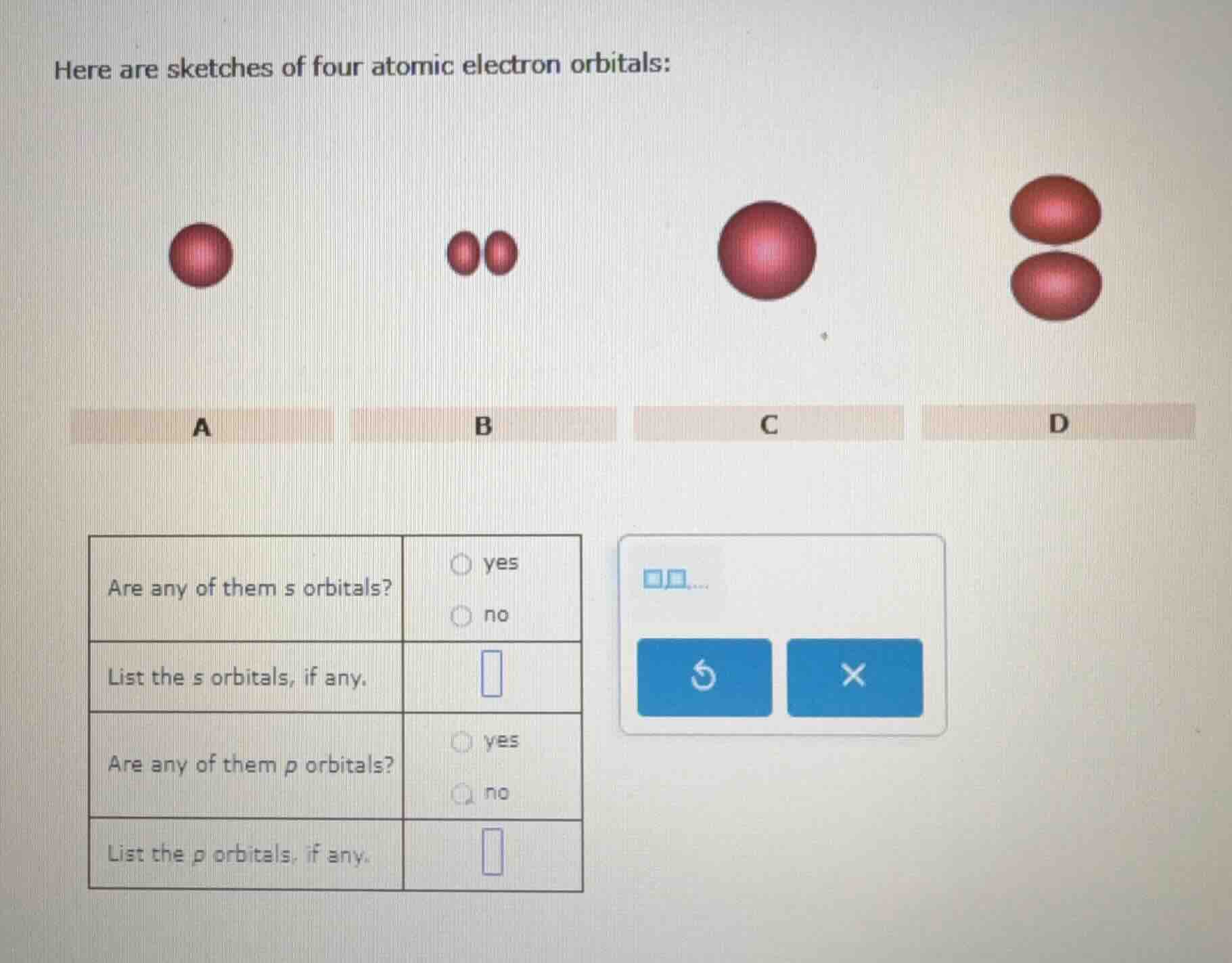
s orbitals have a spherical shape. Orbitals A and C are spherical, so the answer is "yes".
Part 2: List the s orbitals, if any.
From the sketches, A (small sphere) and C (larger sphere) are spherical (s orbital shape). So the s orbitals are A, C.
Part 3: Are any of them p orbitals?
p orbitals have a dumbbell (or two-lobed) shape. Orbitals B (two small lobes) and D (two larger lobes) match this shape, so the answer is "yes".
Part 4: List the p orbitals, if any.
Orbitals B and D have the characteristic two-lobed (dumbbell) shape of p orbitals. So the p orbitals are B, D.
Final Answers:
- Are any of them s orbitals? $\boldsymbol{\text{yes}}$
- List the s orbitals, if any: $\boldsymbol{\text{A, C}}$
- Are any of them p orbitals? $\boldsymbol{\text{yes}}$
- List the p orbitals, if any: $\boldsymbol{\text{B, D}}$

Snap & solve any problem in the app
Get step-by-step solutions on Sovi AI
Photo-based solutions with guided steps
Explore more problems and detailed explanations
Part 1: Are any of them s orbitals?
s orbitals have a spherical shape. Orbitals A and C are spherical, so the answer is "yes".
Part 2: List the s orbitals, if any.
From the sketches, A (small sphere) and C (larger sphere) are spherical (s orbital shape). So the s orbitals are A, C.
Part 3: Are any of them p orbitals?
p orbitals have a dumbbell (or two-lobed) shape. Orbitals B (two small lobes) and D (two larger lobes) match this shape, so the answer is "yes".
Part 4: List the p orbitals, if any.
Orbitals B and D have the characteristic two-lobed (dumbbell) shape of p orbitals. So the p orbitals are B, D.
Final Answers:
- Are any of them s orbitals? $\boldsymbol{\text{yes}}$
- List the s orbitals, if any: $\boldsymbol{\text{A, C}}$
- Are any of them p orbitals? $\boldsymbol{\text{yes}}$
- List the p orbitals, if any: $\boldsymbol{\text{B, D}}$