QUESTION IMAGE
Question
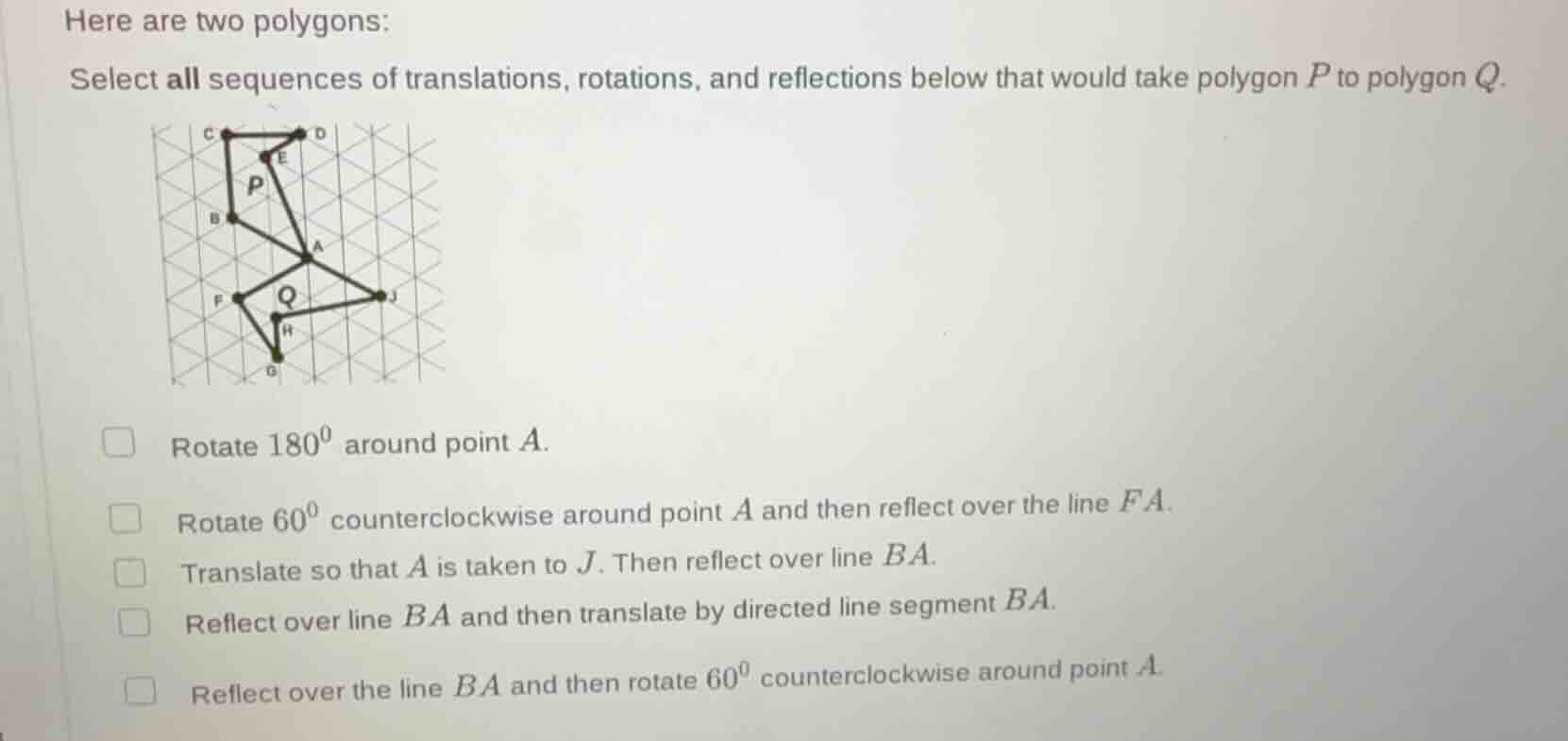
here are two polygons:
select all sequences of translations, rotations, and reflections below that would take polygon p to polygon q.
rotate $180^0$ around point a.
rotate $60^0$ counterclockwise around point a and then reflect over the line fa.
translate so that a is taken to j. then reflect over line ba.
reflect over line ba and then translate by directed line segment ba.
reflect over the line ba and then rotate $60^0$ counterclockwise around point a
Brief Explanations
- Rotate \(180^\circ\) around point \(A\): A \(180^\circ\) rotation around a point maps a figure to a position where each point is opposite the center point. For polygon \(P\) and \(Q\), rotating \(180^\circ\) around \(A\) aligns \(P\) with \(Q\) because the relative positions of vertices (like \(B\) to \(F\), \(C\) to \(G\), etc.) match after a \(180^\circ\) rotation about \(A\).
- Other options:
- Rotating \(60^\circ\) counterclockwise and reflecting over \(FA\) does not align \(P\) to \(Q\) (the angle and reflection combination is incorrect).
- Translating \(A\) to \(J\) and reflecting over \(BA\) misaligns the figure (translation and reflection sequence does not match the symmetry).
- Reflecting over \(BA\) then translating by \(BA\) or reflecting then rotating \(60^\circ\) also do not produce the correct transformation, as the symmetry and orientation of \(Q\) relative to \(P\) is a \(180^\circ\) rotation about \(A\).

Snap & solve any problem in the app
Get step-by-step solutions on Sovi AI
Photo-based solutions with guided steps
Explore more problems and detailed explanations
\(\boldsymbol{\text{Rotate } 180^\circ \text{ around point } A}\) (the checkbox next to this option should be selected).