QUESTION IMAGE
Question
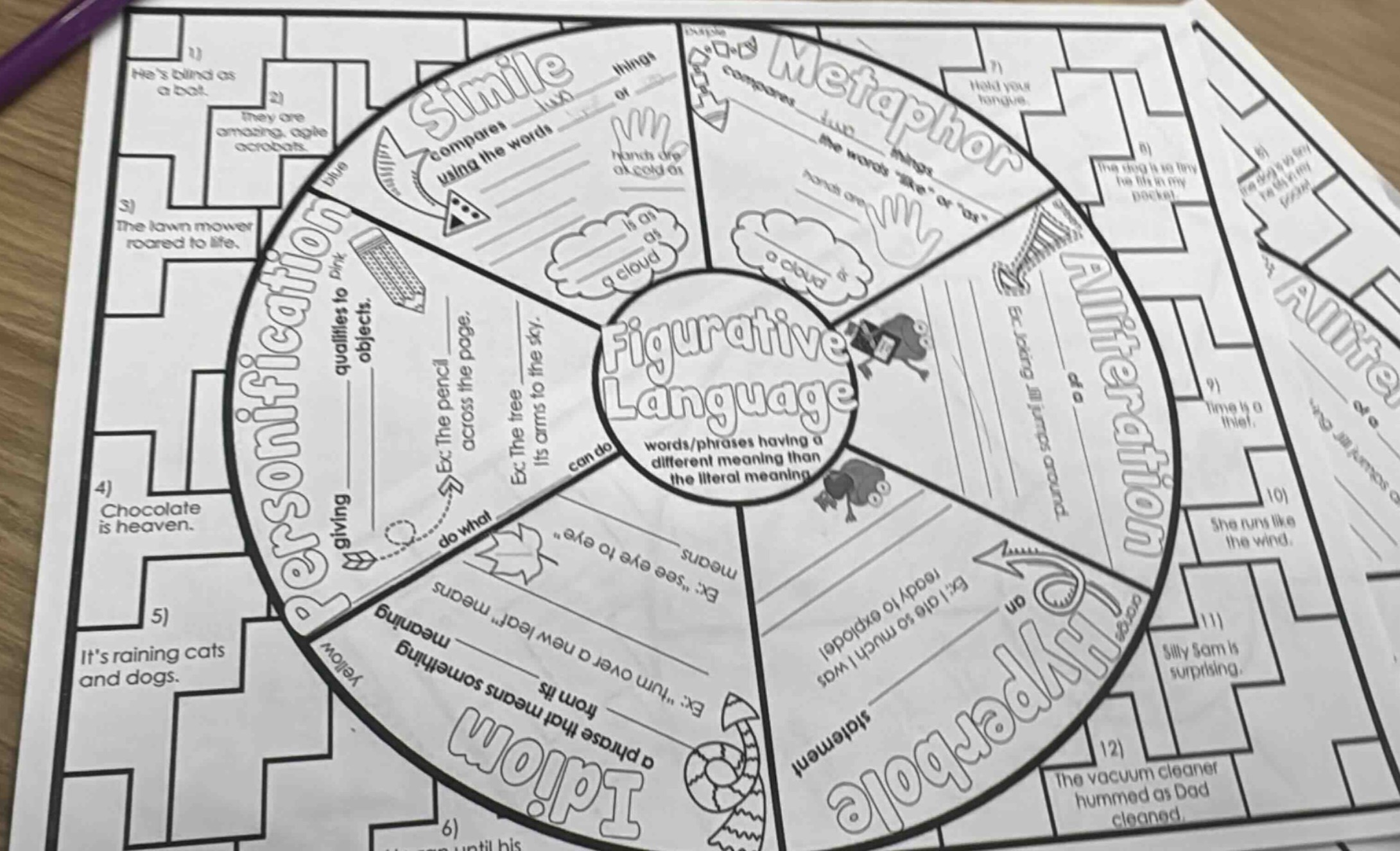
- hes blind as a bat.
- they are amazing, apple acrobats.
- the lawn mower roared to life.
- chocolate is heaven.
- its raining cats and dogs.
- partially visible text
- hold your tongue.
- the dog is so tiny he fits in my pocket.
- time is a thief.
- she runs like the wind.
- silly sam is surprising.
- the vacuum cleaner hummed as dad cleaned.
(in the center circle: figurative language
words/phrases having a
different meaning than
the literal meaning)
segments around the center:
- simile: compares two things using the words of
ex: hands are as cold as ______
____ is as ____ as a cloud
- metaphor: compares two things
the words \like\ or \as\
ex: a cloud is a cloud? (maybe typo, or other example)
- alliteration: text about alliteration, with example like \silly sam...\
- hyperbole: a statement text about hyperbole, example: \i ate so much i was ready to explode!\
- idiom: a phrase that means something from its ______ meaning
ex: \turn over a new leaf\ means ______
ex: \see eye to eye\ means ______
- personification: giving ______ qualities to objects
ex: the pencil ______ across the page.
ex: the tree ______ its arms to the sky.
(colors: blue, pink, yellow etc. on the segments)
To analyze the figurative language in the given sentences, we can use the definitions from the wheel:
1. He’s blind as a bat.
- Type: Simile (compares two things with “as”).
2. They are amazing, apple acrobats.
- Type: Metaphor (compares them to “apple acrobats” without “like” or “as”).
3. The lawn mower roared to life.
- Type: Personification (gives the lawn mower human-like action “roared”).
4. Chocolate is heaven.
- Type: Metaphor (compares chocolate to “heaven” without “like” or “as”).
5. It’s raining cats and dogs.
- Type: Idiom (a common phrase with a non-literal meaning: heavy rain).
6. (Incomplete, but assume context: e.g., “He ran until his legs were jelly”)
- Type: Metaphor (compares legs to “jelly” for effect).
7. Hold your tongue.
- Type: Idiom (non-literal: “stop talking”).
8. The dog is so tiny he fits in my pocket.
- Type: Hyperbole (exaggeration: a dog can’t literally fit in a pocket).
9. Time is a thief.
- Type: Metaphor (compares time to a “thief” without “like” or “as”).
10. She runs like the wind.
- Type: Simile (compares her running to “the wind” with “like”).
11. Silly Sam is surprising.
- Type: Alliteration (repetition of initial “s” sound: Silly Sam surprising).
12. The vacuum cleaner hummed as Dad cleaned.
- Type: Personification (gives the vacuum cleaner human-like action “hummed”).
Each sentence uses a specific type of figurative language (simile, metaphor, personification, idiom, hyperbole, or alliteration) as defined in the wheel.

Snap & solve any problem in the app
Get step-by-step solutions on Sovi AI
Photo-based solutions with guided steps
Explore more problems and detailed explanations
To analyze the figurative language in the given sentences, we can use the definitions from the wheel:
1. He’s blind as a bat.
- Type: Simile (compares two things with “as”).
2. They are amazing, apple acrobats.
- Type: Metaphor (compares them to “apple acrobats” without “like” or “as”).
3. The lawn mower roared to life.
- Type: Personification (gives the lawn mower human-like action “roared”).
4. Chocolate is heaven.
- Type: Metaphor (compares chocolate to “heaven” without “like” or “as”).
5. It’s raining cats and dogs.
- Type: Idiom (a common phrase with a non-literal meaning: heavy rain).
6. (Incomplete, but assume context: e.g., “He ran until his legs were jelly”)
- Type: Metaphor (compares legs to “jelly” for effect).
7. Hold your tongue.
- Type: Idiom (non-literal: “stop talking”).
8. The dog is so tiny he fits in my pocket.
- Type: Hyperbole (exaggeration: a dog can’t literally fit in a pocket).
9. Time is a thief.
- Type: Metaphor (compares time to a “thief” without “like” or “as”).
10. She runs like the wind.
- Type: Simile (compares her running to “the wind” with “like”).
11. Silly Sam is surprising.
- Type: Alliteration (repetition of initial “s” sound: Silly Sam surprising).
12. The vacuum cleaner hummed as Dad cleaned.
- Type: Personification (gives the vacuum cleaner human-like action “hummed”).
Each sentence uses a specific type of figurative language (simile, metaphor, personification, idiom, hyperbole, or alliteration) as defined in the wheel.