QUESTION IMAGE
Question
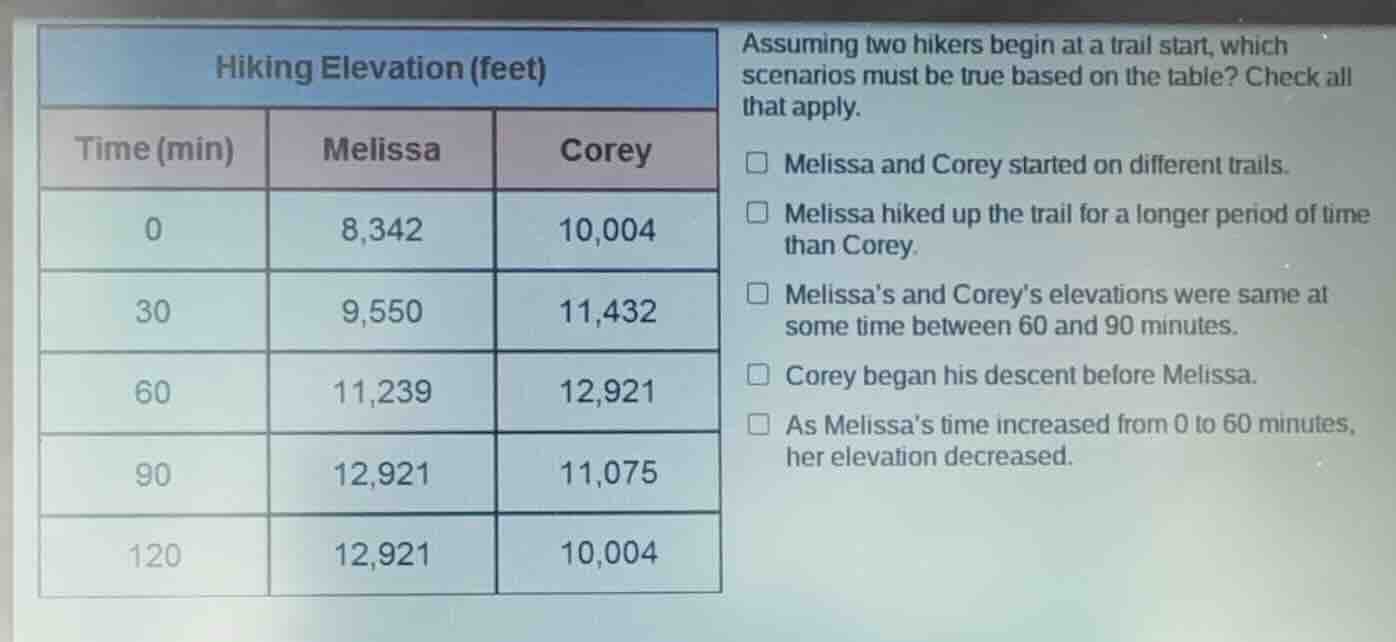
hiking elevation (feet)time (min)\tmelissa\tcorey0\t8,342\t10,00430\t9,550\t11,43260\t11,239\t12,92190\t12,921\t11,075120\t12,921\t10,004assuming two hikers begin at a trail start, which scenarios must be true based on the table? check all that apply.☐ melissa and corey started on different trails.☐ melissa hiked up the trail for a longer period of time than corey.☐ melissas and coreys elevations were same at some time between 60 and 90 minutes.☐ corey began his descent before melissa.☐ as melissas time increased from 0 to 60 minutes, her elevation decreased.
Brief Explanations
- At time 0 (start), Melissa's elevation is 8,342 ft and Corey's is 10,004 ft, so they started on different trails.
- At 60 minutes, Melissa is at 11,239 ft (lower than Corey's 12,921 ft); at 90 minutes, Melissa is at 12,921 ft (higher than Corey's 11,075 ft). By the Intermediate Value Theorem, their elevations must have crossed (been equal) between 60-90 minutes.
- Corey's elevation peaks at 60 minutes (12,921 ft) and drops after that, while Melissa's elevation increases until 90 minutes, so Corey began descending first.
- Melissa's elevation increases from 8,342 to 11,239 ft between 0-60 minutes, so the final statement is false.
- We only have elevation at 30-minute intervals; we cannot confirm Melissa hiked uphill longer than Corey, so this is not a must-be-true statement.

Snap & solve any problem in the app
Get step-by-step solutions on Sovi AI
Photo-based solutions with guided steps
Explore more problems and detailed explanations
- Melissa and Corey started on different trails.
- Melissa's and Corey's elevations were same at some time between 60 and 90 minutes.
- Corey began his descent before Melissa.