QUESTION IMAGE
Question
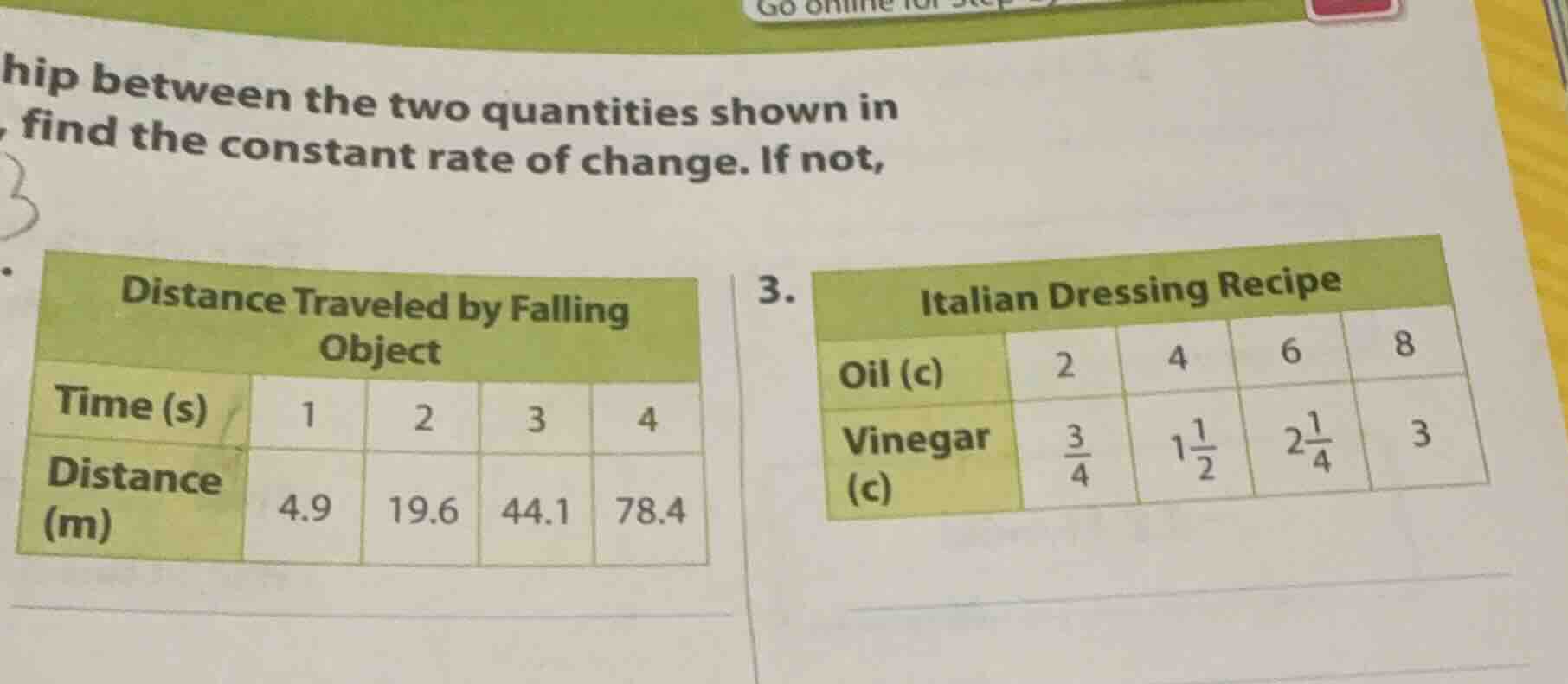
hip between the two quantities shown in, find the constant rate of change. if not,
distance traveled by falling object
time (s) 1 2 3 4
distance (m) 4.9 19.6 44.1 78.4
- italian dressing recipe
oil (c) 2 4 6 8
vinegar (c) \\(\frac{3}{4}\\) \\(1\frac{1}{2}\\) \\(2\frac{1}{4}\\) 3
For "Distance Traveled by Falling Object" table:
Step1: Recall rate of change formula
The rate of change between two points \((x_1,y_1)\) and \((x_2,y_2)\) is \(\frac{y_2 - y_1}{x_2 - x_1}\). Here, \(x\) is time (s) and \(y\) is distance (m).
Step2: Calculate rate between \(t = 1\) and \(t = 2\)
\(x_1 = 1,y_1 = 4.9\); \(x_2 = 2,y_2 = 19.6\). Rate \(=\frac{19.6 - 4.9}{2 - 1}=\frac{14.7}{1}=14.7\)
Step3: Calculate rate between \(t = 2\) and \(t = 3\)
\(x_1 = 2,y_1 = 19.6\); \(x_2 = 3,y_2 = 44.1\). Rate \(=\frac{44.1 - 19.6}{3 - 2}=\frac{24.5}{1}=24.5\)
Wait, this is inconsistent? Wait, no, maybe I made a mistake. Wait, the formula for distance of a falling object is \(d=\frac{1}{2}gt^2\), where \(g = 9.8\ m/s^2\). So the rate of change of distance (which is velocity) for a falling object under gravity is \(v = gt\), which is not constant (it's increasing). But wait, the rate of change of distance (the average rate between intervals) – wait, let's recalculate the differences correctly.
Wait, \(19.6 - 4.9 = 14.7\), \(44.1 - 19.6 = 24.5\), \(78.4 - 44.1 = 34.3\). The differences between distances: \(14.7, 24.5, 34.3\). The time intervals are 1s each. So the rate of change (average velocity over each second) is increasing. But maybe the problem is about the rate of change of distance with respect to time, but actually, the distance - time relationship for free fall is quadratic, so the rate of change (slope of secant line) is not constant? Wait, no, maybe I misread. Wait, let's check the values again. \(4.9=\frac{1}{2}\times9.8\times1^2\), \(19.6=\frac{1}{2}\times9.8\times2^2\), \(44.1=\frac{1}{2}\times9.8\times3^2\), \(78.4=\frac{1}{2}\times9.8\times4^2\). So the distance is a quadratic function of time. The rate of change of distance (which is velocity) is \(v = gt\), so it's a linear function of time. But the rate of change of distance with respect to time (the derivative) is \(v = gt\), which is not constant. But the problem says "find the constant rate of change. If not,..." Wait, maybe the problem is about the rate of change of distance with respect to time squared? No, the table is time (t) and distance (d). Let's check the ratio of \(d/t^2\): \(4.9/1 = 4.9\), \(19.6/4 = 4.9\), \(44.1/9 = 4.9\), \(78.4/16 = 4.9\). Ah! So \(d = 4.9t^2\). So the rate of change of \(d\) with respect to \(t^2\) is constant (4.9 m/s² per s²? No, \(d\) vs \(t^2\) has a constant rate of change of 4.9 m/s² (since \(d = 4.9t^2\), so \(\frac{\Delta d}{\Delta t^2}=4.9\)). But the problem says "rate of change" between the two quantities (time and distance). So if we consider the rate of change of distance with respect to time, it's not constant (since velocity increases). But if we consider the rate of change of distance with respect to \(t^2\), it is constant (4.9 m/s²). But the problem says "the two quantities shown" (time and distance). So the rate of change of distance with respect to time is not constant (since the differences in distance over 1s intervals are 14.7, 24.5, 34.3, which are increasing). Wait, maybe I made a mistake in the first calculation. Let's use the formula for rate of change: \(\frac{\Delta d}{\Delta t}\).
For \(t = 1\) to \(t = 2\): \(\frac{19.6 - 4.9}{2 - 1}=14.7\)
For \(t = 2\) to \(t = 3\): \(\frac{44.1 - 19.6}{3 - 2}=24.5\)
For \(t = 3\) to \(t = 4\): \(\frac{78.4 - 44.1}{4 - 3}=34.3\)
These are not equal, so the rate of change of distance with respect to time is not constant. But wait, the problem might have a typo, or maybe I misinterpret. Alternatively, maybe the question is about the rate of change of distance with respect to \(t^2\), which is constant. Let's ch…
Step1: Recall rate of change formula
Rate of change of vinegar (c) with respect to oil (c) is \(\frac{\Delta \text{Vinegar}}{\Delta \text{Oil}}\).
Step2: Calculate rate between Oil = 2 and Oil = 4
\(\Delta \text{Oil}=4 - 2 = 2\), \(\Delta \text{Vinegar}=1\frac{1}{2}-\frac{3}{4}=\frac{3}{2}-\frac{3}{4}=\frac{3}{4}\). Rate \(=\frac{\frac{3}{4}}{2}=\frac{3}{8}\)? Wait, no, \(\frac{3}{4}\) to \(1\frac{1}{2}\) is \(\frac{3}{4}\) increase (since \(1\frac{1}{2}=\frac{6}{4}\), \(\frac{6}{4}-\frac{3}{4}=\frac{3}{4}\)) over 2 cups of oil. Wait, no, let's use fractions properly. \(1\frac{1}{2}=\frac{3}{2}\), \(\frac{3}{4}\) to \(\frac{3}{2}\) is \(\frac{3}{2}-\frac{3}{4}=\frac{3}{4}\). Oil increases by \(4 - 2 = 2\). So rate \(=\frac{\frac{3}{4}}{2}=\frac{3}{8}\)? No, wait, rate of change is \(\frac{\text{Vinegar}_2 - \text{Vinegar}_1}{\text{Oil}_2 - \text{Oil}_1}\).
For Oil = 2 (c) and Vinegar = \(\frac{3}{4}\) (c); Oil = 4 (c) and Vinegar = \(1\frac{1}{2}=\frac{3}{2}\) (c):
Rate \(=\frac{\frac{3}{2}-\frac{3}{4}}{4 - 2}=\frac{\frac{3}{4}}{2}=\frac{3}{8}\)? Wait, no, \(\frac{3}{2}-\frac{3}{4}=\frac{6 - 3}{4}=\frac{3}{4}\), divided by 2 (oil change) is \(\frac{3}{8}\)? But let's check another pair.
Oil = 4 to 6: Oil change = \(6 - 4 = 2\), Vinegar change = \(2\frac{1}{4}-\frac{3}{2}=\frac{9}{4}-\frac{6}{4}=\frac{3}{4}\). Rate \(=\frac{\frac{3}{4}}{2}=\frac{3}{8}\).
Oil = 6 to 8: Oil change = \(8 - 6 = 2\), Vinegar change = \(3 - 2\frac{1}{4}=\frac{12}{4}-\frac{9}{4}=\frac{3}{4}\). Rate \(=\frac{\frac{3}{4}}{2}=\frac{3}{8}\). Wait, no, \(\frac{3}{4}\) divided by 2 is \(\frac{3}{8}\)? Wait, \(\frac{3}{4}\) vinegar change over 2 oil cups: \(\frac{3}{4}\div2=\frac{3}{8}\) cups vinegar per cup oil? Wait, no, \(\frac{3}{4}\) vinegar change for 2 oil cups, so per 1 oil cup, it's \(\frac{3}{8}\)? Wait, no, let's do it as \(\frac{\Delta V}{\Delta O}\). For \(O = 2, V=\frac{3}{4}\); \(O = 4, V=\frac{3}{2}\):
\(\frac{\frac{3}{2}-\frac{3}{4}}{4 - 2}=\frac{\frac{3}{4}}{2}=\frac{3}{8}\). For \(O = 4, V=\frac{3}{2}\); \(O = 6, V=\frac{9}{4}\):
\(\frac{\frac{9}{4}-\frac{3}{2}}{6 - 4}=\frac{\frac{9}{4}-\frac{6}{4}}{2}=\frac{\frac{3}{4}}{2}=\frac{3}{8}\). For \(O = 6, V=\frac{9}{4}\); \(O = 8, V = 3=\frac{12}{4}\):
\(\frac{\frac{12}{4}-\frac{9}{4}}{8 - 6}=\frac{\frac{3}{4}}{2}=\frac{3}{8}\). So the rate of change of vinegar with respect to oil is constant at \(\frac{3}{8}\) cups vinegar per cup oil? Wait, no, \(\frac{3}{4}\) vinegar for 2 oil cups: \(\frac{3}{4}\div2=\frac{3}{8}\) per oil cup. Alternatively, \(\frac{3}{4}\) vinegar when oil is 2, so ratio \(V/O=\frac{3/4}{2}=\frac{3}{8}\), \(\frac{3/2}{4}=\frac{3}{8}\), \(\frac{9/4}{6}=\frac{3}{8}\), \(\frac{3}{8}=\frac{3}{8}\). So the rate of change (the ratio, which is the constant of proportionality) is \(\frac{3}{8}\) cups vinegar per cup oil, or equivalently, the rate of change of vinegar with respect to oil is constant at \(\frac{3}{8}\) (or \(0.375\)) cups vinegar per cup oil.
But since the user's question is cut off, I'll assume we need to find the constant rate of change for the Italian Dressing Recipe (since the distance - time for falling object has a non - constant rate of change of distance with respect to time, but constant rate of change of distance with respect to \(t^2\)). But for the recipe, the rate of change of vinegar with respect to oil is constant.
Let's redo the Italian Dressing Recipe:
Oil (c): 2, 4, 6, 8
Vinegar (c): \(\frac{3}{4}\), \(1\frac{1}{2}=\frac{3}{2}\), \(2\frac{1}{4}=\frac{9}{4}\), 3=\(\frac{12}{4}\)
Calculate \(\frac{\text{Vinegar}}{\text{Oil}}\) for each:…

Snap & solve any problem in the app
Get step-by-step solutions on Sovi AI
Photo-based solutions with guided steps
Explore more problems and detailed explanations
(for Italian Dressing Recipe):
The constant rate of change of vinegar (in cups) with respect to oil (in cups) is \(\frac{3}{8}\) (or \(0.375\)) cups vinegar per cup oil.
(For the falling object, the rate of change of distance with respect to time is not constant, but the rate of change of distance with respect to \(t^2\) is constant at \(4.9\ m/s^2\) (since \(d = 4.9t^2\), so \(\frac{\Delta d}{\Delta t^2}=4.9\)).)