QUESTION IMAGE
Question
1.2 homework ~ graphing functions, composition of functions, and piece - wise fun
score: 60/80 answered: 7/8
question 8
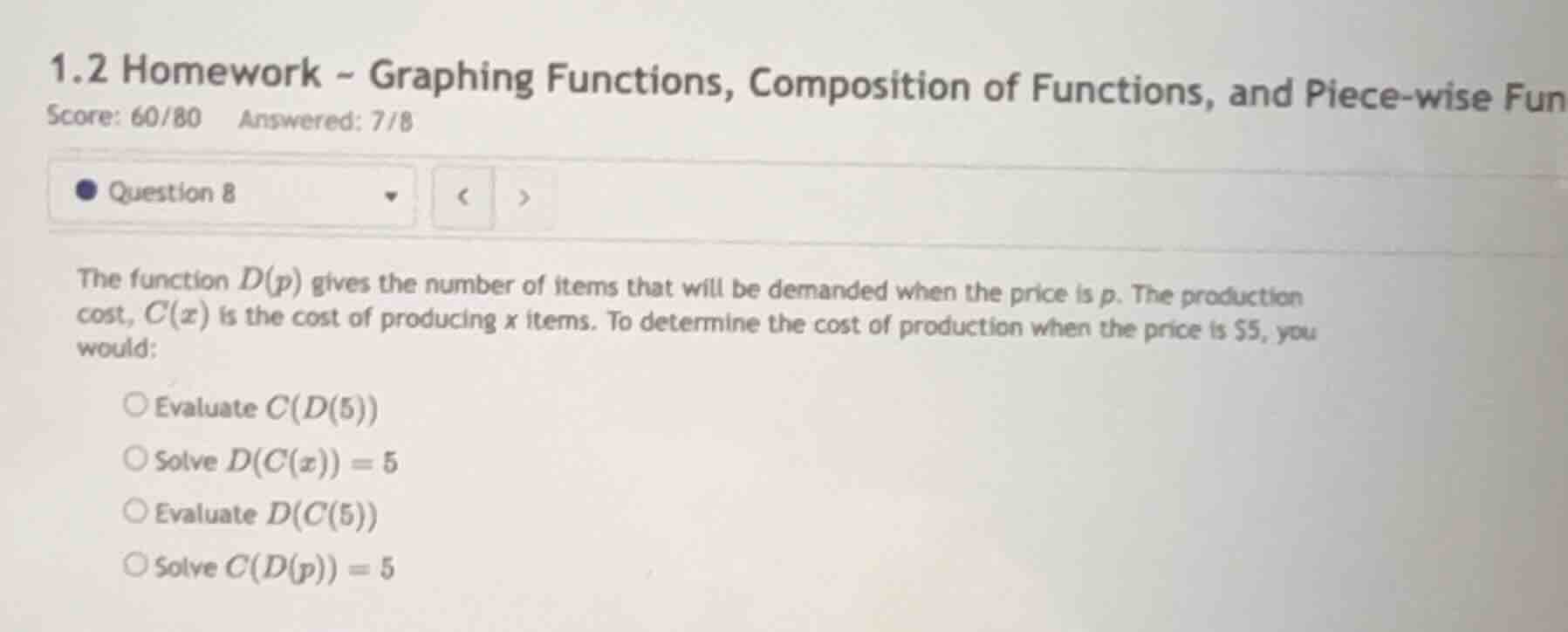
the function d(p) gives the number of items that will be demanded when the price is p. the production cost, c(x) is the cost of producing x items. to determine the cost of production when the price is $5, you would:
evaluate c(d(5))
solve d(c(x)) = 5
evaluate d(c(5))
solve c(d(p)) = 5
To determine the cost of production when the price is $5, we first need to find the number of items demanded at price $5, which is \( D(5) \). Then, we use that number of items as the input for the cost function \( C(x) \), so we evaluate \( C(D(5)) \). The other options do not follow this logical order: solving \( D(C(x)) = 5 \) is about finding \( x \) such that the demand for cost - produced \( x \) items is 5, not related to cost at price 5; \( D(C(5)) \) would be demand for cost of producing 5 items, not relevant; solving \( C(D(p)) = 5 \) is about finding price \( p \) where cost of demand at \( p \) is 5, not cost at price 5.

Snap & solve any problem in the app
Get step-by-step solutions on Sovi AI
Photo-based solutions with guided steps
Explore more problems and detailed explanations
A. Evaluate \( C(D(5)) \)