QUESTION IMAGE
Question
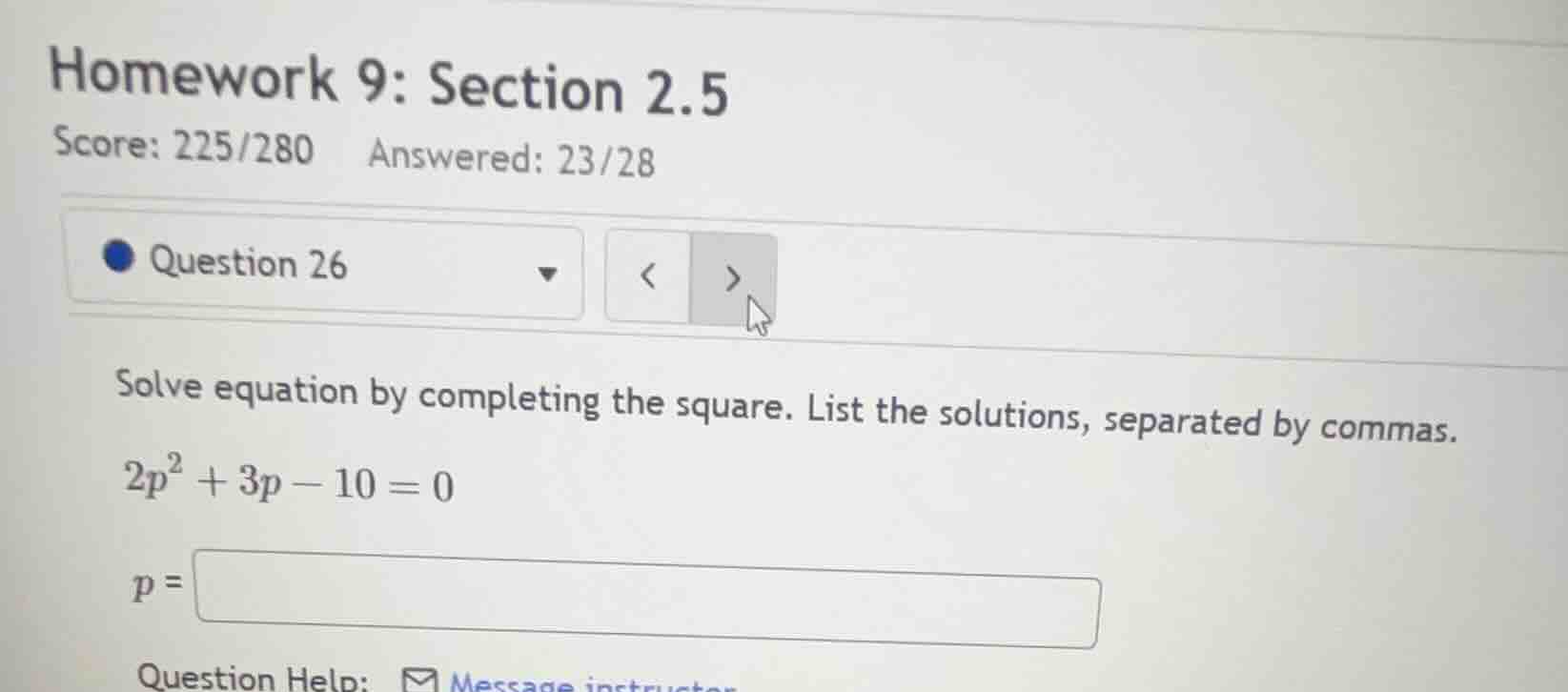
homework 9: section 2.5
score: 225/280 answered: 23/28
question 26
solve equation by completing the square. list the solutions, separated by commas.
$2p^2 + 3p - 10 = 0$
$p = $
Step1: Isolate the quadratic and linear terms
First, we move the constant term to the other side of the equation. For the equation \(2p^{2}+3p - 10=0\), we add 10 to both sides:
\(2p^{2}+3p=10\)
Then, we divide the entire equation by the coefficient of \(p^{2}\) (which is 2) to make the coefficient of \(p^{2}\) equal to 1:
\(p^{2}+\frac{3}{2}p = 5\)
Step2: Complete the square
To complete the square for the expression \(p^{2}+\frac{3}{2}p\), we take half of the coefficient of \(p\), square it, and add it to both sides. The coefficient of \(p\) is \(\frac{3}{2}\), half of it is \(\frac{3}{4}\), and squaring it gives \((\frac{3}{4})^{2}=\frac{9}{16}\).
We add \(\frac{9}{16}\) to both sides of the equation:
\(p^{2}+\frac{3}{2}p+\frac{9}{16}=5 + \frac{9}{16}\)
The left - hand side is now a perfect square trinomial, which can be written as \((p + \frac{3}{4})^{2}\). For the right - hand side, we find a common denominator: \(5=\frac{80}{16}\), so \(\frac{80}{16}+\frac{9}{16}=\frac{89}{16}\). So we have:
\((p+\frac{3}{4})^{2}=\frac{89}{16}\)
Step3: Solve for \(p\)
Take the square root of both sides:
\(p+\frac{3}{4}=\pm\sqrt{\frac{89}{16}}=\pm\frac{\sqrt{89}}{4}\)
Then, subtract \(\frac{3}{4}\) from both sides to solve for \(p\):
\(p=-\frac{3}{4}\pm\frac{\sqrt{89}}{4}=\frac{- 3\pm\sqrt{89}}{4}\)
Wait, there is a mistake in the above calculation. Let's start over from the step of dividing by 2.
Starting again:
We have the equation \(2p^{2}+3p - 10 = 0\)
Step 1: Move the constant term to the right: \(2p^{2}+3p=10\)
Step 2: Divide by 2: \(p^{2}+\frac{3}{2}p = 5\)
Step 3: Complete the square. The coefficient of \(p\) is \(\frac{3}{2}\), half of it is \(\frac{3}{4}\), square is \(\frac{9}{16}\)
Add \(\frac{9}{16}\) to both sides: \(p^{2}+\frac{3}{2}p+\frac{9}{16}=5+\frac{9}{16}\)
Left side: \((p + \frac{3}{4})^{2}\), right side: \(5=\frac{80}{16}\), so \(\frac{80 + 9}{16}=\frac{89}{16}\). So \((p+\frac{3}{4})^{2}=\frac{89}{16}\)
Take square roots: \(p+\frac{3}{4}=\pm\frac{\sqrt{89}}{4}\)
\(p=\frac{-3\pm\sqrt{89}}{4}\)
But let's check the original equation by factoring (to verify). Wait, the original equation \(2p^{2}+3p - 10=0\). Let's use the quadratic formula \(p=\frac{-b\pm\sqrt{b^{2}-4ac}}{2a}\), where \(a = 2\), \(b = 3\), \(c=-10\)
\(\Delta=b^{2}-4ac=3^{2}-4\times2\times(-10)=9 + 80 = 89\)
\(p=\frac{-3\pm\sqrt{89}}{4}\)
But wait, if we made a mistake in the completing the square process earlier, let's re - do the completing the square correctly.
Wait, the original equation is \(2p^{2}+3p - 10 = 0\)
\(2p^{2}+3p=10\)
\(p^{2}+\frac{3}{2}p = 5\)
Completing the square: the formula for completing the square for \(ax^{2}+bx + c\) when \(a = 1\) is \(x^{2}+bx=(x+\frac{b}{2})^{2}-\frac{b^{2}}{4}\)
So \(p^{2}+\frac{3}{2}p=(p + \frac{3}{4})^{2}-\frac{9}{16}\)
Then \((p+\frac{3}{4})^{2}-\frac{9}{16}=5\)
\((p+\frac{3}{4})^{2}=5+\frac{9}{16}=\frac{80 + 9}{16}=\frac{89}{16}\)
Which is the same as before. But let's check with the quadratic formula:
For \(ax^{2}+bx + c = 0\), \(x=\frac{-b\pm\sqrt{b^{2}-4ac}}{2a}\)
Here, \(a = 2\), \(b = 3\), \(c=-10\)
\(\Delta=b^{2}-4ac=9+80 = 89\)
\(p=\frac{-3\pm\sqrt{89}}{4}\)
But wait, let's check if we made a mistake in the problem - solving process. Let's go back to the original equation \(2p^{2}+3p - 10=0\)
We can also factor the quadratic (if possible). Let's try to factor \(2p^{2}+3p - 10\). We need two numbers that multiply to \(2\times(-10)=-20\) and add up to 3. The numbers are 5 and - 4.
So \(2p^{2}+5p-4p - 10=0\)
\(p(2p + 5)-2(2p + 5)=0\)
\((2p + 5)(p - 2)=0\)
Ah! H…

Snap & solve any problem in the app
Get step-by-step solutions on Sovi AI
Photo-based solutions with guided steps
Explore more problems and detailed explanations
\(2,-\frac{5}{2}\)