QUESTION IMAGE
Question
hormone - response element
bound hormone
hormone receptor
hormone - receptor complex
hormone
unbound hormone
carrier protein
blood
amino acids
ribosome
mrna
plasma membrane
interstitial fluid
cytosol
nuclear membrane
dna
mrna synthesis
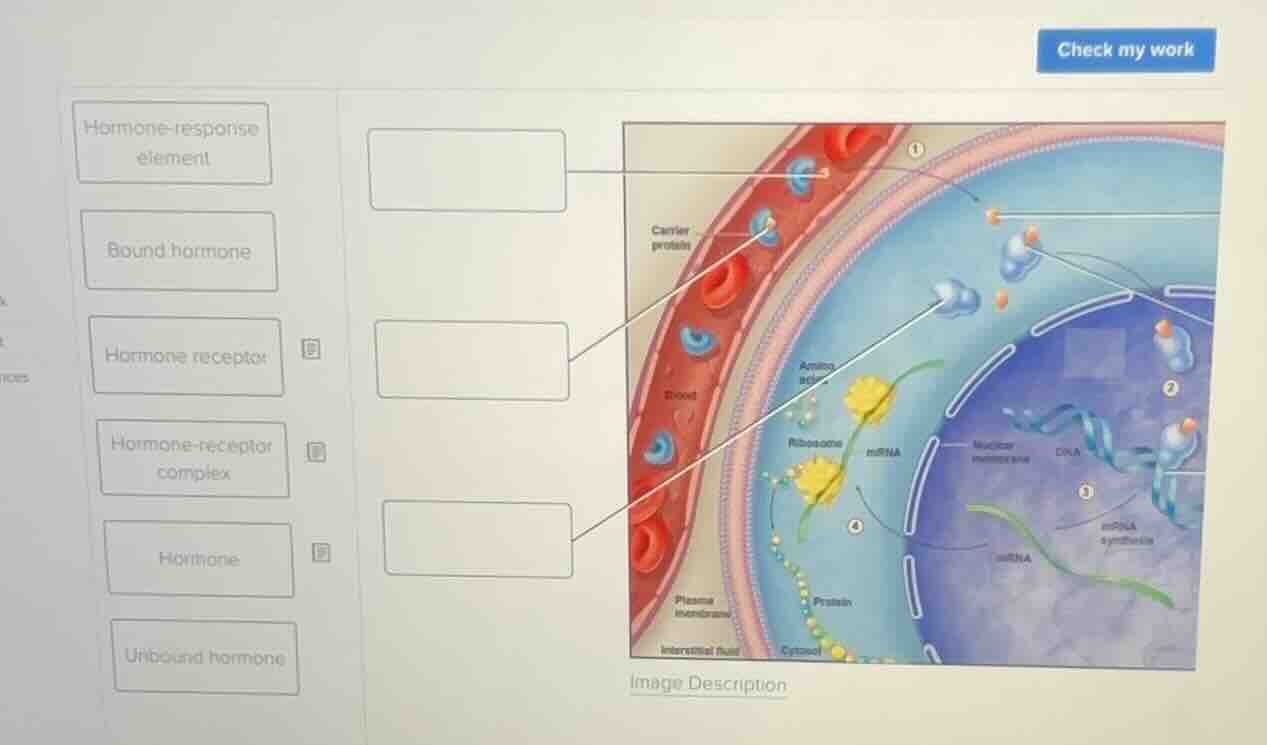
To solve this labeling problem related to the hormone - action pathway (specifically for a steroid hormone - like mechanism, as it involves nuclear entry and gene transcription), we analyze each label and its corresponding structure in the diagram:
Step 1: Identify the top - most label (1st box)
The top - most arrow (1) is pointing to a structure in the blood. In the blood, we have both bound and unbound hormones. The structure here is likely the Unbound hormone because unbound hormones are free in the blood (while bound are attached to carrier proteins). So the first box (top) is labeled with "Unbound hormone".
Step 2: Identify the middle - left label (2nd box)
The middle - left arrow is pointing to the "Carrier proteins" in the blood. The hormone associated with carrier proteins is the Bound hormone (since bound hormones are attached to carrier proteins for transport in the blood). So the second box (middle - left) is labeled with "Bound hormone".
Step 3: Identify the lower - left label (3rd box)
The lower - left arrow is pointing to a structure that is moving towards the nucleus or is in the cytoplasm. This structure is the Hormone - receptor complex (after the hormone binds to the receptor, the complex forms and can enter the nucleus to affect transcription). Wait, no, let's re - examine. Wait, the structure here: after the hormone (unbound) diffuses into the cell, it binds to the receptor to form the hormone - receptor complex? Wait, no, the label here: looking at the diagram, the arrow is pointing to a structure that is a complex. Wait, maybe I made a mistake. Let's re - order. Wait, the labels on the left are: Hormone - response element, Bound hormone, Hormone receptor, Hormone - receptor complex, Hormone, Unbound hormone.
Wait, let's start over. The blood has carrier proteins with bound hormones and unbound hormones. The unbound hormone (free in blood) can diffuse into the cell. Then, inside the cell, the hormone binds to the receptor to form the hormone - receptor complex. The hormone - receptor complex then enters the nucleus and binds to the hormone - response element on DNA to initiate transcription.
So:
- The top arrow (1) in the blood (free) → Unbound hormone.
- The middle arrow (pointing to carrier protein - bound) → Bound hormone.
- The lower arrow (pointing to the complex in the cytoplasm or moving towards nucleus) → Hormone - receptor complex? Wait, no, the label "Hormone" is also there. Wait, maybe the lower arrow is pointing to the "Hormone - receptor complex". Wait, let's check the labels:
Left - hand side labels:
- Hormone - response element
- Bound hormone
- Hormone receptor
- Hormone - receptor complex
- Hormone
- Unbound hormone
So:
- Top box (arrow 1, blood, free) → Unbound hormone.
- Middle box (arrow to carrier protein - bound) → Bound hormone.
- Lower box (arrow to the complex) → Hormone - receptor complex.
Wait, but there is also "Hormone", "Hormone receptor", and "Hormone - response element".
Wait, maybe the correct labeling is:
- Top box (blood, free) → Unbound hormone.
- Middle box (carrier protein - bound) → Bound hormone.
- Lower box (the complex in the cytoplasm) → Hormone - receptor complex.
And then, inside the nucleus, the hormone - response element is on the DNA, the hormone - receptor complex binds to it. The "Hormone" is the unbound or bound that becomes free, and the "Hormone receptor" is inside the cell.
But based on the diagram:
- The first (top) arrow: Unbound hormone (free in blood).
- The second (middle) arrow: Bound hormone (attached to…

Snap & solve any problem in the app
Get step-by-step solutions on Sovi AI
Photo-based solutions with guided steps
Explore more problems and detailed explanations
Top box: Unbound hormone
Middle box: Bound hormone
Lower box: Hormone - receptor complex