QUESTION IMAGE
Question
households
spending
firms
income
goods/
services
product market
refer to the diagram and explain the difference between a factor market and a product market
Brief Explanations
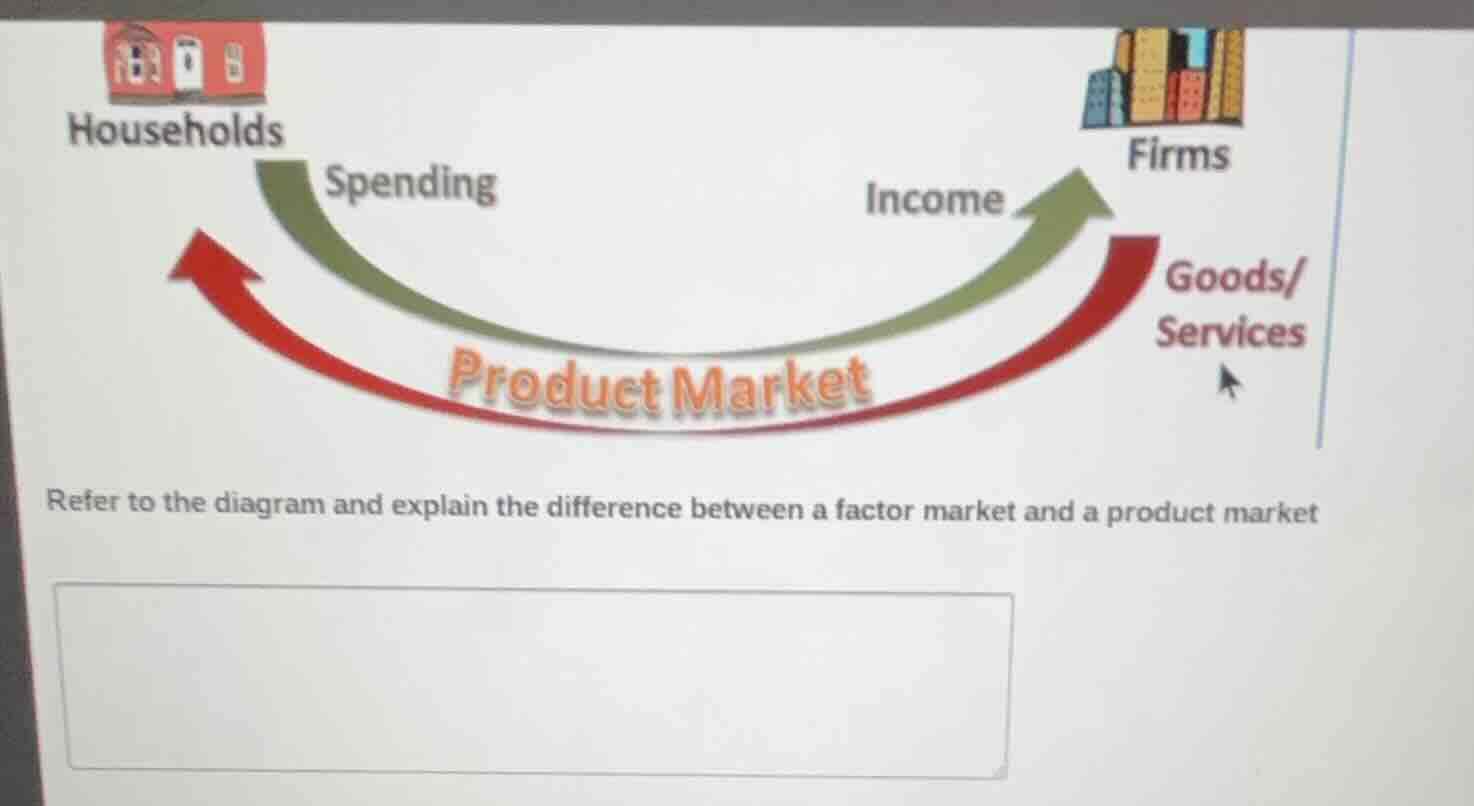
- Product Market (shown in the diagram): This is where firms sell finished goods and services to households. Households spend money (spending arrow) to purchase these, while firms earn income (income arrow) from these sales.
- Factor Market (not shown, complementary to the diagram): This is the opposite side of the circular flow, where households sell factors of production (labor, land, capital, entrepreneurship) to firms. Firms pay households for these factors (wages, rent, interest, profits), which becomes household income, and firms use these factors to produce the goods/services sold in the product market.
The core difference is the type of item exchanged: finished goods/services in the product market, vs. production inputs in the factor market, along with the reverse flow of money and resources between households and firms.

Snap & solve any problem in the app
Get step-by-step solutions on Sovi AI
Photo-based solutions with guided steps
Explore more problems and detailed explanations
- Product Market (illustrated): The market where firms sell finished goods and services to households; households exchange money for these end products, as shown by the "Spending" (households to firms) and "Goods/Services" (firms to households) arrows.
- Factor Market: The complementary market where households sell factors of production (labor, land, capital, entrepreneurship) to firms; firms exchange money (wages, rent, interest, profits) for these inputs to create goods/services for the product market.
The key difference is the item traded: finished goods/services (product market) versus production inputs (factor market), with opposite money and resource flows between households and firms.