QUESTION IMAGE
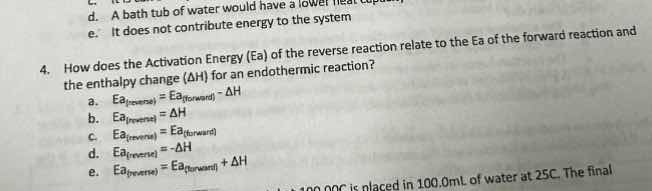
Question
- how does the activation energy (ea) of the reverse reaction relate to the ea of the forward reaction and the enthalpy change (δh) for an endothermic reaction?
a. $e_{a(reverse)} = e_{a(forward)} - δh$
b. $e_{a(reverse)} = δh$
c. $e_{a(reverse)} = e_{a(forward)}$
d. $e_{a(reverse)} = -δh$
e. $e_{a(reverse)} = e_{a(forward)} + δh$
To solve this, we analyze the relationship between activation energies (\(E_a\)) of forward and reverse reactions and enthalpy change (\(\Delta H\)) for an endothermic reaction.
Key Concepts:
For a reaction, the enthalpy change \(\Delta H\) is related to the activation energies of the forward (\(E_{a(\text{forward})}\)) and reverse (\(E_{a(\text{reverse})}\)) reactions by:
\[
\Delta H = E_{a(\text{forward})} - E_{a(\text{reverse})}
\]
For an endothermic reaction, \(\Delta H > 0\) (heat is absorbed, so products have higher energy than reactants).
Step 1: Rearrange the formula for \(E_{a(\text{reverse})}\)
Starting with \(\Delta H = E_{a(\text{forward})} - E_{a(\text{reverse})}\), rearrange to solve for \(E_{a(\text{reverse})}\):
\[
E_{a(\text{reverse})} = E_{a(\text{forward})} - \Delta H
\]
Step 2: Interpret for endothermic \(\Delta H\)
In an endothermic reaction, \(\Delta H\) is positive. From the rearranged formula:
- \(E_{a(\text{forward})}\) is the energy needed to go from reactants to transition state.
- \(E_{a(\text{reverse})}\) is the energy needed to go from products (higher energy, since endothermic) to transition state.
The formula \(E_{a(\text{reverse})} = E_{a(\text{forward})} - \Delta H\) matches option a.
Verify other options:
- Option b: \(E_{a(\text{reverse})} = \Delta H\) is incorrect (no basis in the energy relationship).
- Option c: \(E_{a(\text{reverse})} = E_{a(\text{forward})}\) would imply \(\Delta H = 0\), which is not endothermic.
- Option d: \(E_{a(\text{reverse})} = -\Delta H\) would imply \(E_{a(\text{forward})} = 0\), which is impossible.
- Option e: \(E_{a(\text{reverse})} = E_{a(\text{forward})} + \Delta H\) would make \(\Delta H\) negative (exothermic), contradicting endothermic.

Snap & solve any problem in the app
Get step-by-step solutions on Sovi AI
Photo-based solutions with guided steps
Explore more problems and detailed explanations
a. \( E_{\text{reverse}} = E_{\text{forward}} - \Delta H \)