QUESTION IMAGE
Question
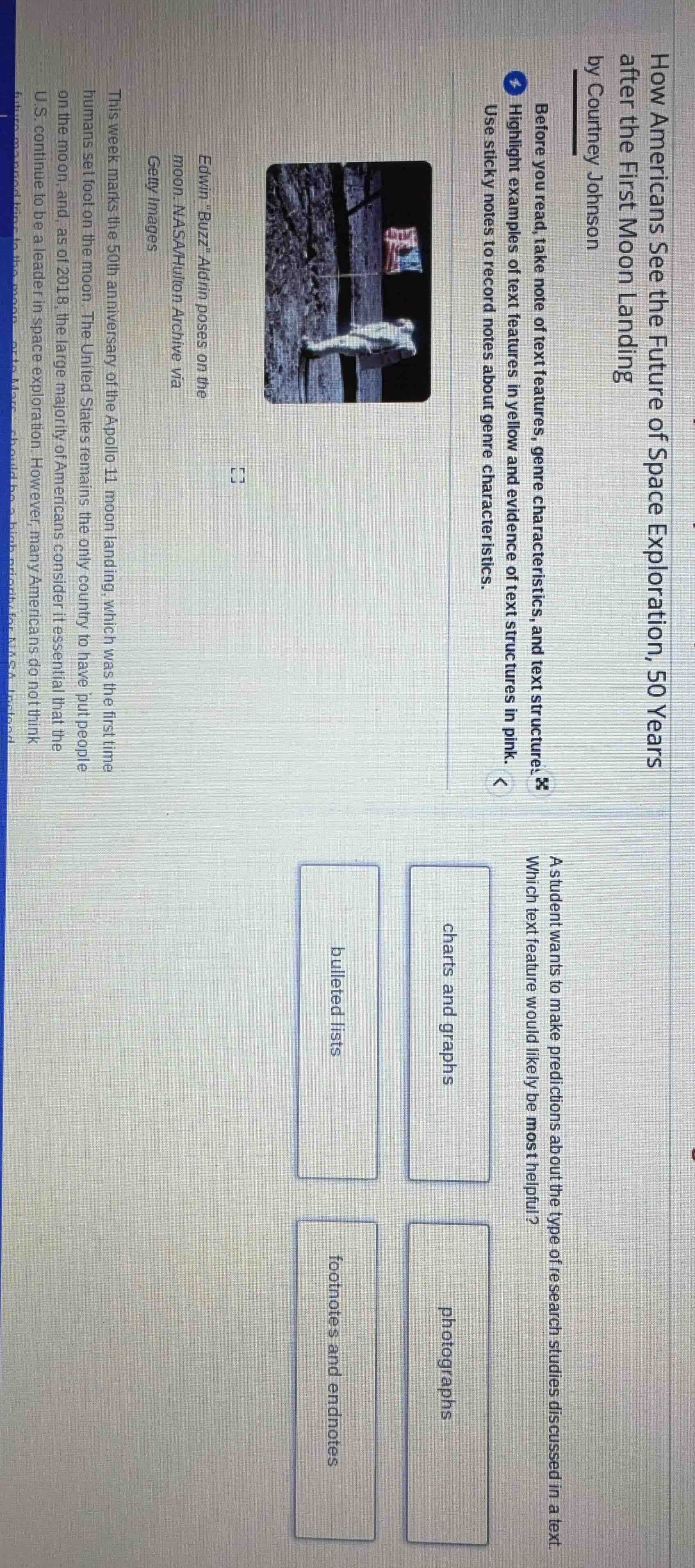
how americans see the future of space exploration, 50 years after the first moon landing by courtney johnson 4 before you read, take note of text features, genre characteristics, and text structure. highlight examples of text features in yellow and evidence of text structures in pink. use sticky notes to record notes about genre characteristics. edwin \buzz\ aldrin poses on the moon. nasa/hulton archive via getty images this week marks the 50th anniversary of the apollo 11 moon landing, which was the first time humans set foot on the moon. the united states remains the only county to have put people on the moon, and, as of 2018, the large majority of americans consider it essential that the u.s. continue to be a leader in space exploration. however, many americans do not think a student wants to make predictions about the type of research studies discussed in a text. which text feature would likely be most helpful? charts and graphs photographs bulleted lists footnotes and endnotes
To determine the most helpful text feature for predicting research studies, we analyze each option:
- "Charts and graphs" can display data (e.g., trends in space - related research over time, public opinion data on space exploration) which helps in predicting the type of research studies. For example, a graph showing the increase in funding for lunar research could indicate that more studies on lunar geology might be conducted.
- "Bulleted lists" are usually for listing items (like key points about the moon landing) and don't provide data for predicting research.
- "Photographs" (like the moon - landing photo) are for visual context, not for research prediction.
- "Footnotes and endnotes" are for citing sources or additional details, not for showing research - related data.
So, charts and graphs are the most helpful.

Snap & solve any problem in the app
Get step-by-step solutions on Sovi AI
Photo-based solutions with guided steps
Explore more problems and detailed explanations
charts and graphs