QUESTION IMAGE
Question
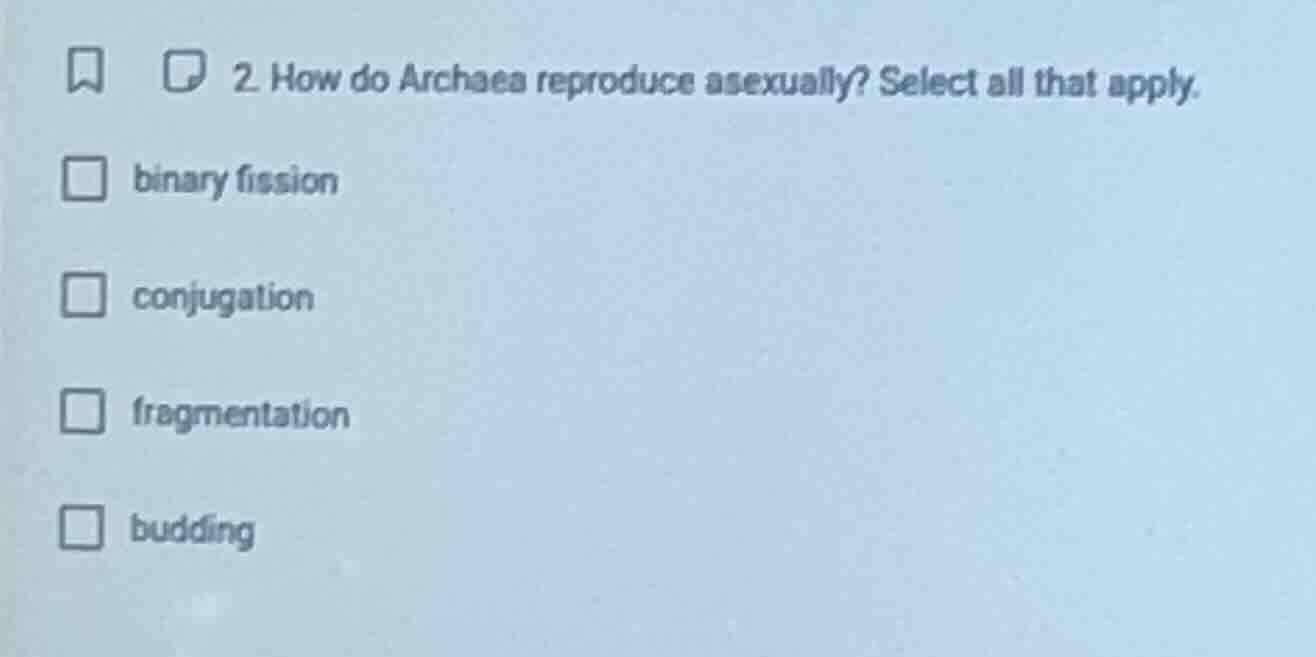
- how do archaea reproduce asexually? select all that apply.
□ binary fission
□ conjugation
□ fragmentation
□ budding
Brief Explanations
- Binary fission: Archaea commonly use binary fission, where a single cell divides into two identical daughter cells.
- Conjugation: This is a form of horizontal gene transfer (not strictly asexual reproduction in the sense of creating new individuals, but sometimes considered in the context of archaeal genetic exchange, though it's more about sharing genetic material). However, for asexual reproduction of the organism (producing new individuals), binary fission, fragmentation, and budding are asexual. Wait, correction: Conjugation is a process of genetic transfer (like in bacteria, and archaea can have similar processes) but it's not a method of asexual reproduction (creating new individuals). Asexual reproduction methods for Archaea include binary fission (most common), fragmentation (where a cell breaks into fragments that grow into new cells), and budding (where a small bud forms on the parent cell and detaches to become a new cell). So the correct options for asexual reproduction are binary fission, fragmentation, and budding. Conjugation is about gene transfer, not producing new individuals via asexual means.

Snap & solve any problem in the app
Get step-by-step solutions on Sovi AI
Photo-based solutions with guided steps
Explore more problems and detailed explanations
A. binary fission, C. fragmentation, D. budding