QUESTION IMAGE
Question
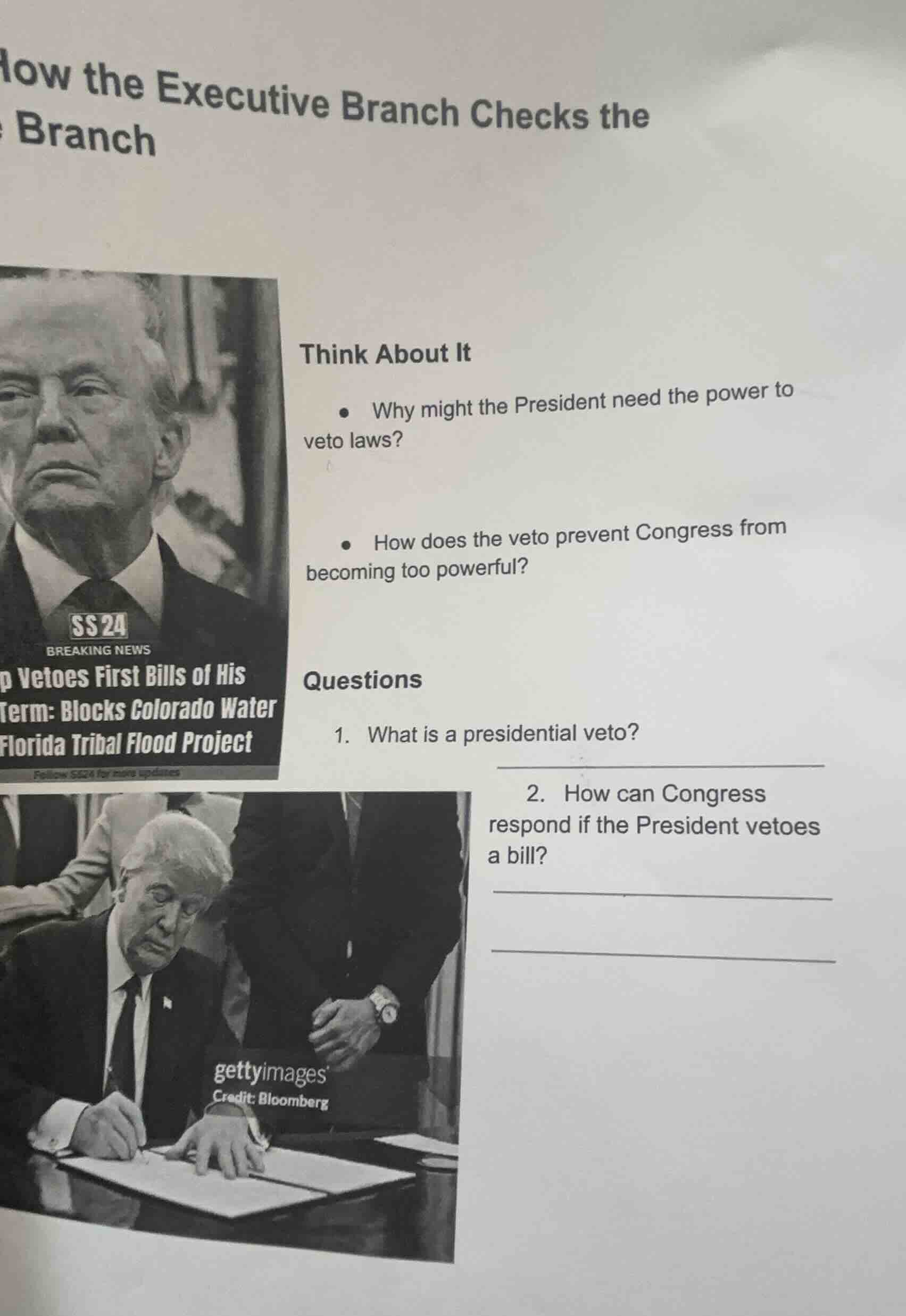
how the executive branch checks the branch
think about it
- why might the president need the power to veto laws?
questions
- what is a presidential veto?
- how can congress respond if the president vetoes a bill?
Question 1: What is a presidential veto?
A presidential veto is a constitutional power of the President (in systems like the US) to reject a bill passed by Congress. This stops the bill from becoming law, unless Congress overrides the veto (usually with a supermajority). It’s part of the system of checks and balances, allowing the Executive Branch to check the Legislative Branch.
If the President vetoes a bill, Congress can attempt to override the veto. In the US, this requires a two - thirds majority vote in both the House of Representatives and the Senate. If Congress achieves this supermajority, the bill becomes law despite the presidential veto. If they don’t get the necessary votes, the bill does not become law.

Snap & solve any problem in the app
Get step-by-step solutions on Sovi AI
Photo-based solutions with guided steps
Explore more problems and detailed explanations
A presidential veto is the power of a President (e.g., in the US) to reject a bill passed by Congress, preventing it from becoming law (unless Congress overrides the veto, typically with a supermajority). It is a key check in the system of checks and balances, enabling the Executive Branch to limit the Legislative Branch’s law - making power.