QUESTION IMAGE
Question
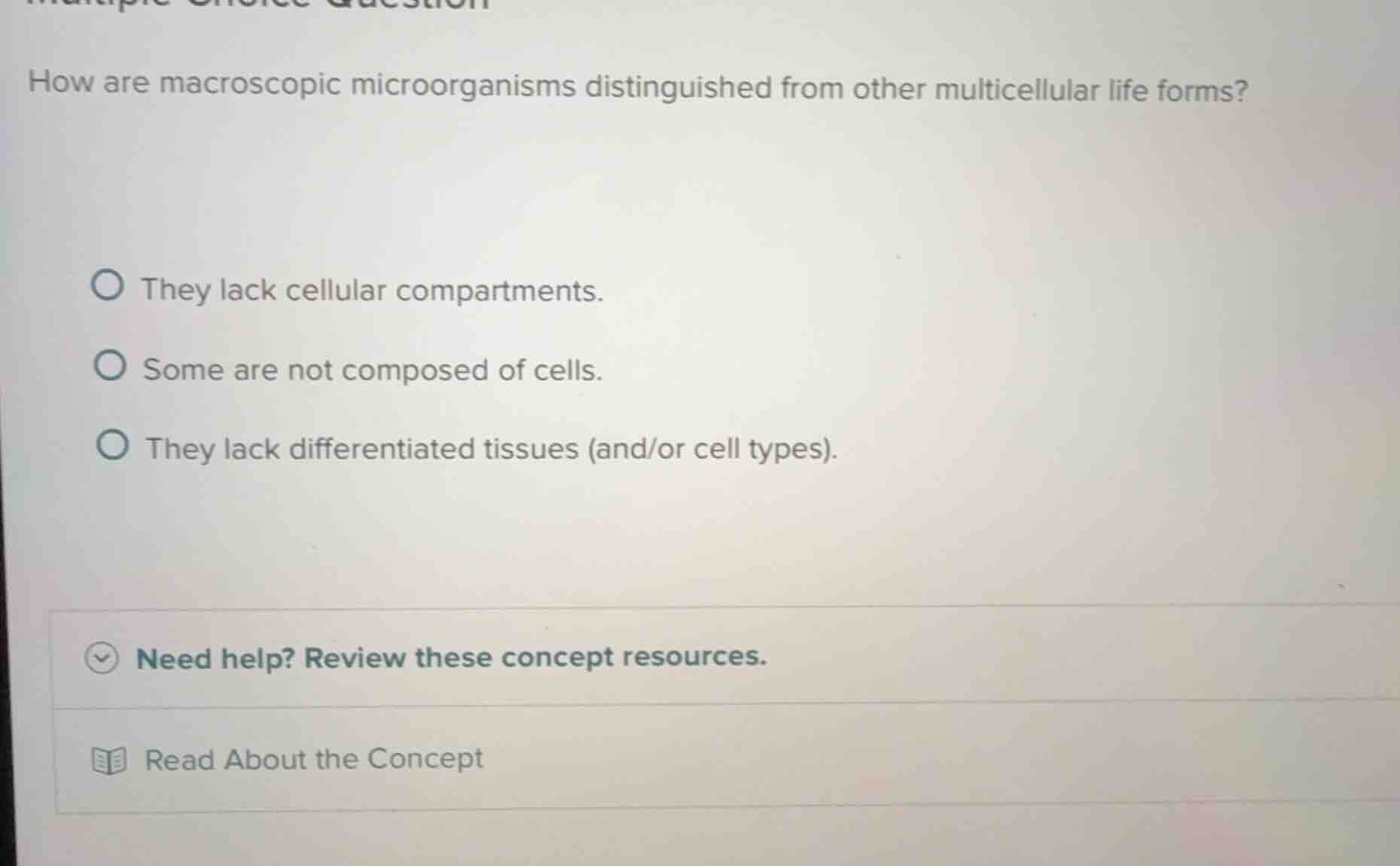
how are macroscopic microorganisms distinguished from other multicellular life forms?
- they lack cellular compartments.
- some are not composed of cells.
- they lack differentiated tissues (and/or cell types).
need help? review these concept resources.
read about the concept
Brief Explanations
- Analyze the first option: Microorganisms (even macroscopic ones like some fungi) are cells and have cellular compartments (like organelles in eukaryotic microbes), so "They lack cellular compartments" is incorrect.
- Analyze the second option: All living organisms (including macroscopic microorganisms) are composed of cells, so "Some are not composed of cells" is wrong (viruses are not cells but are not considered microorganisms in the context of multicellular macroscopic microbes here, and macroscopic microbes are cellular).
- Analyze the third option: Macroscopic microorganisms (e.g., some fungi, algae) are multicellular but lack differentiated tissues or specialized cell types like complex multicellular organisms (e.g., plants, animals) which have tissues like muscle, nerve, or leaf tissues. So this option correctly distinguishes them.

Snap & solve any problem in the app
Get step-by-step solutions on Sovi AI
Photo-based solutions with guided steps
Explore more problems and detailed explanations
They lack differentiated tissues (and/or cell types).