QUESTION IMAGE
Question
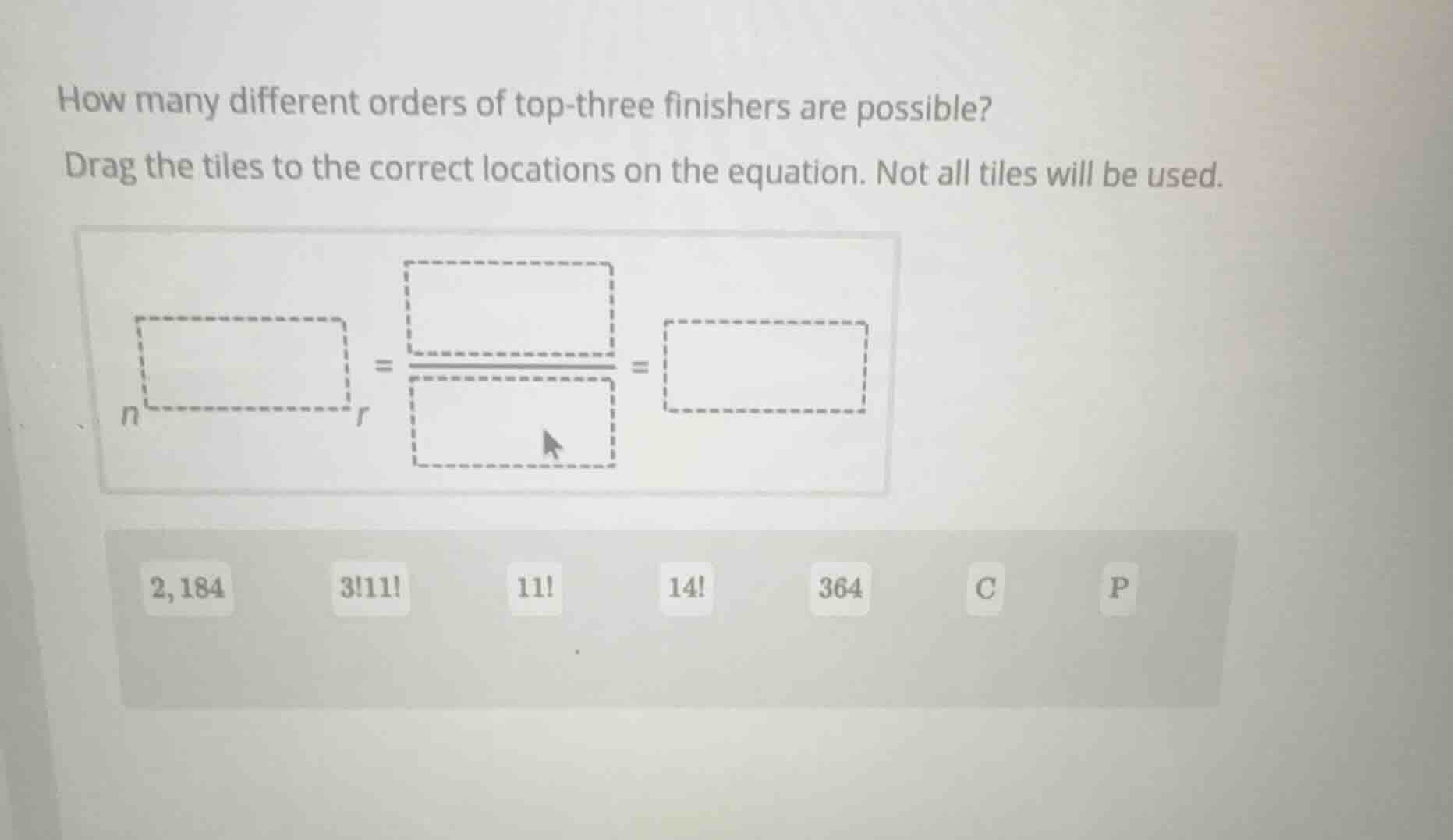
how many different orders of top - three finishers are possible? drag the tiles to the correct locations on the equation. not all tiles will be used. \\(_{n}square_{r}=\frac{square}{square}=square\\) tiles: 2,184, 3!11!, 11!, 14!, 364, c, p
Step1: Identify permutation notation
We use permutation $_nP_r$ since order matters for top finishers, so the first box is $P$. Assume $n=14$ (total participants, implied by the tiles) and $r=3$ (top three).
Step2: Apply permutation formula
The permutation formula is $_nP_r=\frac{n!}{(n-r)!}$. Substitute $n=14, r=3$:
$$_{14}P_3=\frac{14!}{(14-3)!}=\frac{14!}{11!}$$
Step3: Calculate the result
Simplify $\frac{14!}{11!}=14\times13\times12=2184$

Snap & solve any problem in the app
Get step-by-step solutions on Sovi AI
Photo-based solutions with guided steps
Explore more problems and detailed explanations
The filled equation is:
$_{14}P_3=\frac{14!}{11!}=2,184$
So the tiles placed are: $P$ (first box), $14!$ (numerator), $11!$ (denominator), $2,184$ (final value)