QUESTION IMAGE
Question
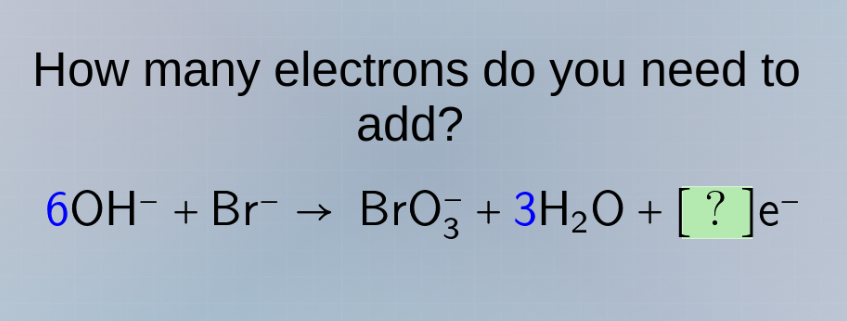
how many electrons do you need to add?
6oh⁻ + br⁻ → bro₃⁻ + 3h₂o + ?e⁻
Step1: Determine oxidation states of Br
In \( \text{Br}^- \), oxidation state of Br is -1. In \( \text{BrO}_3^- \), let oxidation state of Br be \( x \). Oxygen is -2, so \( x + 3(-2) = -1 \), \( x - 6 = -1 \), \( x = +5 \).
Step2: Calculate electron change
Br goes from -1 to +5, so change in oxidation state is \( +5 - (-1) = +6 \). This means each Br atom loses 6 electrons? Wait, no—wait, the reaction: left side Br is -1 (reductant? No, wait, oxidation: loss of electrons. Wait, \( \text{Br}^- \) to \( \text{BrO}_3^- \): Br is oxidized (oxidation state increases from -1 to +5). So the number of electrons lost per Br atom is \( 5 - (-1) = 6 \). But let's check charge balance.
Left side charge: \( 6\text{OH}^- \) is -6, \( \text{Br}^- \) is -1, total charge: -7.
Right side: \( \text{BrO}_3^- \) is -1, \( 3\text{H}_2\text{O} \) is neutral, and we have \( n \) electrons (each \( \text{e}^- \) is -1). So total charge: \( -1 + (-n) \).
Set charge equal: \( -7 = -1 - n \) → \( -n = -6 \) → \( n = 6 \). Wait, but electrons are on the right, so the number of electrons to add (as products) is 6? Wait, no—wait, the reaction is oxidation, so electrons are lost, so they should be on the product side. Wait, let's redo charge balance.
Left: \( 6\text{OH}^- \) (charge -6) + \( \text{Br}^- \) (charge -1) → total -7.
Right: \( \text{BrO}_3^- \) (charge -1) + \( 3\text{H}_2\text{O} \) (charge 0) + \( n\text{e}^- \) (charge -n).
So -7 = -1 + 0 - n → -7 = -1 - n → -n = -6 → n = 6. So we need to add 6 electrons. Wait, but let's check oxidation state change. Br from -1 to +5: change is +6, so each Br atom loses 6 electrons, so electrons are on the product side (since it's oxidation, loss of electrons). So the coefficient of \( \text{e}^- \) is 6.

Snap & solve any problem in the app
Get step-by-step solutions on Sovi AI
Photo-based solutions with guided steps
Explore more problems and detailed explanations
6