QUESTION IMAGE
Question
how does the number of sides of a convex polygon, n, relate to the sum of measures of its interior angles?
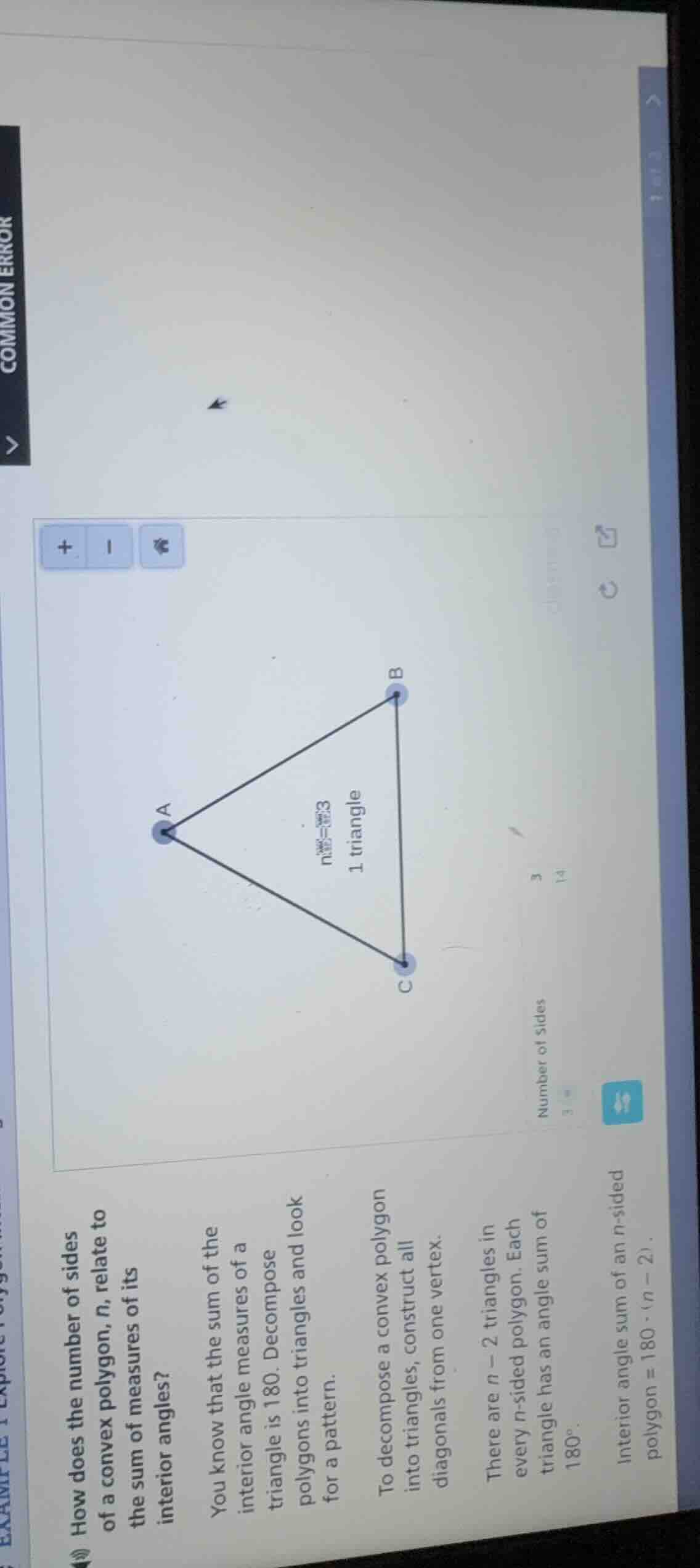
you know that the sum of the interior angle measures of a triangle is 180. decompose polygons into triangles and look for a pattern.
to decompose a convex polygon into triangles, construct all diagonals from one vertex.
there are n - 2 triangles in every n - sided polygon. each triangle has an angle sum of 180°.
interior angle sum of an n - sided polygon = 180·(n - 2).
Step1: Recall triangle angle sum
A triangle (\(n = 3\)) has an interior angle sum of \(180^{\circ}\). Using the formula \(180^{\circ}\cdot(n - 2)\), substitute \(n = 3\): \(180^{\circ}\cdot(3 - 2)=180^{\circ}\), which matches.
Step2: Test quadrilateral (\(n = 4\))
A quadrilateral can be decomposed into \(4 - 2 = 2\) triangles. Each triangle has \(180^{\circ}\), so total sum is \(2\times180^{\circ}=360^{\circ}\). Using the formula: \(180^{\circ}\cdot(4 - 2)=360^{\circ}\), which matches.
Step3: Generalize for \(n\)-sided polygon
When we decompose an \(n\)-sided convex polygon into triangles by drawing diagonals from one vertex, we get \(n - 2\) triangles. Since each triangle has an interior angle sum of \(180^{\circ}\), the total interior angle sum of the polygon is the number of triangles times \(180^{\circ}\), so the formula is \(180^{\circ}\cdot(n - 2)\).

Snap & solve any problem in the app
Get step-by-step solutions on Sovi AI
Photo-based solutions with guided steps
Explore more problems and detailed explanations
The sum of the interior angle measures of a convex \(n\)-sided polygon is \(180^{\circ}\cdot(n - 2)\), where \(n\) is the number of sides. As \(n\) increases by 1, the sum increases by \(180^{\circ}\) (since \((n + 1-2)\times180^{\circ}-(n - 2)\times180^{\circ}=180^{\circ}\)).