QUESTION IMAGE
Question
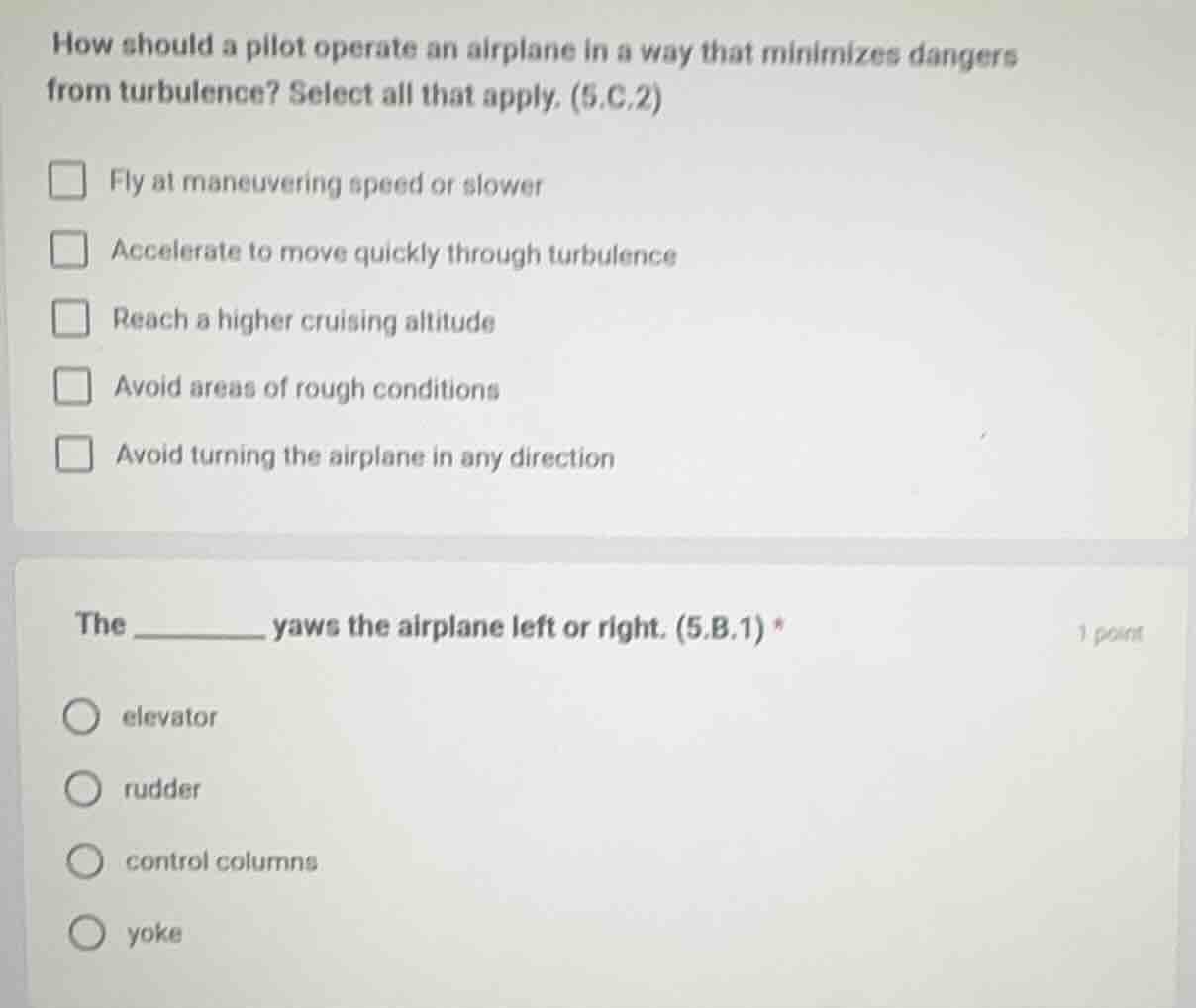
how should a pilot operate an airplane in a way that minimizes dangers from turbulence? select all that apply. (5.c.2)
fly at maneuvering speed or slower
accelerate to move quickly through turbulence
reach a higher cruising altitude
avoid areas of rough conditions
avoid turning the airplane in any direction
the _______ yaws the airplane left or right. (5.b.1) *
1 point
elevator
rudder
control columns
yoke
Response
First Sub - Question (Select all that apply for minimizing turbulence dangers)
Brief Explanations
- Fly at maneuvering speed or slower: Maneuvering speed is a safe speed for handling turbulence as it limits the stress on the aircraft structure.
- Accelerate to move quickly through turbulence: This is incorrect as accelerating can increase stress on the aircraft and make the ride more dangerous in turbulence.
- Reach a higher cruising altitude: Turbulence can be less severe at higher altitudes in some cases, so this is a valid strategy.
- Avoid areas of rough conditions: By avoiding turbulent areas (e.g., using weather radar), the pilot can minimize exposure to danger.
- Avoid turning the airplane in any direction: Turning in turbulence can increase stress, so avoiding turns is a good practice.
Brief Explanations
- Elevator: Controls the pitch (up - down movement) of the aircraft, not yaw.
- Rudder: The rudder is the control surface that is responsible for yawing the aircraft (left - right movement about the vertical axis).
- Control columns: Are used for pitch and roll control, not yaw.
- Yoke: Is used for roll and pitch control, not yaw.

Snap & solve any problem in the app
Get step-by-step solutions on Sovi AI
Photo-based solutions with guided steps
Explore more problems and detailed explanations
- Fly at maneuvering speed or slower
- Reach a higher cruising altitude
- Avoid areas of rough conditions
- Avoid turning the airplane in any direction