QUESTION IMAGE
Question
- how do trigonometric ratios relate angle measures to side lengths of right triangles?
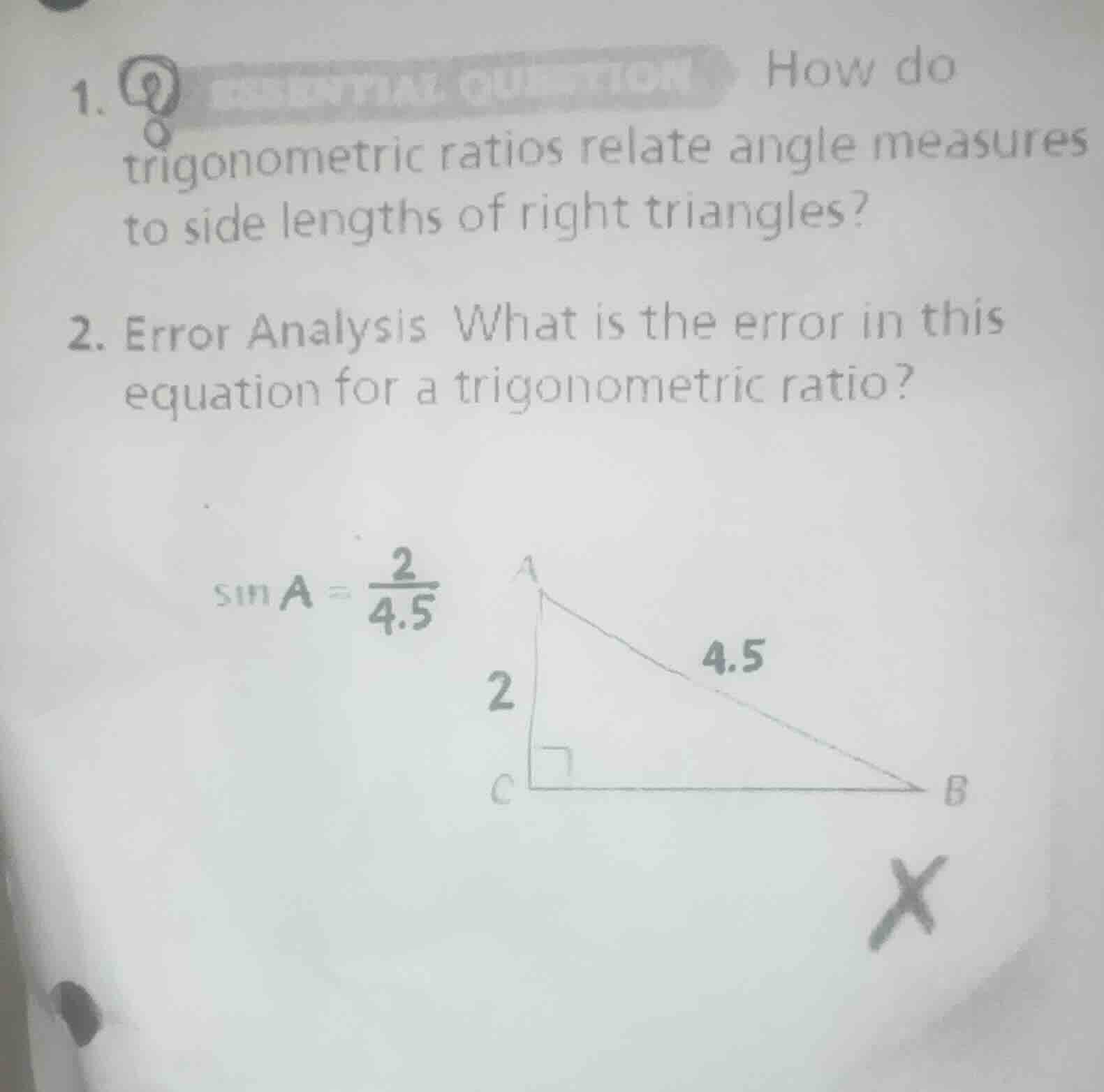
- error analysis what is the error in this equation for a trigonometric ratio?
\\(\sin a = \frac{2}{4.5}\\) (with a right triangle diagram where angle c is right, side ac is 2, hypotenuse ab is 4.5)
Question 1
Trigonometric ratios (sine, cosine, tangent) in right triangles relate angle measures to side lengths. For an acute angle \( \theta \) in a right triangle:
- Sine (\( \sin\theta \)) = \( \frac{\text{opposite side to } \theta}{\text{hypotenuse}} \)
- Cosine (\( \cos\theta \)) = \( \frac{\text{adjacent side to } \theta}{\text{hypotenuse}} \)
- Tangent (\( \tan\theta \)) = \( \frac{\text{opposite side to } \theta}{\text{adjacent side to } \theta} \)
These ratios define the proportional relationships between angles and sides, allowing us to find unknown angles or sides using known values.
To identify the error, recall the definition of sine: \( \sin A = \frac{\text{opposite side to } A}{\text{hypotenuse}} \).
- In the right triangle, \( \angle C = 90^\circ \), so the hypotenuse is \( AB = 4.5 \).
- The side opposite \( \angle A \) is \( BC \) (not \( AC = 2 \); \( AC \) is adjacent to \( \angle A \)).
- Thus, \( \sin A \) should be \( \frac{\text{opposite (BC)}}{\text{hypotenuse (4.5)}} \), but the equation incorrectly uses \( AC = 2 \) (adjacent) as the opposite side.

Snap & solve any problem in the app
Get step-by-step solutions on Sovi AI
Photo-based solutions with guided steps
Explore more problems and detailed explanations
Trigonometric ratios relate angle measures to side lengths of right triangles by defining proportional relationships: \( \sin\theta = \frac{\text{opposite}}{\text{hypotenuse}} \), \( \cos\theta = \frac{\text{adjacent}}{\text{hypotenuse}} \), and \( \tan\theta = \frac{\text{opposite}}{\text{adjacent}} \), where \( \theta \) is an acute angle, and "opposite," "adjacent," and "hypotenuse" refer to the sides relative to \( \theta \).