QUESTION IMAGE
Question
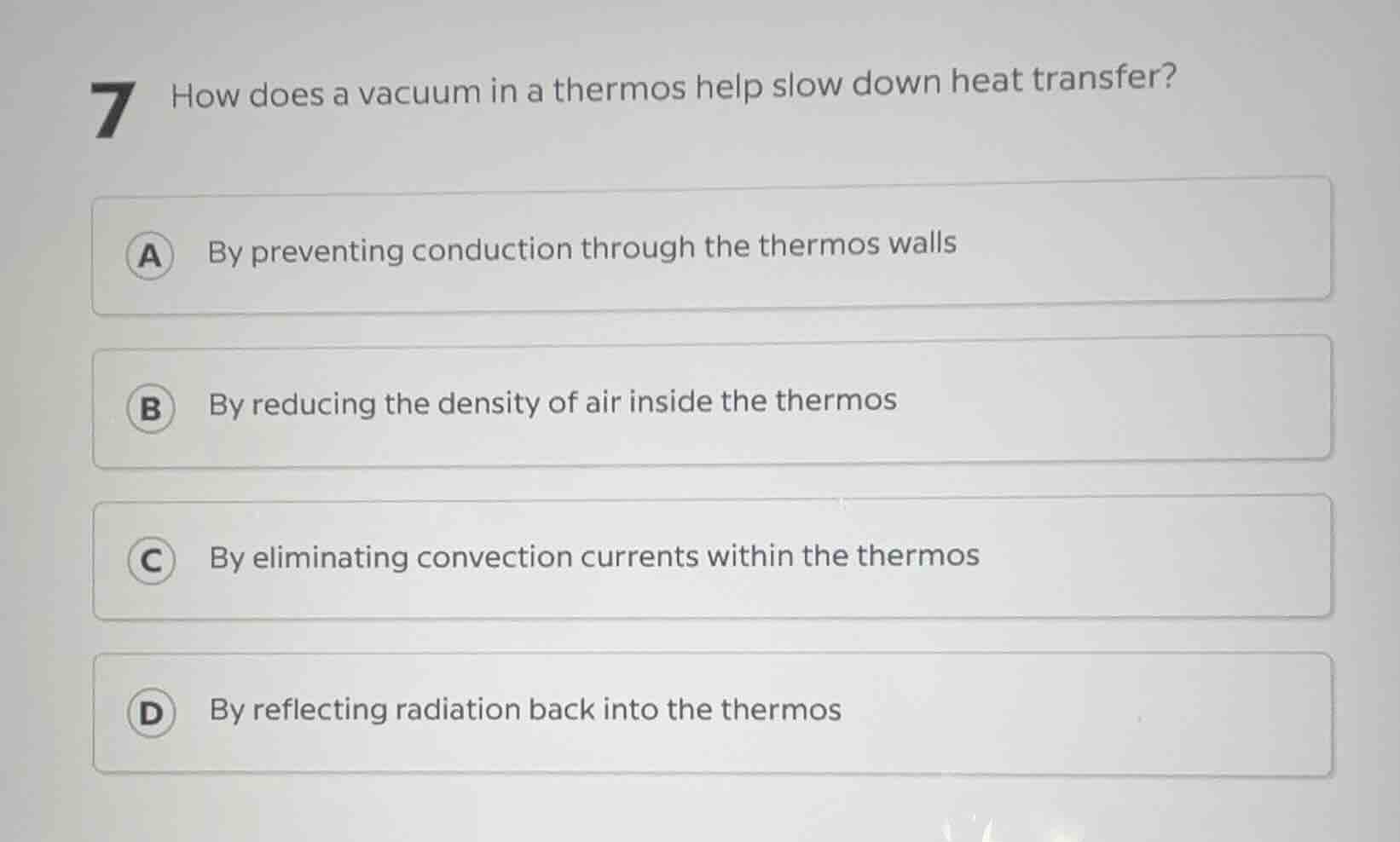
7 how does a vacuum in a thermos help slow down heat transfer? a by preventing conduction through the thermos walls b by reducing the density of air inside the thermos c by eliminating convection currents within the thermos d by reflecting radiation back into the thermos
Brief Explanations
To solve this, we analyze each option:
- Option A: Conduction through thermos walls is not prevented by the vacuum (the vacuum is between the walls, not in the walls' material).
- Option B: Reducing air density isn't the main way the vacuum slows heat transfer (convection is the key here).
- Option C: Convection requires a fluid (like air) to transfer heat. A vacuum has no air, so convection currents (which rely on fluid movement) are eliminated. This is how the vacuum slows heat transfer.
- Option D: Reflection of radiation is done by the shiny coating of the thermos, not the vacuum.

Snap & solve any problem in the app
Get step-by-step solutions on Sovi AI
Photo-based solutions with guided steps
Explore more problems and detailed explanations
C. By eliminating convection currents within the thermos