QUESTION IMAGE
Question
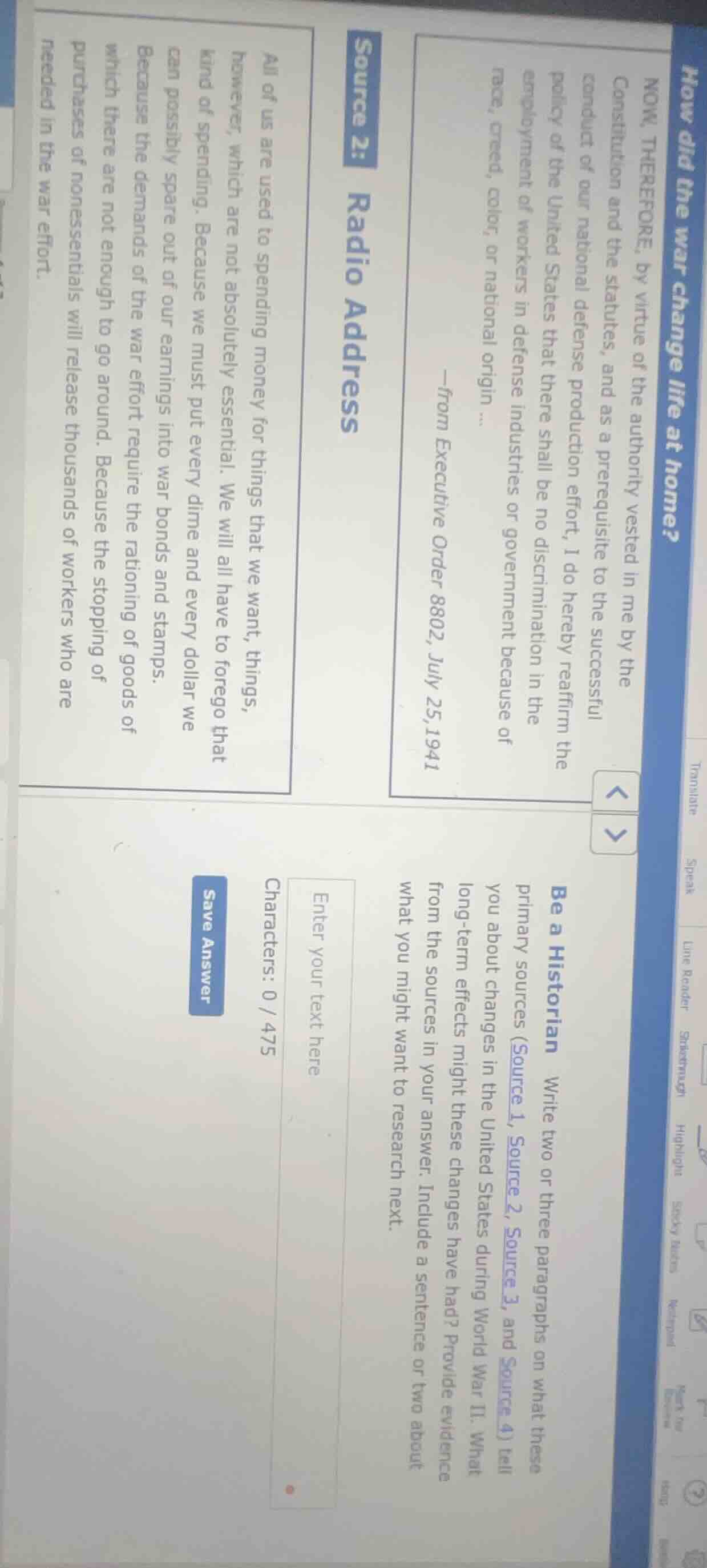
how did the war change life at home?now, therefore, by virtue of the authority vested in me by theconstitution and the statutes, and as a prerequisite to the successfulconduct of our national defense production effort, i do hereby reaffirm thepolicy of the united states that there shall be no discrimination in theemployment of workers in defense industries or government because ofrace, creed, color, or national origin ...—from executive order 8802, july 25,1941source 2: radio addressall of us are used to spending money for things that we want, things,however, which are not absolutely essential. we will all have to forego thatkind of spending. because we must put every dime and every dollar wecan possibly spare out of our earnings into war bonds and stamps.because the demands of the war effort require the rationing of goods ofwhich there are not enough to go around. because the stopping ofpurchases of nonessentials will release thousands of workers who areneeded in the war effort.be a historian write two or three paragraphs on what theseprimary sources (source 1, source 2, source 3, and source 4) tellyou about changes in the united states during world war ii. whatlong-term effects might these changes have had? provide evidencefrom the sources in your answer. include a sentence or two aboutwhat you might want to research next.enter your text herecharacters: 0 / 475save answer
First, analyze the provided WWII home front sources: Executive Order 8802 ended defense industry employment discrimination based on race/creed/color/national origin, opening new economic opportunities for marginalized groups. The radio address shows economic shifts: mandatory war bond purchases, rationing of non-essential goods, and redirection of workers to war production.
For immediate changes: Executive Order 8802 broke workplace barriers for Black Americans and other minority groups, letting them access higher-paying defense jobs that were previously closed. The economic measures meant civilians had limited consumer goods, as resources went to the war, and they were required to financially support the war effort through bonds.
For long-term effects: Executive Order 8802 laid a legal foundation for later civil rights legislation like the Civil Rights Act of 1964, as it established federal oversight of workplace discrimination. The economic mobilization expanded women's and minority participation in the workforce, shifting societal views on who could hold skilled jobs, and the war-time economic controls helped stabilize the post-Depression economy, setting the stage for the post-WWII economic boom. A follow-up research topic could be how Executive Order 8802 impacted post-war Black labor market participation rates.

Snap & solve any problem in the app
Get step-by-step solutions on Sovi AI
Photo-based solutions with guided steps
Explore more problems and detailed explanations
World War II brought immediate and long-lasting changes to daily life and society in the United States, as shown by the provided sources.
Executive Order 8802, issued in July 1941, marked an immediate shift in workplace equality: it banned discrimination in defense industry and government employment based on race, creed, color, or national origin. This opened critical economic opportunities for Black Americans, Latinx people, and other marginalized groups who had been excluded from skilled, well-paying war production jobs. For everyday civilians, the radio address revealed immediate economic restrictions: Americans were required to forgo non-essential spending, purchase war bonds, and accept rationing of goods, as resources were redirected entirely to the war effort. This meant limited access to consumer products, and a new expectation that all citizens would contribute financially and materially to the war.
The long-term effects of these changes reshaped American society and policy. Executive Order 8802 created a federal precedent for combating workplace discrimination, laying the groundwork for key civil rights legislation in the 1960s, including the Civil Rights Act of 1964. It also began to shift societal attitudes toward minority participation in the formal workforce, challenging long-held systemic barriers. Economically, the war-time mobilization and controls pulled the U.S. fully out of the Great Depression, creating a post-war economic boom fueled by industrial growth and expanded labor force participation. Rationing and war bond drives also fostered a culture of collective civic responsibility that persisted in post-war community and political engagement. To deepen this analysis, further research could explore how Executive Order 8802 specifically impacted Black women's access to defense industry jobs and their long-term economic mobility.