QUESTION IMAGE
Question
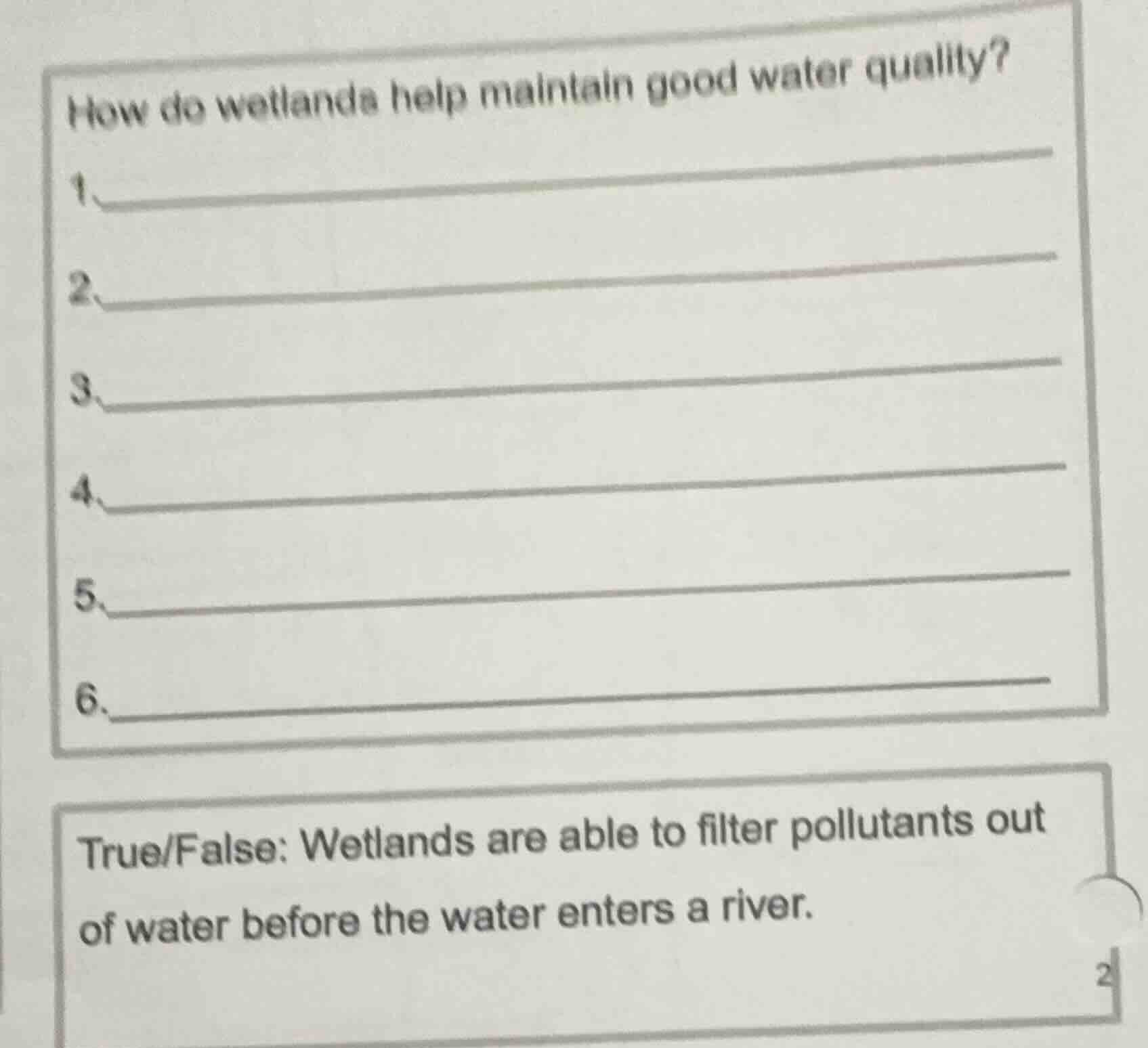
how do wetlands help maintain good water quality?
1.
2.
3.
4.
5.
6.
true/false: wetlands are able to filter pollutants out of water before the water enters a river.
Response
Part 1: How do wetlands help maintain good water quality?
Brief Explanations
- Wetlands act as natural filters, trapping sediments (like soil particles) from runoff. Sediment can cloud water and carry pollutants, so removing it improves clarity and reduces pollutant transport.
- They absorb excess nutrients (e.g., nitrogen, phosphorus) from fertilizers or sewage. These nutrients can cause algal blooms in water bodies, so wetlands prevent eutrophication by taking up or cycling these nutrients.
- Wetlands support microbial communities that break down organic pollutants (e.g., pesticides, oil residues) into less harmful substances, a process called bioremediation.
- They help in removing heavy metals (e.g., lead, mercury) from water. Plants in wetlands can absorb or accumulate heavy metals, reducing their concentration in the water.
- Wetlands slow down water flow, allowing more time for physical, chemical, and biological processes (like filtration, nutrient uptake) to purify the water.
- They provide habitat for aquatic organisms that contribute to water quality, such as mussels that filter feed and remove particles, or plants that release oxygen into the water.
Brief Explanations
Wetlands have various mechanisms (sediment trapping, nutrient absorption, microbial breakdown, etc.) that allow them to remove pollutants from water. As water moves through wetlands (before entering a river, for example), these processes act to filter out pollutants. So the statement is consistent with the known functions of wetlands.

Snap & solve any problem in the app
Get step-by-step solutions on Sovi AI
Photo-based solutions with guided steps
Explore more problems and detailed explanations
s (for the numbered list):
- Trap sediments from runoff to improve clarity.
- Absorb excess nutrients to prevent eutrophication.
- Host microbes that break down organic pollutants.
- Remove heavy metals via plant absorption/accumulation.
- Slow water flow to enhance purification processes.
- Provide habitat for water - purifying organisms.