QUESTION IMAGE
Question
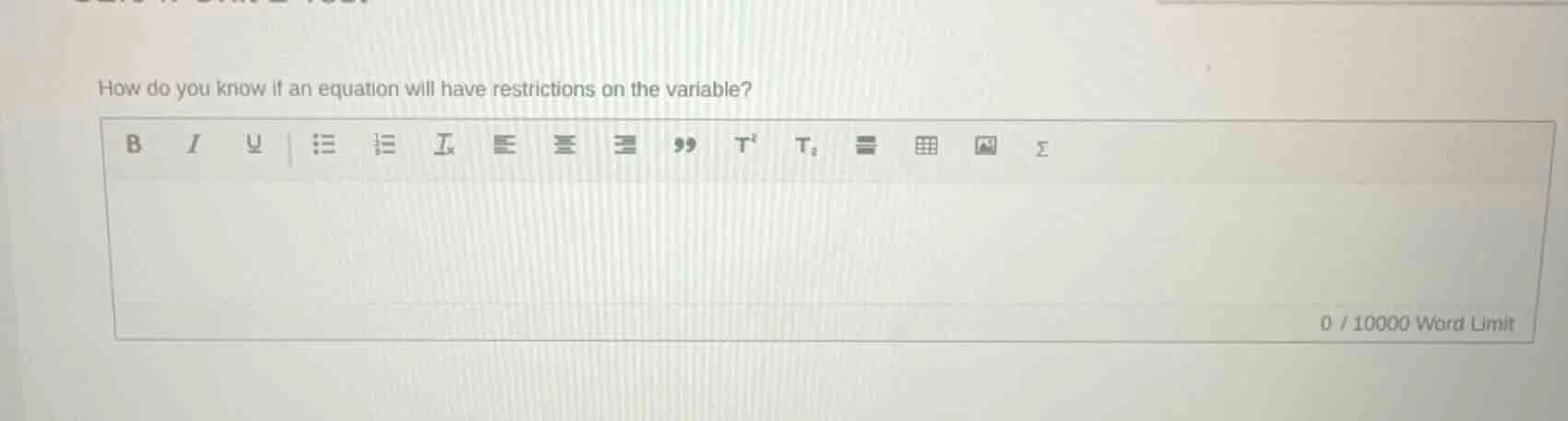
how do you know if an equation will have restrictions on the variable?
To determine if an equation has variable restrictions, we analyze the equation's components:
- Denominators in fractions: If there's a fraction like $\frac{f(x)}{g(x)}$, $g(x)
eq0$ (e.g., $\frac{1}{x - 2}$ implies $x
eq2$).
- Even - root radicals (square roots, fourth roots, etc.): For $\sqrt[n]{f(x)}$ where $n$ is even, $f(x)\geq0$ (e.g., $\sqrt{x - 3}$ requires $x-3\geq0\Rightarrow x\geq3$).
- Logarithms: For $\log_b(f(x))$, $f(x)>0$ and $b>0,b
eq1$ (e.g., $\log(x + 1)$ needs $x + 1>0\Rightarrow x>-1$).
- Real - valued functions with domain constraints: Some functions (like inverse trigonometric functions in certain contexts) have natural domain restrictions that carry over to equations involving them.
We check for these structures (rational expressions, even - root radicals, logarithms, etc.) in the equation. If any of these components are present, the variable must satisfy the conditions to keep the expression well - defined (e.g., no division by zero, non - negative radicands for even roots, positive arguments for logarithms).

Snap & solve any problem in the app
Get step-by-step solutions on Sovi AI
Photo-based solutions with guided steps
Explore more problems and detailed explanations
To know if an equation has variable restrictions, check for: 1) Denominators (denominator ≠ 0); 2) Even - root radicals (radicand ≥ 0); 3) Logarithms (argument > 0, valid base). If these structures exist, the variable must satisfy the conditions to keep the expression well - defined.