QUESTION IMAGE
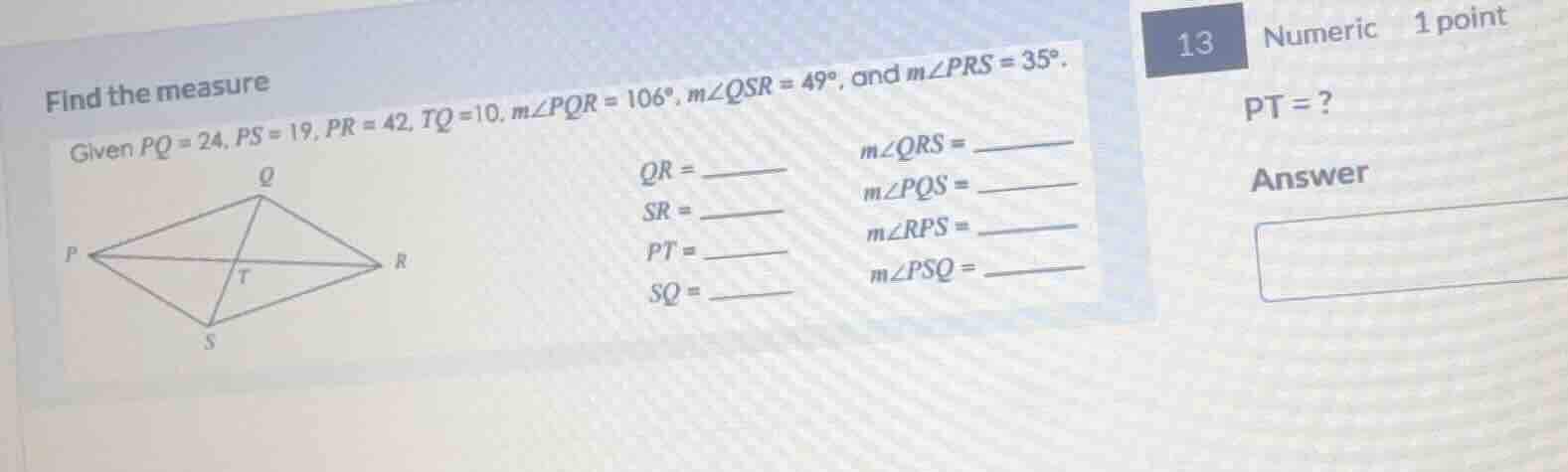
Question
Question was provided via image upload.
Step1: Recognize triangle similarity
In quadrilateral \(PQRS\), the diagonals \(PR\) and \(QS\) intersect at \(T\). By the property of intersecting diagonals in such a figure, \(\triangle PTQ \sim \triangle RTS\) and \(\triangle PTS \sim \triangle RTQ\). The key proportionality is \(\frac{PT}{TR} = \frac{PQ}{SR}\), but we can also use the ratio of segments on \(QS\): \(\frac{TQ}{TS} = \frac{PQ}{SR}\). First, we need to find \(SR\) using the Law of Sines in \(\triangle QSR\) and \(\triangle PRS\).
In \(\triangle QSR\): \(\frac{QR}{\sin 49^\circ} = \frac{SR}{\sin m\angle QRS}\)
In \(\triangle PRS\): \(\frac{SR}{\sin 35^\circ} = \frac{PS}{\sin m\angle PRS}\)
But first, find \(m\angle QRS\): \(m\angle PQR = 106^\circ\), \(m\angle QSR = 49^\circ\), \(m\angle PRS = 35^\circ\). In \(\triangle QRS\), \(m\angle QRS = 180^\circ - 49^\circ - m\angle RQS\). \(m\angle RQS = 106^\circ - m\angle PQS\). However, using the Law of Sines in \(\triangle PQR\) and \(\triangle PRS\) is not needed. Instead, use the theorem of intersecting diagonals: the ratio of the segments of one diagonal equals the ratio of the segments of the other diagonal, proportional to the adjacent sides.
The ratio \(\frac{PT}{TR} = \frac{PQ}{SR}\), and \(\frac{TQ}{TS} = \frac{PQ}{SR}\). First, find \(SR\) using \(\triangle PRS\): \(\frac{SR}{\sin 35^\circ} = \frac{PS}{\sin m\angle PRS}\) is not correct. Instead, use \(\triangle QSR\) and \(\triangle PQR\):
In \(\triangle QSR\), \(m\angle QRS = 180^\circ - 49^\circ - (106^\circ - m\angle PQS)\) is too complex. The correct approach is using the Menelaus' Theorem for \(\triangle PRS\) with transversal \(Q-T-S\):
\(\frac{PQ}{PS} \times \frac{ST}{TQ} \times \frac{RT}{PT} = 1\)
Let \(PT = x\), so \(RT = 42 - x\), \(ST = SQ - 10\). First, find \(SQ\) using Law of Cosines in \(\triangle PQS\): but we don't know angles. Instead, use the ratio from similar triangles: \(\frac{PT}{RT} = \frac{TQ}{TS} = \frac{PQ}{SR}\)
From \(\triangle PRS\) and \(\triangle QRS\): \(\frac{SR}{PR} = \frac{\sin 35^\circ}{\sin m\angle PSR}\), and \(\frac{QR}{PR} = \frac{\sin (106^\circ - m\angle PQS)}{\sin m\angle QRP}\)
The simpler method is using the section formula for intersecting diagonals: \(\frac{PT}{TR} = \frac{PQ \times \sin m\angle PQS}{SR \times \sin m\angle RQS}\), but we know \(m\angle PQR = 106^\circ = m\angle PQS + m\angle RQS\), \(m\angle QSR = 49^\circ\), \(m\angle PRS = 35^\circ\).
In \(\triangle QRS\), \(m\angle RQS = 180^\circ - 49^\circ - m\angle QRS\)
In \(\triangle PRS\), \(m\angle PSR = 180^\circ - 35^\circ - m\angle RPS\)
But the key insight is that \(\triangle PTQ \sim \triangle RTS\), so \(\frac{PT}{RT} = \frac{PQ}{SR} = \frac{TQ}{TS}\)
First, find \(SR\) using Law of Sines in \(\triangle PRS\):
\(\frac{SR}{\sin 35^\circ} = \frac{PS}{\sin m\angle PRS}\) → No, \(m\angle PRS = 35^\circ\), so \(\frac{SR}{\sin m\angle RPS} = \frac{PS}{\sin 35^\circ}\)
In \(\triangle PQR\): \(\frac{QR}{\sin m\angle QPR} = \frac{PQ}{\sin m\angle QRP}\)
\(m\angle QRP = m\angle QRS + 35^\circ\)
This is too complex. Instead, use the ratio of areas:
Area of \(\triangle PQT\) / Area of \(\triangle RQT = \frac{PT}{RT} = \frac{PQ \times TQ \times \sin m\angle PQS}{QR \times TQ \times \sin m\angle RQS} = \frac{PQ \sin m\angle PQS}{QR \sin m\angle RQS}\)
Area of \(\triangle PST\) / Area of \(\triangle RST = \frac{PT}{RT} = \frac{PS \times ST \times \sin m\angle PSQ}{SR \times ST \times \sin m\angle QSR} = \frac{PS \sin m\angle PSQ}{SR \sin 49^\circ}\)
But we know that \(m\angle PQS + m\angle RQS = 106^\circ\), \(m\angle PSQ + m\angle QSR = m\angle PSR\…

Snap & solve any problem in the app
Get step-by-step solutions on Sovi AI
Photo-based solutions with guided steps
Explore more problems and detailed explanations
\(24\)