QUESTION IMAGE
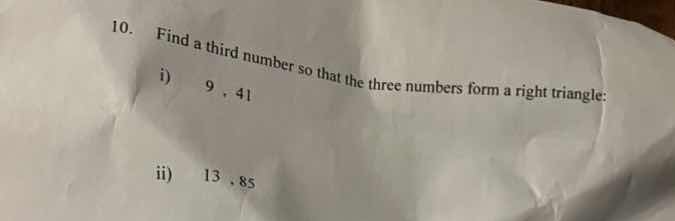
Question
Question was provided via image upload.
Part (i)
Step1: Recall Pythagorean theorem
For a right triangle with sides \(a\), \(b\), \(c\) (where \(c\) is the hypotenuse, the longest side), \(a^{2}+b^{2}=c^{2}\). Let the third number be \(x\). We have two cases: either \(41\) is the hypotenuse or \(x\) is the hypotenuse.
Step2: Case 1: \(41\) is the hypotenuse
Then \(9^{2}+x^{2}=41^{2}\). So \(x^{2}=41^{2}-9^{2}=(41 - 9)(41 + 9)=32\times50 = 1600\). Then \(x=\sqrt{1600}=40\).
Step3: Case 2: \(x\) is the hypotenuse
Then \(9^{2}+41^{2}=x^{2}\). \(x^{2}=81 + 1681=1762\), and \(x=\sqrt{1762}\approx41.98\) (not an integer, usually we look for integer side lengths in such problems, so the first case is more probable).
Step1: Recall Pythagorean theorem
Let the third number be \(y\). We have two cases: \(85\) is the hypotenuse or \(y\) is the hypotenuse.
Step2: Case 1: \(85\) is the hypotenuse
Then \(13^{2}+y^{2}=85^{2}\). \(y^{2}=85^{2}-13^{2}=(85 - 13)(85 + 13)=72\times98 = 7056\). Then \(y=\sqrt{7056}=84\).
Step3: Case 2: \(y\) is the hypotenuse
Then \(13^{2}+85^{2}=y^{2}\). \(y^{2}=169+7225 = 7394\), and \(y=\sqrt{7394}\approx85.99\) (not an integer, so the first case is more probable).

Snap & solve any problem in the app
Get step-by-step solutions on Sovi AI
Photo-based solutions with guided steps
Explore more problems and detailed explanations
For \(9,41\), the third number is \(40\)