QUESTION IMAGE
Question
Question was provided via image upload.
Step1: Identify Similar Triangles
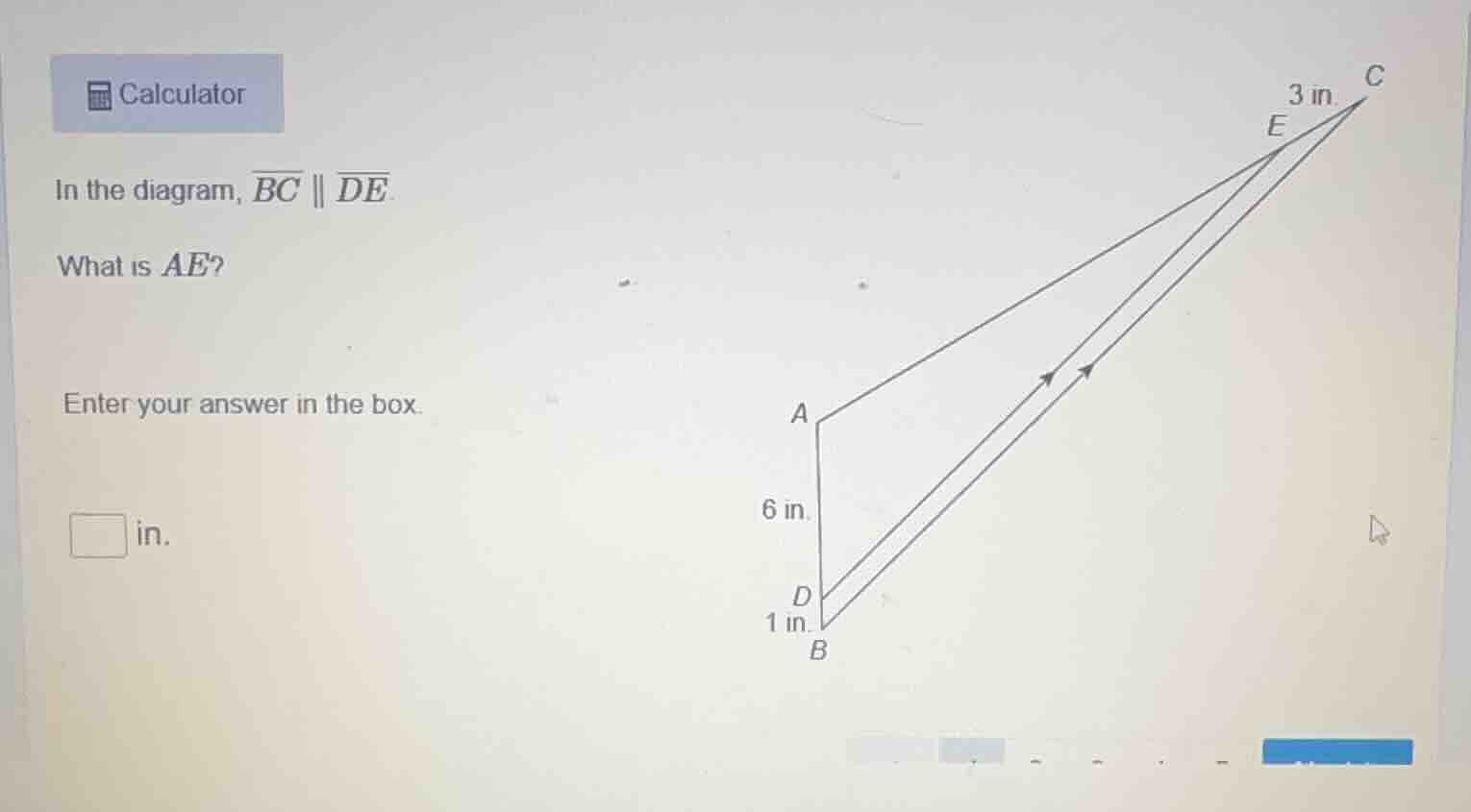
Since \(\overline{BC} \parallel \overline{DE}\), by the Basic Proportionality Theorem (Thales' theorem), \(\triangle ADE \sim \triangle ABC\) (similar triangles) and \(\triangle CDE \sim \triangle CBA\) in terms of proportional segments. The ratio of corresponding sides should be equal. Let \(AE = x\), then \(AC=AE + EC=x + 3\). Also, \(AD = 6\) in, \(DB = 1\) in, so \(AB=AD + DB=6 + 1 = 7\) in? Wait, no, wait: Wait, \(AD\) is 6 in, \(DB\) is 1 in? Wait, looking at the diagram: \(AD = 6\) in, \(DB = 1\) in, so \(AB=AD + DB = 7\)? Wait, no, maybe the segments are \(AD = 6\), \(DB = 1\), and \(CE = 3\), \(DE \parallel BC\). So the triangles \(\triangle CDE\) and \(\triangle CBA\) are similar? Wait, no, \(DE \parallel BC\), so \(\triangle ADE \sim \triangle ABC\) by AA similarity (since \(\angle A\) is common, and \(\angle ADE = \angle ABC\) because \(DE \parallel BC\), corresponding angles). So the ratio of sides: \(\frac{AD}{AB}=\frac{AE}{AC}\). Wait, \(AD = 6\), \(AB = AD + DB=6 + 1 = 7\)? Wait, no, maybe \(AD = 6\), \(DB = 1\), so \(AB = AD + DB = 7\), and \(CE = 3\), \(AC = AE + EC = AE + 3\). Wait, no, maybe the other way: \(\triangle CDE \sim \triangle CBA\), so \(\frac{CD}{CB}=\frac{CE}{CA}\)? Wait, no, let's re-examine. The correct approach: since \(DE \parallel BC\), by the Basic Proportionality Theorem (Thales' theorem), \(\frac{AD}{DB}=\frac{AE}{EC}\). Wait, is that the case? Wait, Thales' theorem states that if a line is drawn parallel to one side of a triangle, intersecting the other two sides, then it divides those sides proportionally. So in triangle \(ABC\), if \(DE \parallel BC\), then \(D\) is on \(AB\), \(E\) is on \(AC\), so \(\frac{AD}{DB}=\frac{AE}{EC}\). Wait, \(AD = 6\) in, \(DB = 1\) in, \(EC = 3\) in. So \(\frac{AD}{DB}=\frac{AE}{EC}\) => \(\frac{6}{1}=\frac{AE}{3}\). Then \(AE = 6 \times 3 = 18\)? Wait, that makes sense. Let's check: \(AD = 6\), \(DB = 1\), so \(AD/DB = 6/1\), so \(AE/EC = 6/1\), so \(AE = 6 \times EC = 6 \times 3 = 18\). Wait, that seems right. So \(AE = 18\) inches. Wait, let's confirm the theorem. Thales' theorem: In a triangle, if a line is drawn parallel to one side, intersecting the other two sides, then it divides those sides proportionally. So here, \(DE \parallel BC\), so line \(DE\) intersects \(AB\) at \(D\) and \(AC\) at \(E\). So \(D\) is on \(AB\), \(E\) is on \(AC\). Then \(\frac{AD}{DB}=\frac{AE}{EC}\). \(AD = 6\), \(DB = 1\), \(EC = 3\). So \(\frac{6}{1}=\frac{AE}{3}\) => \(AE = 6 \times 3 = 18\). Yes, that works.
Step1: Apply Thales' Theorem
Since \(DE \parallel BC\), by the Basic Proportionality Theorem (Thales' theorem), \(\frac{AD}{DB}=\frac{AE}{EC}\).
Given \(AD = 6\) in, \(DB = 1\) in, \(EC = 3\) in.
Step2: Solve for \(AE\)
Substitute the values into the proportion:
\(\frac{6}{1}=\frac{AE}{3}\)
Cross - multiply: \(AE = 6\times3 = 18\).

Snap & solve any problem in the app
Get step-by-step solutions on Sovi AI
Photo-based solutions with guided steps
Explore more problems and detailed explanations
18